For High Schools
Author’s Note
This Teaching Guide for High Schools was created by two outstanding educators, Carrie Venable and Melissa Finn, with a foreword by author Rye Barcott.
The guide is designed for instructors of government, history, civics, social studies, political science, public policy, leadership, ethics, and seminar-style courses. It also works well for ROTC programs, homeschool settings, and civic, leadership, veteran, and public service organizations.
Each of its ten lessons is aligned to the C3 Framework for Social Studies and maps to learning objectives in AP U.S. Government and Politics, AP Comparative Government and Politics, AP U.S. History, and IB Global Politics.
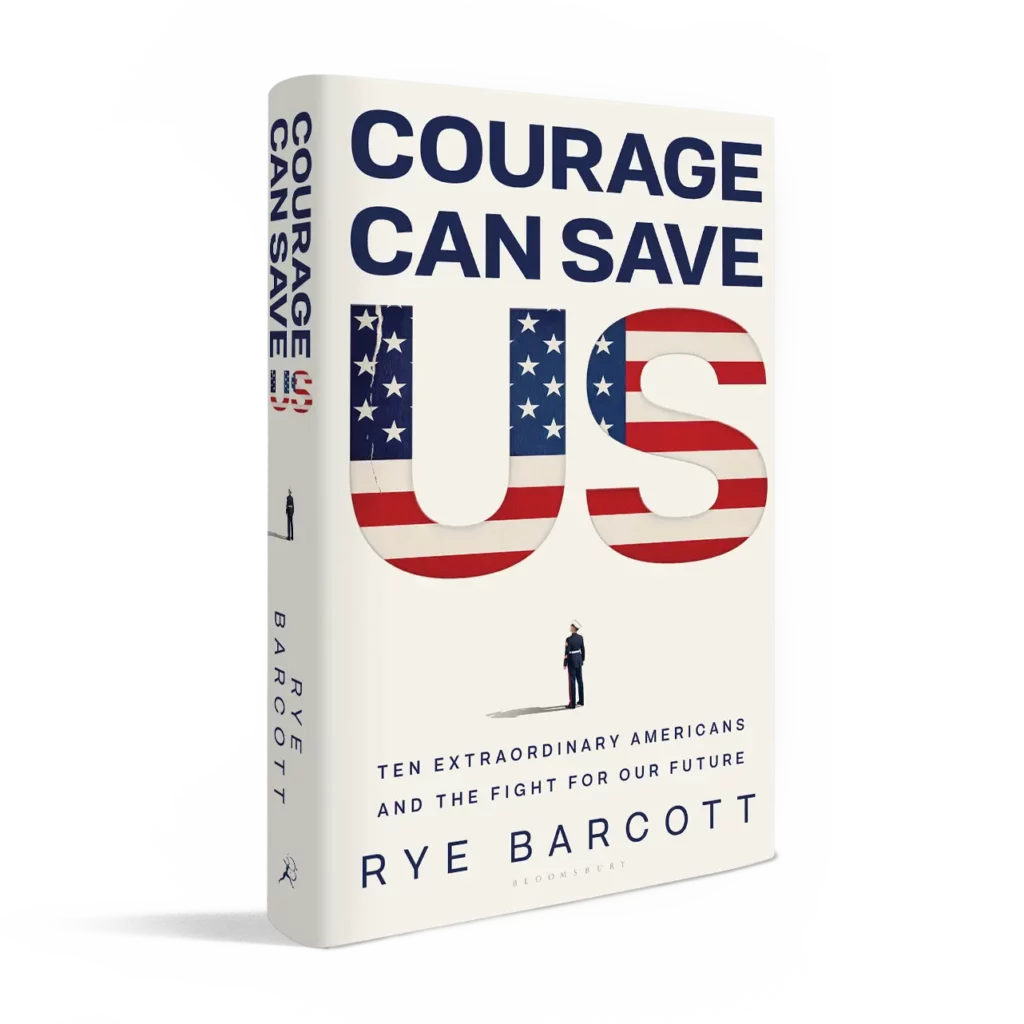
If you are an educator interested in bringing Courage Can Save US to your classroom, write to us to receive the complete PDF of this guide and a complimentary copy of the book — underwritten by a donor to the nonprofit With Honor, which receives all author proceeds from sales. While supplies last.
Email With Honor Communications Director Jen Montee at montee@withhonor.org.
Excerpt from the Teacher’s guide
Foreward
Foreword to Teaching Guide for High Schools
Before I entered high school, I asked my father how he got the diagonal scar across his cheek. He led me downstairs to the basement office he had built with his own hands and told me about the night in Vietnam when a bullet tore through his face during a reconnaissance patrol. After recovering, he turned down a safer assignment and returned to his platoon to finish his thirteen-month tour in the jungle.
I have been trying to understand courage ever since: where it comes from, what it costs, and why it matters—for us as individuals and as a country.
What I have learned is that courage is not inherited. It is formed by parents and mentors, by institutions and hardship, and—more often than we acknowledge—by teachers and the books they choose to place in front of their students.
My late mentor David Gergen advised four presidents, yet he spent the last decades of his life teaching. He believed democracies do not survive through laws alone. They depend on character, and character can be taught.
If character can be taught, so can courage.
Courage Can Save US profiles ten leaders—five Democrats and five Republicans—who, at pivotal moments, chose principle over party at real personal and political cost. No audience matters more to me than high school students. Through my own children, I have seen both the challenges young Americans face at this moment in history and their remarkable resilience, idealism, and capacity for courage.
I am grateful to educators Carrie Venable and Melissa Finn, two extraordinary Americans in their own right, for creating this outstanding Teaching Guide. It invites students to weigh evidence, examine competing arguments, and judge leaders by their actions rather than their political parties. That is the kind of civic education our democracy needs.
More than sixty-five years ago, President John F. Kennedy challenged Americans to “ask not what your country can do for you—ask what you can do for your country.”
For many Americans today, that question can feel harder to answer.
Patriotic sentiment is near historic lows in communities across our nation. But America has lived through darker chapters before. We fought a civil war over slavery. Black Americans and women spent generations securing the right to vote. We endured two world wars and lived under the constant shadow of nuclear conflict. Every generation has faced its own tests. What carried our country forward was not luck. It was citizens who chose courage over comfort and service over self-interest.
This Teaching Guide invites students to wrestle with the book, challenge its ideas, and learn from the lives of ten Americans who stepped into the arena. The leaders profiled here often disagree with one another. Thoughtful disagreement, honestly defended, is not a threat to democracy. It is the practice of it.
The country our children inherit will first be shaped by our example. Before long, it will be shaped by their own choices. As teachers, you help prepare them for those choices every day. That is public service. Sometimes that takes courage.
Thank you for your service.
Rye Barcott
Author, Courage Can Save US
Co-Founder & CEO, With Honor
June 11, 2026
Charlotte, North Carolina
Introduction and Using This Teaching Guide
Introduction
This Teaching Guide helps instructors bring into the classroom the themes, arguments, and examples from Rye Barcott’s Courage Can Save US: Ten Extraordinary Americans and the Fight for Our Future. While the book offers rich material for discussion, reflection, civic understanding, and academic inquiry, this guide moves beyond general conversation by providing practical, ready-to-use instructional support for teaching selected excerpts with purpose, structure, and depth.
Using This Teaching Guide
The guide is designed for secondary and postsecondary instructors teaching government, history, civics, social studies, political science, public policy, contemporary issues, leadership, ethics, and seminar-style courses. It is also well suited for ROTC programs, homeschooling, civic organizations, leadership institutes, military and veteran leadership programs, public service organizations, and community leaders who facilitate discussions on leadership, citizenship, ethical decision-making, and democratic participation.
The lessons are designed for flexible use, allowing instructors to teach a single lesson, a thematic unit, or the full book as a complete course of study. Each lesson includes selected readings, objectives, activities, discussion questions, and assessment options so instructors can adapt the material to their learners, course goals, and available time. In addition to supporting academic learning and civic understanding, the lessons ask learners to consider how civic responsibility, leadership, and service apply in their own lives and communities. This structure makes the guide practical for a one-day classroom lesson, a multi-day unit, or a longer seminar-style exploration of the book’s major themes.
Consistent with the spirit of Courage Can Save US, this Teaching Guide is intentionally nonpartisan. Examples are drawn from both Democratic and Republican public officials featured in the book, inviting learners to evaluate ideas, leadership decisions, constitutional responsibilities, and civic principles rather than political affiliation. The emphasis is on critical thinking, civic reasoning, and informed discussion, not advocacy for any political viewpoint or party.
Rather than serving only as a traditional reading guide, this Teaching Guide provides a complete instructional framework grounded in civic education and historical inquiry. Using contemporary case studies drawn primarily from the post-9/11 era, it integrates textual analysis with political science, history, and civic reasoning to help learners understand both the content of Courage Can Save US and its broader significance for leadership, citizenship, public service, political courage, and democratic life.
Carrie Venable, M.S., and Melissa Finn developed this Teaching Guide. Carrie Venable, owner of Imponna Academics, brings experience as a college professor, secondary educator, academic advisor, curriculum developer, and civic educator. Melissa Finn brings more than twenty-five years of experience teaching history and government, serves as an AP Exam Reader, and holds professional distinctions as a James Madison Memorial Fellowship Foundation Fellow and National Board Certified Teacher. Together, their experience in secondary education, higher education, curriculum design, Advanced Placement assessment, and civic education shaped the structure, rigor, and instructional approach of this guide.
Lessons Overview
Each lesson is designed to stand on its own and may be taught independently without requiring instruction from previous lessons. At the same time, the lessons are intentionally sequenced to provide a comprehensive exploration of the major themes in Courage Can Save US: Ten Extraordinary Americans and the Fight for Our Future.
Reading selections, concepts, and activities have been carefully coordinated to minimize unnecessary repetition while allowing instructors to teach a single lesson, a thematic unit, or the entire guide as a complete course of study. Each lesson intentionally includes more instructional material than most instructors will use in one class meeting. This allows instructors to select the excerpts, questions, activities, and assessments that best fit their learners, course objectives, and available time. Instructors may use selected portions of a lesson for a single session or expand a lesson across multiple meetings for deeper study, discussion, and application.
Lesson 1
Political Courage, Civic Virtue, and Public Service
Topics include: bipartisan work, bravery, civic virtue, common good, constituent responsibility, constitutional duty, courage, democratic responsibility, duty, institutional integrity, institutional responsibility, leadership, military service, moral courage, oath of public office, party pressure, physical courage, political cost, political courage, political risk, pressure, public service, public trust, representation.
Lesson 2
Political Socialization and the Formation of Beliefs
Topics include: 9/11, character formation, citizenship, civic identity, civic responsibility, courage, discipline, education, faith, family influence, formative experience, gender, institutional culture, leadership, major events, media influence, mentorship, military service, moral responsibility, national security, opportunity, political ideology, political socialization, public responsibility, public service, public trust, rural culture, service, shared purpose.
Lesson 3
Constitutional Principles, Oaths, and the Rule of Law
Topics include: civic virtue, civil liberties, Congress, constitutional duty, constitutional procedure, constitutional responsibility, democracy, election certification, free speech, illegal orders, impeachment, institutional duty, January 6, military oath, oath, oath of public office, political pressure, political risk, public service, public trust, rule of law, servant leadership, trust.
Lesson 4
Political Parties, Partisanship, and Congressional Behavior
Topics include: bipartisanship, campaign barriers, campaign judgment, campaign messaging, competitive districts, compromise, congressional behavior, constituent communication, electoral coalition, electoral incentives, generational change, governing beyond party base, independent judgment, independent voting, party conflict, party factions, party identity, party leadership, party loyalty, party pressure, party strategy, polarization, political coalition, political parties, political risk, primary pressure, public service, public trust, representation, Speaker of the House, voter appeal.
Lesson 5
Public Opinion, Representation, and Democratic Leadership
Topics include: civic discourse, civic understanding, common good, competitive districts, constituent communication, constituent judgment, constituent opinion, delegate model, democratic leadership, influencers, media environment, online audiences, party discomfort, party identity, party pressure, polarization, policy judgment, policy reversal, political courage, public backlash, public opinion, public pressure, public response, public trust, race, racial justice, representation, representative judgment, trustee model, voter appeal.
Lesson 6
Congress, Policymaking, and Bipartisan Governance
Topics include: bipartisan governance, bipartisan negotiation, border policy, CHIPS Act, coalition building, committee process, compromise, Congress, constituent concerns, constituent communication, constituent service, cross-party cooperation, defense policy, democratic accountability, democratic stability, discharge petition, district representation, economic policy, independent voting, infrastructure, jobs, legislation, national competitiveness, national policy, party pressure, polarization, policy judgment, policy tradeoffs, policymaking, political courage, practical governance, Problem Solvers Caucus, public responsibility, public service, public trust, regular order, representation, Ukraine, veterans policy.
Lesson 7
Presidential Power, War Powers, and Checks and Balances
Topics include: accountability, Afghanistan, Afghanistan withdrawal, checks and balances, congressional authorization, congressional judgment, congressional oversight, constitutional responsibility, democratic leadership, executive accountability, foreign policy, military leadership, national security, polarization, power, presidential power, public accountability, public trust, responsibility, separation of powers, SIVs, territorial sovereignty, Ukraine, war powers.
Lesson 8
Campaigns, Elections, and Political Participation
Topics include: campaign entry, campaign finance, campaign persistence, campaign strategy, campaign viability, candidate biography, candidate recruitment, coalition building, constituent relationship, democratic accountability, district identity, early money, electoral competition, electoral incentives, electoral positioning, electoral strategy, fundraising, gerrymandering, name recognition, outside spending, pandemic campaigning, party identity, political networks, political participation, primaries, primary competition, public memory, race, representation, running mate choice, state politics, voter appeal, voter behavior.
Lesson 9
Media, Social Media, and Political Communication
Topics include: cable news, civic discourse, civic trust, constituent communication, credibility, democratic participation, direct communication, evidence, influencers, information environment, January 6, media, traditional media, media incentives, media literacy, media pressure, disinformation, news organizations, outrage, partisan signaling, party conflict, podcasts, polarization, political communication, political rhetoric, public accountability, public pressure, public tragedy, public trust, representation, social media, social media incentives, source evaluation, threats.
Lesson 10
Political Polarization, Citizenship, and the Common Good
Topics include: citizenship, civic engagement, civic renewal, civic repair, common good, democratic leadership, democratic responsibility, democratic stability, difficult debate, generational change, independence, influencer politics, open primaries, party backlash, party factions, party pressure, political burnout, political courage, political polarization, practical governance, primary pressure, public trust, retirement, service, shared purpose, shutdown politics, Ukraine.
Leader Profile Coverage Index
The Leader Profile Lesson Coverage Index identifies each public official featured in the book Courage Can Save US: Ten Extraordinary Americans and the Fight for Our Future, including political affiliation, chapter title, and the lessons in which each excerpt is used. Because many public officials illustrate multiple civic and political concepts, their experiences appear in different lessons where they best support the instructional objectives. The matrix also reflects the guide’s intentionally nonpartisan approach by drawing examples from both Democratic and Republican leaders while emphasizing civic principles, constitutional responsibility, leadership, and public service rather than partisan advocacy. Offices held by these officials are current as of 2026.

Lesson 1: Political Courage, Civic Virtue, and Public Service
Essential Question
What makes an action politically courageous, and how can public officials show civic virtue when a decision may carry personal or political costs?
Recommended Ages/Grades
Ages 14 to adult; grades 9-12, dual enrollment, undergraduate courses
Recommended Courses/Programs
U.S. Government; American Government and Civics; Civics; U.S. History; Debate; AP U.S. Government and Politics; AP Comparative Government and Politics; AP U.S. History; IB Global Politics; Political Science; Government; American Politics; American Political Institutions; Legislative Politics; Political Behavior; College First-Year Seminar; Programs in Service Learning and Leadership
Subject Areas
U.S. government; civics; politics; U.S. history; democracy; citizenship; civic responsibility; political behavior; political courage; moral courage; bravery; civic virtue; common good; public trust; military service; leadership; civic leadership; public service; character education; service learning
Learning Outcomes
Academic: Learners analyze how political courage, moral courage, civic virtue, and public service are defined and demonstrated by public officials facing political risk or pressure.
Civic: Learners evaluate how citizens can assess public officials who make difficult decisions in service of constitutional duty, public trust, or the common good.
Personal: Learners reflect on how courage, service, and civic virtue may apply to their own roles as learners, leaders, citizens, and members of a community.
Pre-Planning
Timing
- 40-50 minutes, adaptable to a 90-minute block
- Instructors should select from the activities and suggested excerpts based on age/course level, available time, and whether readings were assigned before the lesson as pre-reading.
Overview
In Courage Can Save US: Ten Extraordinary Americans and the Fight for Our Future, Rye Barcott introduces public leaders who have faced pressure, criticism, risk, or political cost when making difficult decisions. The book asks learners to look beyond simple labels and consider what courage requires in public life. Courage is not presented as mere boldness or popularity, but as a choice connected to duty, principle, public service, and the common good.
This lesson helps learners distinguish between bravery, moral courage, and political courage while evaluating how public officials respond to pressure. Academically, learners build vocabulary and analytical tools for understanding public leadership. Civically, they examine how citizens can assess leaders without relying only on party agreement or personal preference. Personally, learners consider how courage, civic virtue, and service may apply in their own schools, organizations, communities, and future civic roles.
Learning Objectives
The learner will:
- Define political courage, moral courage, civic virtue, public service, common good, and public trust.
- Distinguish between bravery, moral courage, and political courage.
- Identify examples of personal risk, political risk, and institutional pressure.
- Explain how public officials may demonstrate civic virtue when facing criticism or possible political consequences.
- Compare examples of physical courage, moral courage, and political courage.
- Analyze how public service can require decisions that conflict with popularity, party loyalty, or personal comfort.
- Evaluate whether a public official’s decision reflects courage, principle, ambition, or political calculation.
- Apply the concept of political courage to a school, organizational, community, or civic situation.
- Assess a personal situation in which acting with courage or civic virtue may require accepting disagreement, criticism, or risk.
Suggested Reading Excerpts & Reading Questions
The selected excerpts were chosen to provide a variety of bipartisan perspectives and examples that align with the lesson’s learning objectives. Instructors may assign any or all of the excerpts at their discretion. Although the excerpts are intended for guided pre-reading with the accompanying Reading Questions, they may be used in whatever manner best meets the needs of the learners.
Excerpt 1.
Author Rye Barcott, Prologue: Courage, Bravery, and the Common Good (pp. xi-xvii) – Author Rye Barcott served as a U.S. Marine Corps officer and is the cofounder of With Honor, a cross-partisan organization that supports principled veteran and national security leaders in public office. In Courage Can Save US: Ten Extraordinary Americans and the Fight for Our Future, Barcott profiles public officials from both major political parties who carried an ethic of service into political life. This excerpt introduces courage as a choice made in service of others and distinguishes courage from bravery. It is a strong opening selection because it gives learners the core vocabulary needed to evaluate moral courage, political courage, civic virtue, public service, and the common good. Topics include: courage, bravery, public service, common good, civic virtue, democratic responsibility.
Excerpt 2.
Governor Rebecca “Mikie” Sherrill: Courage as Service to Others and Constitutional Duty (pp. 3-5, 18-20) – Governor Rebecca “Mikie” Sherrill is a Democrat serving as Governor of New Jersey. She previously represented New Jersey’s 11th district the U.S. House of Representatives. Prior to elected office, she served as a U.S. Navy helicopter pilot and federal prosecutor. This excerpt includes Sherrill’s lifesaving rescue aboard YP-690 and later connects political courage to constitutional duty during impeachment. This excerpt allows learners to compare physical bravery, service to others, political risk, criticism, and public responsibility within one leader’s story. Topics include: bravery, political courage, public service, constitutional duty, political risk, civic virtue.
Excerpt 3.
Senator Todd Young: Preferring the Hard and Accepting Political Cost (pp. 33-35, 56-58) – Senator Todd Young is a Republican representing Indiana in the U.S. Senate. Before serving in Congress, he served as a U.S. Marine Corps officer and represented Indiana’s 9th Congressional District in the U.S. House of Representatives. This excerpt connects Young’s “Prefer the Hard” ethic to public service, discipline, January 6, election certification, and gun safety and Respect for Marriage Act votes that carried political cost. This excerpt illustrates how political courage may involve unglamorous duty, criticism from one’s own side, and decisions connected to his oath of public office, principle, and public responsibility. Topics include: political courage, oath, party pressure, public service, institutional responsibility, political cost.
Excerpt 4.
Senator Mark Kelly: Physical Courage Under Pressure (pp. 63-66) – Senator Mark Kelly is a Democrat representing Arizona in the U.S. Senate. Before entering public office, he served as a U.S. Navy combat pilot and NASA astronaut. This excerpt focuses on Kelly’s Gulf War missile attack experience and his decision to continue the mission under dangerous conditions. This passage allows learners to distinguish physical bravery from moral or political courage while still connecting courage to duty, discipline, and responsibility under pressure. Topics include: bravery, physical courage, military service, duty, pressure, leadership.
Excerpt 5.
Congressman Brian Fitzpatrick: Crossing Party Lines and Representing Constituents (pp. 105-110) – Congressman Brian Fitzpatrick is a Republican representing Pennsylvania’s 1st Congressional District in the U.S. House of Representatives. Before entering Congress, he served as an FBI special agent and worked on national security and public corruption matters. This excerpt discusses Fitzpatrick’s vote related to Affordable Care Act (ACA) repeal, constituent responsibility, the Problem Solvers Caucus, and crossing party lines on major legislation. This reading asks learners to evaluate whether political courage can include voting against party expectations in order to represent constituents or pursue practical governance. Topics include: political courage, constituent responsibility, party pressure, bipartisan work, public trust, representation.
Excerpt 6.
Congressman Don Bacon: Moral Courage, Institutional Integrity, and the Compass of Public Service (pp. 233-235, 249-259) – Congressman Don Bacon is a Republican representing Nebraska’s 2nd Congressional District in the U.S. House of Representatives. Before entering Congress, he served as a U.S. Air Force officer and retired as a brigadier general. This excerpt includes Bacon’s reporting of misconduct by senior officers and later examples of resisting party pressure, criticism from President Trump, the Speaker fight, Ukraine, and his decision to follow his own moral compass. This excerpt connects moral courage, institutional integrity, political pressure, and civic responsibility across both military and congressional settings. Topics include: moral courage, political courage, institutional integrity, party pressure, public trust, common good.
Reading Questions:
- What action or decision required courage, bravery, or moral judgment?
- What risk, pressure, criticism, or possible consequence did the public official or leader face?
- What principle, duty, or public purpose seemed to guide the action?
- How does the excerpt show the difference between bravery, moral courage, and political courage?
- What can this example teach about civic virtue, public service, public trust, or the common good?
Teaching Instruction
Anticipatory Set/Warm-Up (5-10 minutes)
The purpose of the anticipatory set is to activate prior knowledge, generate curiosity, and prepare learners for the lesson. Encourage brief explanations, but avoid evaluating responses before learners engage with the readings and lesson activities.
Option A: Opinion Poll (Assigned Excerpt Reading Completed)
Tell learners they will respond to three statements based on the assigned readings. Display or read the statements below.
- Political courage usually requires personal or political sacrifice.
- A public official can make the right decision even if many constituents disagree.
- Courage should be judged by principles rather than popularity.
Learners respond using any preferred polling method (electronic poll, raised hands, movement to designated areas, response cards, etc.).
After each statement, invite one or two volunteers to briefly explain their reasoning. Do not evaluate responses or identify a “correct” answer.
Explain that today’s lesson examines how Courage Can Save US defines political courage and why it is often more complex than simply doing something difficult or unpopular.
Option B: Quick Judgment Challenge (No Prior Reading Required)
Read the following scenario aloud: “An elected official knows a vote will likely end their political career but believes it is the right decision.”
Ask learners: “Should the official cast the vote?”
Learners respond using any preferred polling method (electronic poll, raised hands, movement to designated areas, response cards, etc.).
Ask two or three learners to explain their reasoning.
Explain that today’s readings examine real public officials who faced similar situations and ask what political courage looks like in practice.
Direct Instruction (10-30 minutes)
Instructors should not attempt to teach every concept in the framework during a single class period. Select the concepts most relevant to the assigned excerpts, lesson objectives, and learners’ academic levels. Allow 10-20 minutes extra time if excerpts are read during class/instructional time.
- Open by connecting the anticipatory set / warm-up to the essential question: What makes an action politically courageous, and how can public officials show civic virtue when a decision may carry personal or political costs?
- Explain that political decisions are rarely motivated by only one factor. A public official may act from courage, principle, ambition, political calculation, or a combination of these.
The purpose is not for learners to decide whether they personally agree with the decision. Instead, learners should evaluate the evidence: what the official did, what risk or pressure existed, what principle or goal was stated, who benefited, and what consequences the official appeared willing to accept.
Remind learners: “When evaluating political courage, focus on the action, not whether you like the person, party, or policy. A politically courageous action usually involves a meaningful risk or cost, such as public criticism, loss of support, party backlash, damaged relationships, or possible harm to a political career. Courage is stronger when the action is tied to a principle, constitutional duty, public service, or the common good.”
- Introduce the following concepts: Instructors may select the concepts most relevant to the assigned excerpts, learners, and lesson goals.
Civic virtue means acting in ways that support democratic life, public responsibility, and the well-being of the community.
Remind learners: “Civic virtue asks people to think beyond personal advantage. For public officials, civic virtue may mean respecting democratic institutions, serving constituents, protecting rights, accepting accountability, or making decisions that support the common good even when those decisions are unpopular.”
Public trust is the confidence citizens have that public officials and institutions will act responsibly, honestly, lawfully, and in service of the public.
Remind learners: “Public trust matters because democracy depends on citizens believing that government can be held accountable. When officials act only for personal power, party advantage, or public attention, trust can weaken. When officials explain decisions, accept responsibility, and act according to duty, they can strengthen trust even when people disagree with the decision.”
The common good refers to the well-being of the broader community, not only the interests of one person, group, party, or faction.
Remind learners: “The common good does not mean everyone will agree on the same policy. It means public officials should consider the larger impact of their decisions. Evaluate whether an action serves only personal or party interests, or whether it is connected to a broader public purpose.”
Bravery is the willingness to face danger, fear, pain, or difficulty.
Remind learners: “Bravery often involves immediate danger or fear. A person may be brave in a physical crisis, in military service, during an emergency, or while protecting another person. Bravery can overlap with courage, but political courage usually involves public pressure, reputation, party conflict, or career risk rather than only physical danger.”
Moral courage is the willingness to act according to conscience, ethics, or principle despite pressure, criticism, or personal cost.
Remind learners: “Moral courage appears when someone believes an action is right and chooses to do it even though it may be uncomfortable, costly, or unpopular. It may happen in public life, but it can also happen in families, schools, workplaces, organizations, and communities.”
Political courage is the willingness of a public official or civic leader to take a position or action despite political risk because the decision is tied to duty, principle, public service, or the common good. It is moral courage demonstrated in a political context.
Remind learners: “Political courage requires more than taking a strong position. It usually involves a meaningful cost or risk. Look for evidence of pressure, criticism, party backlash, loss of support, or possible damage to a political career. Ask whether the action was connected to a principle, duty, or public purpose.”
Political calculation occurs when a decision appears shaped mainly by strategy, timing, party incentives, polling, donor pressure, voter reaction, coalition-building, or an effort to avoid political consequences.
Remind learners: “Political calculation is not automatically bad. Public officials have to think about elections, coalitions, public reaction, and whether a policy can succeed. The question is whether strategy appears to guide the decision responsibly, or whether political advantage seems to matter more than principle, duty, or the common good.”
- Remind learners to use these Evaluation Criteria to evaluate an action or decision:
- Principle may be present when a public official’s action is connected to a clearly stated value, constitutional responsibility, moral belief, public duty, or consistent standard of judgment.
- Ambition may be present when the action appears connected mainly to personal advancement, public image, power, career protection, media attention, or future political opportunity.
- Political calculation may be present when the action appears shaped mainly by strategy, timing, party incentives, polling, donor pressure, voter reaction, coalition-building, or an effort to avoid political consequences.Courage may be present when a public official acts despite real risk, pressure, criticism, or possible loss because the official believes the action serves a larger duty, principle, or the common good.
Remind learners: “These categories can overlap. A decision can be both principled and politically calculated. A courageous decision can still involve ambition. A strategic decision can still serve the common good. Strong analysis acknowledges complexity rather than forcing every action into only one category. Do not assume ambition or political calculation is present simply because an official is an elected leader. Look for evidence.”
- If learners have not completed the assigned pre-reading, pause here for teacher-led or independent reading of the selected excerpt(s). Provide brief context and vocabulary support as needed before moving to discussion.
- Consider modeling a Reading & Source Analysis using one assigned reading. Examine one passage from the suggested excerpts. Guide learners through questions, such as:
Source Questions To Be Answered Before Reading
- Who is the author?
- When and where (if applicable) did the author write it?
- To whom is the author writing?
- Why did the author choose to write this?
- Does the author have an identifiable perspective, point of view, or bias?
Reading & Context Questions – To Be Answered After Reading
- What event, decision, or challenge is described in the excerpt?
- What pressure or competing responsibilities influenced the individual’s actions?
- How did the experience shape the leader’s values, judgment, or decision?
- What does this excerpt suggest about leadership, courage, citizenship, or public service?
- How might someone with a different political perspective, life experience, or set of values interpret this situation differently?
Consider Adding a Comparison Question
- Compare this reading excerpt with other excerpts that you have read. How are they similar and different? Require learners to support each response with evidence from the excerpt by citing words, phrases, or passages.
Consider Holding a Group Discussion
R = question connected to the excerpt Reading;
G = question connected to the General concept
A = question focuses on Academic outcome;
C = question focuses on Civic outcome;
P = question focuses on Personal outcome
- R/A: Which assigned excerpt most clearly shows a difference between bravery and political courage? What evidence supports that distinction?
- R/C: In an assigned excerpt, how did a public official connect a difficult decision to public trust or the common good?
- R/P: Which excerpt shows a kind of courage that could also appear in a school, workplace, organization, or community?
- R/A: What risk or cost in an assigned reading makes the action more than simply a strong opinion?
- R/C: How should citizens judge a leader when they disagree with the policy but can see evidence of principle?
- R/P: What makes it hard for ordinary people to act with civic virtue when others may criticize them?
- G/A: What is the difference between political courage, moral courage, and political calculation?
- G/A: Can a decision be both principled and strategic? Give a brief example.
- G/C: Why does democracy need leaders who sometimes accept criticism or political cost?
- G/C: What should matter more when evaluating political courage: motive, risk, outcome, or public explanation?
- G/P: Where might young people practice courage (without turning the issue into a personal confession)?
- G/P: What is one sign that a group values principle over popularity?
Consider Holding a Partner or Small Group Discussion
- Academic: Build a two-column comparison of bravery and political courage using one assigned excerpt and one original example.
- Academic: Choose one action from an excerpt and classify it as courage, principle, ambition, political calculation, or a combination. Defend the classification with evidence.
- Civic: Create criteria citizens could use to evaluate political courage without relying on party preference.
- Civic: Discuss whether public trust is strengthened more by popular decisions or well-explained principled decisions.
- Personal: Identify a low-risk community or school situation where civic virtue could be practiced by a group.
- Personal: Draft one sentence a leader could say when making an unpopular but principled decision.
Consider Doing a Classroom Activity
Option A (Academic Analysis): Sentence Frame: Criteria Practice to Evaluate Political Actions
- Create a chart with four columns: Action Taken / Evidence of Risk / Evidence of Principle or Duty / Possible Ambition or Political Calculation
- Model by filling in one row together. Then write a one-sentence judgment as a sentence frame: Based on the evidence, _’s (person) _ (action) most strongly reflects _ (political courage, principle, ambition, political calculation) because _. However, it may also reflect _ (political courage, principle, ambition, political calculation) because _.
Example sentence frame: Based on the evidence, Congressman Brian Fitzpatrick’s vote related to the Affordable Care Act (ACA) repeal most strongly reflects political courage because he accepted the risk of party pressure and possible political criticism in order to act on his stated responsibility to constituents. However, it may also reflect political calculation because elected officials must consider district needs, voter reaction, and future accountability when making a high-profile vote.
- Keep the wording brief so learners can recreate the structure. Learners can continue completing the chart alone, in partners, in small groups, or as a large group. It can also be assigned for independent work after the lesson.
Option B (Academic Engagement): Courage Sort
- Write the four categories on the board: bravery, moral courage, political courage, or political calculation.
- Read examples from the readings or from familiar school / community situations.
- Ask learners to vote for the best category in which the reading excerpt(s) best fit. (It is possible that the example may fit into multiple categories.) They may vote by: electronic polling, show of hands, moving to a location in a room, or another appropriate method.
- Ask: “What evidence made you choose that category?”
- Invite a learner in each category to speak, allowing alternative interpretations.
Closure / Wrap-Up (5 minutes)
Ask learners: “Can an action be politically courageous even if you strongly disagree with the decision?”
Remind learners: “Political courage is not measured by whether we agree with a leader. It requires us to examine the risk, pressure, principle, and public responsibility involved in the decision.”
Optional Extension Exercises/Independent Practice
Courage in Current Events: The learner identifies a recent decision by a public official and evaluates whether the action demonstrates political courage, moral courage, civic virtue, political calculation, or a combination of these.
Civic Courage Profile: The learner creates a brief written, visual, or recorded profile of a public official, community leader, or historical figure whose actions required accepting risk, criticism, or personal cost in service of others.
Personal Courage Reflection: The learner reflects on a situation in which they faced or may face pressure to remain silent, follow a group, or avoid a difficult decision and considers what acting with courage or civic virtue might require.
Assessment
The following questions are suggested ways to assess learner understanding of the lesson objectives, key concepts, and selected readings. Instructors may use them as written, adapt them for class discussion or written response, or select questions that best fit their course goals, learners, and available time.
True / False
- Political courage may involve accepting political risk in order to act according to a principle, duty, or public purpose. True
- Political risk alone is enough to demonstrate political courage. False
- Civic virtue involves considering public responsibility and the well-being of the broader community. True
- Political calculation and political courage cannot be factors in the same decision. False
- Moral courage may require a person to act according to conscience or principle despite criticism or personal cost. True
- Public trust depends primarily on citizens agreeing with the decisions made by public officials. False
- Citizens can evaluate political courage by examining risk, pressure, stated principles, and public purpose. True
- Bravery and political courage involve the same forms of risk and pressure. False
Multiple Choice
- Which situation best illustrates political courage?
A. A mayor delays a decision while waiting for public opinion to become clearer.
B. A representative accepts party criticism after voting according to a stated constitutional duty.
C. A senator promotes a popular policy during a reelection campaign.
D. A state official attends a community event with local leaders.
Answer: B - Which factor is most important when distinguishing political courage from simply taking a strong political position?
A. Acceptance of meaningful political risk or cost
B. Attention from national media organizations
C. Membership in a major political party
D. Support from political allies and donors
Answer: A - A legislator considers polling data, voter reaction, coalition support, and the timing of a vote before deciding how to proceed. Which concept best describes these considerations?
A. Bravery
B. Civic virtue
C. Moral courage
D. Political calculation
Answer: D - Which action best demonstrates civic virtue?
A. Avoiding a public issue that may create political controversy
B. Delaying a decision until political allies agree on a position
C. Evaluating how a public decision may affect the broader community
D. Promoting a decision because it may increase public attention
Answer: C - A public official makes a controversial decision that carries significant political risk. What additional information would be most useful in evaluating whether the action demonstrates political courage?
A. The amount of media coverage the official received after the decision
B. The number of years the official has served in public office
C. The official’s explanation of the principle, duty, or public purpose guiding the decision
D. The size and population of the official’s electoral district
Answer: C - A member of Congress votes for a bill that is unpopular with many party supporters and explains that the vote reflects public responsibility and the long-term interests of the country. Which concept best explains how the decision may strengthen representative democracy?
A. Campaign strategy can help officials respond to changing public opinion.
B. Civic virtue can lead officials to consider the common good when making public decisions.
C. Party leadership can reduce disagreement among elected officials.
D. Political calculation can increase support for controversial legislation.
Answer: B
Short Answer
- Define political courage and explain one difference between political courage and bravery.
- Describe one example of moral or political courage from the readings and explain what risk, pressure, or possible cost made the action courageous.
- Compare physical bravery and political courage using examples from the readings, government, history, or current public life.
- Explain how civic virtue or the common good can influence a public official’s decision. Use one example from the readings or a current public issue.
- Explain how party pressure, public criticism, or possible political consequences can test a public official’s commitment to principle or duty. Use one example from the readings, government, history, or current public life.
Civic Application Question
Explain how citizens can evaluate whether a public official’s controversial decision demonstrates political courage rather than primarily political calculation. Identify two factors citizens should consider when making this judgment.
Argumentative Essay Questions
- Evaluate the extent to which political courage is necessary for effective leadership in a representative democracy.
*Respond to the prompt with a defensible claim or thesis;
*Support your argument with relevant and specific evidence;
*Explain how political risk, principle, public duty, or the common good can influence a leader’s decisions; and
*Address an alternative perspective using evidence. - Evaluate the extent to which public officials should be willing to accept political costs when their judgment conflicts with public opinion or party expectations.
*Respond to the prompt with a defensible claim or thesis;
*Support your argument with relevant and specific evidence;
*Explain how political courage, civic virtue, public trust, or political calculation may influence a public official’s decision; and
*Address an alternative perspective using evidence. - Develop an argument about whether public officials strengthen representative democracy when they accept political risk in order to act according to civic virtue, public trust, or the common good.
*Respond to the prompt with a defensible claim or thesis;
*Support your argument with relevant and specific evidence;
*Explain how political courage, civic virtue, public service, or public trust can influence democratic leadership; and
*Address an alternative perspective using evidence.
Comparative Government and Global Politics Questions
These prompts use the lesson excerpts as a starting point to analyze leadership, service, politics, and civic responsibility across governments, political systems, and historical events beyond the United States.
- To what extent is political courage necessary for effective democratic leadership? Use examples from political systems, governments, or historical events.
- Discuss the relationship between civic virtue and public trust. Use examples from political systems, governments, or historical events.
- To what extent should political leaders place principle or the common good above public opinion or party expectations? Use examples from political systems, governments, or historical events.
Educational Curriculum Guidelines
This lesson supports instruction in secondary, AP, IB, dual enrollment, undergraduate, civic leadership, and seminar-style settings. Instructors may use the applicable course connections below based on grade level, course goals, and assigned readings. These guidelines emphasize inquiry, evidence-based reading, source analysis, argumentation, and civic application.
National Council for the Social Studies (NCSS) – College, Career, and Civic Life (C3) Framework for Social Studies State Standards (grades 9-12):
Note: The C3 Framework is guidance, not a required national content standard. States and local districts set required social studies standards and curriculum requirements.
Dimension 1: Developing Questions and Planning Inquiries:
D1.1.9-12: Explain how a question reflects an enduring issue in the field
Dimension 2: Applying Disciplinary Tools and Concepts:
(Civ = Civics)
D2.Civ.2.9-12: Analyze the role of citizens in the U.S. political system, with attention to various theories of democracy, changes in Americans’ participation over time, and alternative models from other countries, past and present
D2.Civ.7.9-12: Apply civic virtues and democratic principles when working with others
D2.Civ.10.9-12: Analyze the impact and appropriate roles of personal interests and perspectives on the application of civic virtues, democratic principles, constitutional rights, and human rights
D2.Civ.14.9-12: Analyze historical, contemporary, and emerging means of changing societies, promoting the common good, and protecting rights
Dimension 4: Communicating Conclusions and Taking Informed Action:
D4.1.9-12: Construct arguments using precise and knowledgeable claims, with evidence from multiple sources, while acknowledging counterclaims and evidentiary weaknesses
D4.7.9-12. Assess options for individual and collective action to address local, regional, and global problems by engaging in self-reflection, strategy identification, and complex causal reasoning
AP U.S. Government and Politics Course
Primary Learning Objectives:
1.1.A Ideals of Democracy (how democratic ideals are reflected in the Declaration of Independence and the U.S. Constitution)
1.2.A Types of Democracy (how models of representative democracy are visible in major institutions, policies, events, or debates in the U.S.)
4.8.A Ideology and Policymaking (how U.S. political cultures (e.g., democratic ideals, principles, and core values) influence the formation, goals, and implementation of public policy over time)
Reinforced Learning Objectives:
2.3.A Congressional Behavior (how congressional behavior is influenced by election processes, partisanship, and divided government)
5.3.B Political Parties (the functions and impact of political parties on the electorate and government)
5.7.A Groups Influencing Policy Outcomes (how various political actors influence public policy outcomes)
AP Comparative Government and Politics Course
Topics (Learning Objectives):
1.8 Political Legitimacy (LEG-1.A the sources of political legitimacy for different types of regimes among course countries)
3.4 Political Values and Beliefs (IEF-1.D how political values and beliefs frame policy choices to address particular political problems)
3.5 Nature and Role of Political Participation (DEM-1.A the nature and role of political participation as related to a regime’s use of authority and power)
AP U.S. History Course
Unit 9, Period 9: 1980-Present, Topics (Learning Objectives):
9.6 Challenges of the 21st Century (F. the causes and effects of domestic and international challenges the United States has faced in the twenty-first century)
9.7 Causation in Period 9 (G. the relative significance of the effects of change in the period after 1980 on American national identity)
Themes:
1: American and National Identity (how and why definitions of American and national identity and values have developed among the diverse and changing population of North America as well as on related topics, such as citizenship, constitutionalism, foreign policy, assimilation, and American exceptionalism)
5: Politics and Power (how different social and political groups have influenced society and government in the United States as well as how political beliefs and institutions have changed over time)
7: American and Regional Culture (how and why national, regional, and group cultures developed and changed as well as how culture has shaped government policy and the economy)
8: Social Structures (how and why systems of social organization develop and change as well as the impact that these systems have on the broader society)
International Baccalaureate (IB) Global Politics Course
Core:
Understanding power and global politics
Thematic Studies:
Power, sovereignty and international relations (how states interact, the role of non-state actors, global governance, and diplomacy)
Concepts:
- Power
- Legitimacy
Assessment Objectives:
- Knowledge and Understanding (demonstrate knowledge and understanding of political concepts)
- Synthesis and Evaluation (synthesize and evaluate evidence (including source material) about global politics)
- Synthesis and Evaluation (synthesize and evaluate perspectives and approaches to global politics)
Glossary of Vocabulary, Key Concepts, Key Events, Key Participants
Courage and Bravery
- How does the author differentiate between courage and bravery? Why does he argue that bravery alone is not a virtue?
- What is the difference between physical courage and moral courage?
- Which historical figure does the author identify as embodying both physical and moral courage? Why? Identify another historical figure whose actions you believe fused both forms of courage, and explain your reasoning.
Courage and the Common Good
- The author defines courage as a choice that serves the common good. He argues that two people can disagree about what the common good is and both still act with courage, giving the example of a soldier who volunteers for war and a conscientious objector who refuses to serve because he views the same war as unjust. What does this suggest about courage? Do you agree that two people on opposite sides of a moral question can both be courageous?
- Can courage be measured? What does the author say about this? What do you think?
Stoicism and Servant-Leadership
- What is Stoicism, and why does the author find it relevant to leadership today?
- What is servant-leadership? How does the author argue that Marcus Aurelius embodied it?
- Identify a contemporary or historical American leader whom you believe embodies servant-leadership, and describe a specific action by this individual that reflected this ideal.
This Prologue and You
- Drawing on the author’s distinction between courage and bravery, identify an act of courage you have observed or read about — physical, moral, or both. Why does it qualify as courage rather than bravery? What did you learn from it?
The Book Itself
- How did the author select the ten leaders in this book? What criteria did he use? Do you believe he could have made better choices? Is there another contemporary elected official he could have chosen—and if so, why?

Home