
 Home
Home
High School Teaching Guide
The High School Teaching Guide is a free, complete instructional framework for teaching political courage, civic virtue, and contemporary American government. It was built for:
- AP U.S. Government and Politics — Units 1–5
- U.S. Government, American Government, and Civics
- IB Global Politics (SL and HL)
- AP U.S. History — Unit 9
- AP Comparative Government and Politics
- Dual enrollment, JROTC, debate, and seminar courses
Every lesson stands alone. Each assigns short excerpts with page numbers rather than whole chapters, so a teacher can run a full class period without assigning the book.
PDFs of the Teaching Guide are available for teachers planning to use the book in the classroom. To request one, email couragecansaveus@withhonor.org.
Preview the Teaching Guide
ForewOrd
Foreword to Teaching Guide for High Schools
Before I entered high school, I asked my father how he got the diagonal scar across his cheek. He led me downstairs to the basement office he had built with his own hands and told me about the night in Vietnam when a bullet tore through his face during a reconnaissance patrol. After recovering, he turned down a safer assignment and returned to his platoon to finish his thirteen-month tour in the jungle.
I have been trying to understand courage ever since: where it comes from, what it costs, and why it matters—for us as individuals and as a country.
What I have learned is that courage is not inherited. It is formed by parents and mentors, by institutions and hardship, and—more often than we acknowledge—by teachers and the books they choose to place in front of their students.
My late mentor David Gergen advised four presidents, yet he spent the last decades of his life teaching. He believed democracies do not survive through laws alone. They depend on character, and character can be taught.
If character can be taught, so can courage.
Courage Can Save US profiles ten leaders—five Democrats and five Republicans—who, at pivotal moments, chose principle over party at real personal and political cost. No audience matters more to me than high school students. Through my own children, I have seen both the challenges young Americans face at this moment in history and their remarkable resilience, idealism, and capacity for courage.
I am grateful to educators Carrie Venable and Melissa Finn, two extraordinary Americans in their own right, for creating this outstanding Teaching Guide. It invites students to weigh evidence, examine competing arguments, and judge leaders by their actions rather than their political parties. That is the kind of civic education our democracy needs.
More than sixty-five years ago, President John F. Kennedy challenged Americans to “ask not what your country can do for you—ask what you can do for your country.”
For many Americans today, that question can feel harder to answer.
Patriotic sentiment is near historic lows in communities across our nation. But America has lived through darker chapters before. We fought a civil war over slavery. Black Americans and women spent generations securing the right to vote. We endured two world wars and lived under the constant shadow of nuclear conflict. Every generation has faced its own tests. What carried our country forward was not luck. It was citizens who chose courage over comfort and service over self-interest.
This Teaching Guide invites students to wrestle with the book, challenge its ideas, and learn from the lives of ten Americans who stepped into the arena. The leaders profiled here often disagree with one another. Thoughtful disagreement, honestly defended, is not a threat to democracy. It is the practice of it.
The country our children inherit will first be shaped by our example. Before long, it will be shaped by their own choices. As teachers, you help prepare them for those choices every day. That is public service. Sometimes that takes courage.
Thank you for your service.
Rye Barcott
Author, Courage Can Save US
Co-Founder & CEO, With Honor
June 11, 2026
Charlotte, North Carolina
Introduction and Using This Teaching Guide
Introduction
This Teaching Guide helps instructors bring into the classroom the themes, arguments, and examples from Rye Barcott’s Courage Can Save US: Ten Extraordinary Americans and the Fight for Our Future. While the book offers rich material for discussion, reflection, civic understanding, and academic inquiry, this guide moves beyond general conversation by providing practical, ready-to-use instructional support for teaching selected excerpts with purpose, structure, and depth.
Using This Teaching Guide
The guide is designed for secondary and postsecondary instructors teaching government, history, civics, social studies, political science, public policy, contemporary issues, leadership, ethics, and seminar-style courses. It is also well suited for ROTC programs, homeschooling, civic organizations, leadership institutes, military and veteran leadership programs, public service organizations, and community leaders who facilitate discussions on leadership, citizenship, ethical decision-making, and democratic participation.
The lessons are designed for flexible use, allowing instructors to teach a single lesson, a thematic unit, or the full book as a complete course of study. Each lesson includes selected readings, objectives, activities, discussion questions, and assessment options so instructors can adapt the material to their learners, course goals, and available time. In addition to supporting academic learning and civic understanding, the lessons ask learners to consider how civic responsibility, leadership, and service apply in their own lives and communities. This structure makes the guide practical for a one-day classroom lesson, a multi-day unit, or a longer seminar-style exploration of the book’s major themes.
Consistent with the spirit of Courage Can Save US, this Teaching Guide is intentionally nonpartisan. Examples are drawn from both Democratic and Republican public officials featured in the book, inviting learners to evaluate ideas, leadership decisions, constitutional responsibilities, and civic principles rather than political affiliation. The emphasis is on critical thinking, civic reasoning, and informed discussion, not advocacy for any political viewpoint or party.
Rather than serving only as a traditional reading guide, this Teaching Guide provides a complete instructional framework grounded in civic education and historical inquiry. Using contemporary case studies drawn primarily from the post-9/11 era, it integrates textual analysis with political science, history, and civic reasoning to help learners understand both the content of Courage Can Save US and its broader significance for leadership, citizenship, public service, political courage, and democratic life.
Carrie Venable, M.S., and Melissa Finn developed this Teaching Guide. Carrie Venable, owner of Imponna Academics, brings experience as a college professor, secondary educator, academic advisor, curriculum developer, and civic educator. Melissa Finn brings more than twenty-five years of experience teaching history and government, serves as an AP Exam Reader, and holds professional distinctions as a James Madison Memorial Fellowship Foundation Fellow and National Board Certified Teacher. Together, their experience in secondary education, higher education, curriculum design, Advanced Placement assessment, and civic education shaped the structure, rigor, and instructional approach of this guide.
Lessons Overview
Each lesson is designed to stand on its own and may be taught independently without requiring instruction from previous lessons. At the same time, the lessons are intentionally sequenced to provide a comprehensive exploration of the major themes in Courage Can Save US: Ten Extraordinary Americans and the Fight for Our Future.
Reading selections, concepts, and activities have been carefully coordinated to minimize unnecessary repetition while allowing instructors to teach a single lesson, a thematic unit, or the entire guide as a complete course of study. Each lesson intentionally includes more instructional material than most instructors will use in one class meeting. This allows instructors to select the excerpts, questions, activities, and assessments that best fit their learners, course objectives, and available time. Instructors may use selected portions of a lesson for a single session or expand a lesson across multiple meetings for deeper study, discussion, and application.
Lesson 1
Political Courage, Civic Virtue, and Public Service
Topics include: bipartisan work, bravery, civic virtue, common good, constituent responsibility, constitutional duty, courage, democratic responsibility, duty, institutional integrity, institutional responsibility, leadership, military service, moral courage, oath of public office, party pressure, physical courage, political cost, political courage, political risk, pressure, public service, public trust, representation.
Lesson 2
Political Socialization and the Formation of Beliefs
Topics include: 9/11, character formation, citizenship, civic identity, civic responsibility, courage, discipline, education, faith, family influence, formative experience, gender, institutional culture, leadership, major events, media influence, mentorship, military service, moral responsibility, national security, opportunity, political ideology, political socialization, public responsibility, public service, public trust, rural culture, service, shared purpose.
Lesson 3
Constitutional Principles, Oaths, and the Rule of Law
Topics include: civic virtue, civil liberties, Congress, constitutional duty, constitutional procedure, constitutional responsibility, democracy, election certification, free speech, illegal orders, impeachment, institutional duty, January 6, military oath, oath, oath of public office, political pressure, political risk, public service, public trust, rule of law, servant leadership, trust.
Lesson 4
Political Parties, Partisanship, and Congressional Behavior
Topics include: bipartisanship, campaign barriers, campaign judgment, campaign messaging, competitive districts, compromise, congressional behavior, constituent communication, electoral coalition, electoral incentives, generational change, governing beyond party base, independent judgment, independent voting, party conflict, party factions, party identity, party leadership, party loyalty, party pressure, party strategy, polarization, political coalition, political parties, political risk, primary pressure, public service, public trust, representation, Speaker of the House, voter appeal.
Lesson 5
Public Opinion, Representation, and Democratic Leadership
Topics include: civic discourse, civic understanding, common good, competitive districts, constituent communication, constituent judgment, constituent opinion, delegate model, democratic leadership, influencers, media environment, online audiences, party discomfort, party identity, party pressure, polarization, policy judgment, policy reversal, political courage, public backlash, public opinion, public pressure, public response, public trust, race, racial justice, representation, representative judgment, trustee model, voter appeal.
Lesson 6
Congress, Policymaking, and Bipartisan Governance
Topics include: bipartisan governance, bipartisan negotiation, border policy, CHIPS Act, coalition building, committee process, compromise, Congress, constituent concerns, constituent communication, constituent service, cross-party cooperation, defense policy, democratic accountability, democratic stability, discharge petition, district representation, economic policy, independent voting, infrastructure, jobs, legislation, national competitiveness, national policy, party pressure, polarization, policy judgment, policy tradeoffs, policymaking, political courage, practical governance, Problem Solvers Caucus, public responsibility, public service, public trust, regular order, representation, Ukraine, veterans policy.
Lesson 7
Presidential Power, War Powers, and Checks and Balances
Topics include: accountability, Afghanistan, Afghanistan withdrawal, checks and balances, congressional authorization, congressional judgment, congressional oversight, constitutional responsibility, democratic leadership, executive accountability, foreign policy, military leadership, national security, polarization, power, presidential power, public accountability, public trust, responsibility, separation of powers, SIVs, territorial sovereignty, Ukraine, war powers.
Lesson 8
Campaigns, Elections, and Political Participation
Topics include: campaign entry, campaign finance, campaign persistence, campaign strategy, campaign viability, candidate biography, candidate recruitment, coalition building, constituent relationship, democratic accountability, district identity, early money, electoral competition, electoral incentives, electoral positioning, electoral strategy, fundraising, gerrymandering, name recognition, outside spending, pandemic campaigning, party identity, political networks, political participation, primaries, primary competition, public memory, race, representation, running mate choice, state politics, voter appeal, voter behavior.
Lesson 9
Media, Social Media, and Political Communication
Topics include: cable news, civic discourse, civic trust, constituent communication, credibility, democratic participation, direct communication, evidence, influencers, information environment, January 6, media, traditional media, media incentives, media literacy, media pressure, disinformation, news organizations, outrage, partisan signaling, party conflict, podcasts, polarization, political communication, political rhetoric, public accountability, public pressure, public tragedy, public trust, representation, social media, social media incentives, source evaluation, threats.
Lesson 10
Political Polarization, Citizenship, and the Common Good
Topics include: citizenship, civic engagement, civic renewal, civic repair, common good, democratic leadership, democratic responsibility, democratic stability, difficult debate, generational change, independence, influencer politics, open primaries, party backlash, party factions, party pressure, political burnout, political courage, political polarization, practical governance, primary pressure, public trust, retirement, service, shared purpose, shutdown politics, Ukraine.
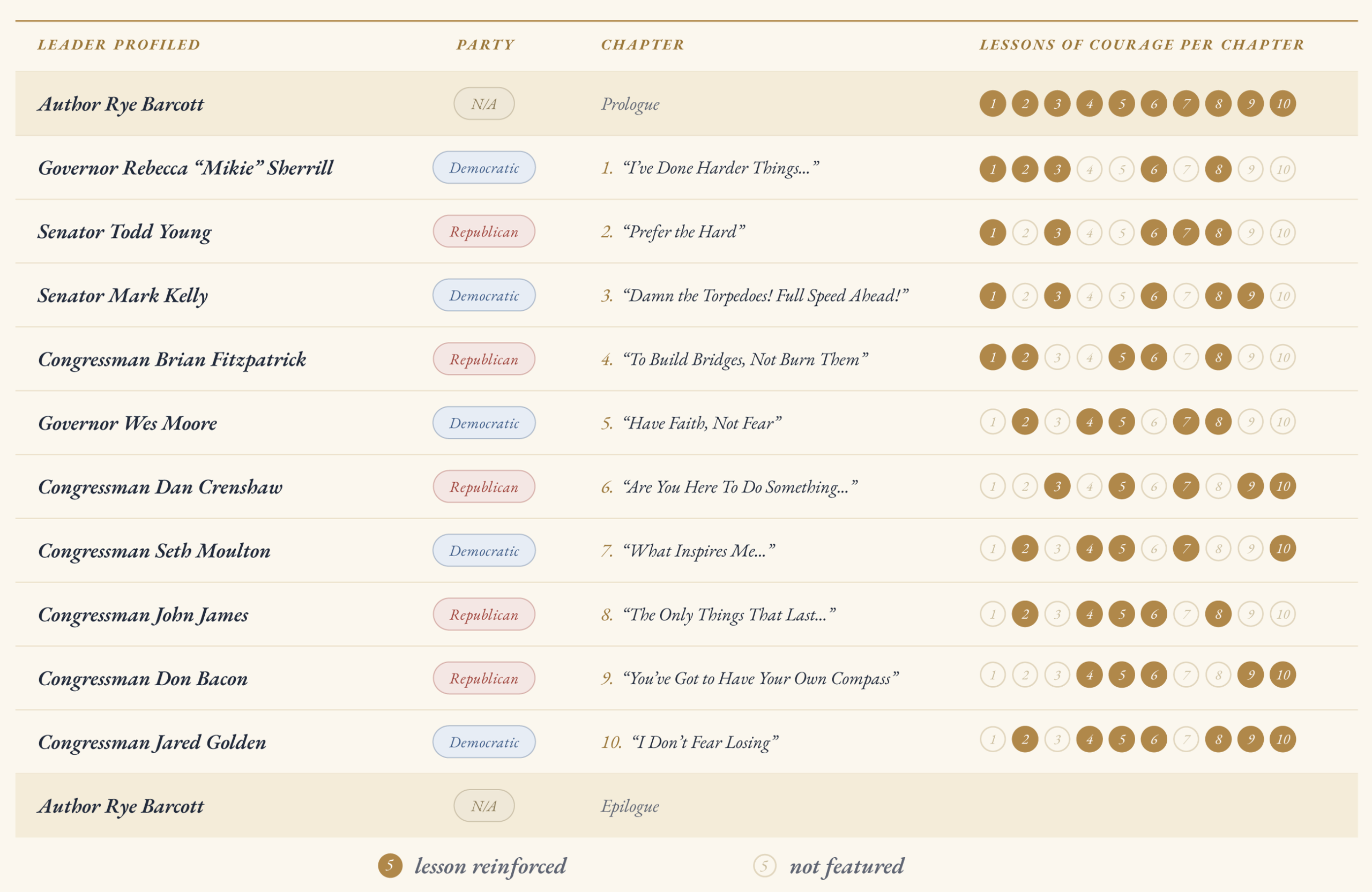
Leader Profile Coverage Index
The Leader Profile Lesson Coverage Index identifies each public official featured in the book Courage Can Save US: Ten Extraordinary Americans and the Fight for Our Future, including political affiliation, chapter title, and the lessons in which each excerpt is used. Because many public officials illustrate multiple civic and political concepts, their experiences appear in different lessons where they best support the instructional objectives. The matrix also reflects the guide’s intentionally nonpartisan approach by drawing examples from both Democratic and Republican leaders while emphasizing civic principles, constitutional responsibility, leadership, and public service rather than partisan advocacy. Offices held by these officials are current as of 2026.
Lesson 1: Political Courage, Civic Virtue, and Public Service
Essential Question
What makes an action politically courageous, and how can public officials show civic virtue when a decision may carry personal or political costs?
Recommended Ages/Grades
Ages 14 to adult; grades 9-12, dual enrollment, undergraduate courses
Recommended Courses/Programs
U.S. Government; American Government and Civics; Civics; U.S. History; Debate; AP U.S. Government and Politics; AP Comparative Government and Politics; AP U.S. History; IB Global Politics; Political Science; Government; American Politics; American Political Institutions; Legislative Politics; Political Behavior; College First-Year Seminar; Programs in Service Learning and Leadership
Subject Areas
U.S. government; civics; politics; U.S. history; democracy; citizenship; civic responsibility; political behavior; political courage; moral courage; bravery; civic virtue; common good; public trust; military service; leadership; civic leadership; public service; character education; service learning
Learning Outcomes
Academic: Learners analyze how political courage, moral courage, civic virtue, and public service are defined and demonstrated by public officials facing political risk or pressure.
Civic: Learners evaluate how citizens can assess public officials who make difficult decisions in service of constitutional duty, public trust, or the common good.
Personal: Learners reflect on how courage, service, and civic virtue may apply to their own roles as learners, leaders, citizens, and members of a community.
Pre-Planning
Timing
- 40-50 minutes, adaptable to a 90-minute block
- Instructors should select from the activities and suggested excerpts based on age/course level, available time, and whether readings were assigned before the lesson as pre-reading.
Overview
In Courage Can Save US: Ten Extraordinary Americans and the Fight for Our Future, Rye Barcott introduces public leaders who have faced pressure, criticism, risk, or political cost when making difficult decisions. The book asks learners to look beyond simple labels and consider what courage requires in public life. Courage is not presented as mere boldness or popularity, but as a choice connected to duty, principle, public service, and the common good.
This lesson helps learners distinguish between bravery, moral courage, and political courage while evaluating how public officials respond to pressure. Academically, learners build vocabulary and analytical tools for understanding public leadership. Civically, they examine how citizens can assess leaders without relying only on party agreement or personal preference. Personally, learners consider how courage, civic virtue, and service may apply in their own schools, organizations, communities, and future civic roles.
Learning Objectives
The learner will:
- Define political courage, moral courage, civic virtue, public service, common good, and public trust.
- Distinguish between bravery, moral courage, and political courage.
- Identify examples of personal risk, political risk, and institutional pressure.
- Explain how public officials may demonstrate civic virtue when facing criticism or possible political consequences.
- Compare examples of physical courage, moral courage, and political courage.
- Analyze how public service can require decisions that conflict with popularity, party loyalty, or personal comfort.
- Evaluate whether a public official’s decision reflects courage, principle, ambition, or political calculation.
- Apply the concept of political courage to a school, organizational, community, or civic situation.
- Assess a personal situation in which acting with courage or civic virtue may require accepting disagreement, criticism, or risk.
Suggested Reading Excerpts & Reading Questions
The selected excerpts were chosen to provide a variety of bipartisan perspectives and examples that align with the lesson’s learning objectives. Instructors may assign any or all of the excerpts at their discretion. Although the excerpts are intended for guided pre-reading with the accompanying Reading Questions, they may be used in whatever manner best meets the needs of the learners.
Excerpt 1.
Author Rye Barcott, Prologue: Courage, Bravery, and the Common Good (pp. xi-xvii) – Author Rye Barcott served as a U.S. Marine Corps officer and is the cofounder of With Honor, a cross-partisan organization that supports principled veteran and national security leaders in public office. In Courage Can Save US: Ten Extraordinary Americans and the Fight for Our Future, Barcott profiles public officials from both major political parties who carried an ethic of service into political life. This excerpt introduces courage as a choice made in service of others and distinguishes courage from bravery. It is a strong opening selection because it gives learners the core vocabulary needed to evaluate moral courage, political courage, civic virtue, public service, and the common good. Topics include: courage, bravery, public service, common good, civic virtue, democratic responsibility.
Excerpt 2.
Governor Rebecca “Mikie” Sherrill: Courage as Service to Others and Constitutional Duty (pp. 3-5, 18-20) – Governor Rebecca “Mikie” Sherrill is a Democrat serving as Governor of New Jersey. She previously represented New Jersey’s 11th district in the U.S. House of Representatives. Prior to elected office, she served as a U.S. Navy helicopter pilot and federal prosecutor. This excerpt includes Sherrill’s lifesaving rescue aboard YP-690 and later connects political courage to constitutional duty during impeachment. This excerpt allows learners to compare physical bravery, service to others, political risk, criticism, and public responsibility within one leader’s story. Topics include: bravery, political courage, public service, constitutional duty, political risk, civic virtue.
Excerpt 3.
Senator Todd Young: Preferring the Hard and Accepting Political Cost (pp. 33-35, 56-58) – Senator Todd Young is a Republican representing Indiana in the U.S. Senate. Before serving in Congress, he served as a U.S. Marine Corps officer and represented Indiana’s 9th Congressional District in the U.S. House of Representatives. This excerpt connects Young’s “Prefer the Hard” ethic to public service, discipline, January 6, election certification, and gun safety and Respect for Marriage Act votes that carried political cost. This excerpt illustrates how political courage may involve unglamorous duty, criticism from one’s own side, and decisions connected to his oath of public office, principle, and public responsibility. Topics include: political courage, oath, party pressure, public service, institutional responsibility, political cost.
Excerpt 4.
Senator Mark Kelly: Physical Courage Under Pressure (pp. 63-66) – Senator Mark Kelly is a Democrat representing Arizona in the U.S. Senate. Before entering public office, he served as a U.S. Navy combat pilot and NASA astronaut. This excerpt focuses on Kelly’s Gulf War missile attack experience and his decision to continue the mission under dangerous conditions. This passage allows learners to distinguish physical bravery from moral or political courage while still connecting courage to duty, discipline, and responsibility under pressure. Topics include: bravery, physical courage, military service, duty, pressure, leadership.
Excerpt 5.
Congressman Brian Fitzpatrick: Crossing Party Lines and Representing Constituents (pp. 105-110) – Congressman Brian Fitzpatrick is a Republican representing Pennsylvania’s 1st Congressional District in the U.S. House of Representatives. Before entering Congress, he served as an FBI special agent and worked on national security and public corruption matters. This excerpt discusses Fitzpatrick’s vote related to Affordable Care Act (ACA) repeal, constituent responsibility, the Problem Solvers Caucus, and crossing party lines on major legislation. This reading asks learners to evaluate whether political courage can include voting against party expectations in order to represent constituents or pursue practical governance. Topics include: political courage, constituent responsibility, party pressure, bipartisan work, public trust, representation.
Excerpt 6.
Congressman Don Bacon: Moral Courage, Institutional Integrity, and the Compass of Public Service (pp. 233-235, 249-259) – Congressman Don Bacon is a Republican representing Nebraska’s 2nd Congressional District in the U.S. House of Representatives. Before entering Congress, he served as a U.S. Air Force officer and retired as a brigadier general. This excerpt includes Bacon’s reporting of misconduct by senior officers and later examples of resisting party pressure, criticism from President Trump, the Speaker fight, Ukraine, and his decision to follow his own moral compass. This excerpt connects moral courage, institutional integrity, political pressure, and civic responsibility across both military and congressional settings. Topics include: moral courage, political courage, institutional integrity, party pressure, public trust, common good.
Reading Questions:
- What action or decision required courage, bravery, or moral judgment?
- What risk, pressure, criticism, or possible consequence did the public official or leader face?
- What principle, duty, or public purpose seemed to guide the action?
- How does the excerpt show the difference between bravery, moral courage, and political courage?
- What can this example teach about civic virtue, public service, public trust, or the common good?
Teaching Instruction
Anticipatory Set/Warm-Up (5-10 minutes)
The purpose of the anticipatory set is to activate prior knowledge, generate curiosity, and prepare learners for the lesson. Encourage brief explanations, but avoid evaluating responses before learners engage with the readings and lesson activities.
Option A: Opinion Poll (Assigned Excerpt Reading Completed)
Tell learners they will respond to three statements based on the assigned readings. Display or read the statements below.
- Political courage usually requires personal or political sacrifice.
- A public official can make the right decision even if many constituents disagree.
- Courage should be judged by principles rather than popularity.
Learners respond using any preferred polling method (electronic poll, raised hands, movement to designated areas, response cards, etc.).
After each statement, invite one or two volunteers to briefly explain their reasoning. Do not evaluate responses or identify a “correct” answer.
Explain that today’s lesson examines how Courage Can Save US defines political courage and why it is often more complex than simply doing something difficult or unpopular.
Option B: Quick Judgment Challenge (No Prior Reading Required)
Read the following scenario aloud: “An elected official knows a vote will likely end their political career but believes it is the right decision.”
Ask learners: “Should the official cast the vote?”
Learners respond using any preferred polling method (electronic poll, raised hands, movement to designated areas, response cards, etc.).
Ask two or three learners to explain their reasoning.
Explain that today’s readings examine real public officials who faced similar situations and ask what political courage looks like in practice.
Direct Instruction (10-30 minutes)
Instructors should not attempt to teach every concept in the framework during a single class period. Select the concepts most relevant to the assigned excerpts, lesson objectives, and learners’ academic levels. Allow 10-20 minutes extra time if excerpts are read during class/instructional time.
- Open by connecting the anticipatory set / warm-up to the essential question: What makes an action politically courageous, and how can public officials show civic virtue when a decision may carry personal or political costs?
- Explain that political decisions are rarely motivated by only one factor. A public official may act from courage, principle, ambition, political calculation, or a combination of these.
The purpose is not for learners to decide whether they personally agree with the decision. Instead, learners should evaluate the evidence: what the official did, what risk or pressure existed, what principle or goal was stated, who benefited, and what consequences the official appeared willing to accept.
Remind learners: “When evaluating political courage, focus on the action, not whether you like the person, party, or policy. A politically courageous action usually involves a meaningful risk or cost, such as public criticism, loss of support, party backlash, damaged relationships, or possible harm to a political career. Courage is stronger when the action is tied to a principle, constitutional duty, public service, or the common good.”
- Introduce the following concepts: Instructors may select the concepts most relevant to the assigned excerpts, learners, and lesson goals.
Civic virtue means acting in ways that support democratic life, public responsibility, and the well-being of the community.
Remind learners: “Civic virtue asks people to think beyond personal advantage. For public officials, civic virtue may mean respecting democratic institutions, serving constituents, protecting rights, accepting accountability, or making decisions that support the common good even when those decisions are unpopular.”
Public trust is the confidence citizens have that public officials and institutions will act responsibly, honestly, lawfully, and in service of the public.
Remind learners: “Public trust matters because democracy depends on citizens believing that government can be held accountable. When officials act only for personal power, party advantage, or public attention, trust can weaken. When officials explain decisions, accept responsibility, and act according to duty, they can strengthen trust even when people disagree with the decision.”
The common good refers to the well-being of the broader community, not only the interests of one person, group, party, or faction.
Remind learners: “The common good does not mean everyone will agree on the same policy. It means public officials should consider the larger impact of their decisions. Evaluate whether an action serves only personal or party interests, or whether it is connected to a broader public purpose.”
Bravery is the willingness to face danger, fear, pain, or difficulty.
Remind learners: “Bravery often involves immediate danger or fear. A person may be brave in a physical crisis, in military service, during an emergency, or while protecting another person. Bravery can overlap with courage, but political courage usually involves public pressure, reputation, party conflict, or career risk rather than only physical danger.”
Moral courage is the willingness to act according to conscience, ethics, or principle despite pressure, criticism, or personal cost.
Remind learners: “Moral courage appears when someone believes an action is right and chooses to do it even though it may be uncomfortable, costly, or unpopular. It may happen in public life, but it can also happen in families, schools, workplaces, organizations, and communities.”
Political courage is the willingness of a public official or civic leader to take a position or action despite political risk because the decision is tied to duty, principle, public service, or the common good. It is moral courage demonstrated in a political context.
Remind learners: “Political courage requires more than taking a strong position. It usually involves a meaningful cost or risk. Look for evidence of pressure, criticism, party backlash, loss of support, or possible damage to a political career. Ask whether the action was connected to a principle, duty, or public purpose.”
Political calculation occurs when a decision appears shaped mainly by strategy, timing, party incentives, polling, donor pressure, voter reaction, coalition-building, or an effort to avoid political consequences.
Remind learners: “Political calculation is not automatically bad. Public officials have to think about elections, coalitions, public reaction, and whether a policy can succeed. The question is whether strategy appears to guide the decision responsibly, or whether political advantage seems to matter more than principle, duty, or the common good.”
- Remind learners to use these Evaluation Criteria to evaluate an action or decision:
- Principle may be present when a public official’s action is connected to a clearly stated value, constitutional responsibility, moral belief, public duty, or consistent standard of judgment.
- Ambition may be present when the action appears connected mainly to personal advancement, public image, power, career protection, media attention, or future political opportunity.
- Political calculation may be present when the action appears shaped mainly by strategy, timing, party incentives, polling, donor pressure, voter reaction, coalition-building, or an effort to avoid political consequences. Courage may be present when a public official acts despite real risk, pressure, criticism, or possible loss because the official believes the action serves a larger duty, principle, or the common good.
Remind learners: “These categories can overlap. A decision can be both principled and politically calculated. A courageous decision can still involve ambition. A strategic decision can still serve the common good. Strong analysis acknowledges complexity rather than forcing every action into only one category. Do not assume ambition or political calculation is present simply because an official is an elected leader. Look for evidence.”
- If learners have not completed the assigned pre-reading, pause here for teacher-led or independent reading of the selected excerpt(s). Provide brief context and vocabulary support as needed before moving to discussion.
- Consider modeling a Reading & Source Analysis using one assigned reading. Examine one passage from the suggested excerpts. Guide learners through questions, such as:
Source Questions To Be Answered Before Reading
- Who is the author?
- When and where (if applicable) did the author write it?
- To whom is the author writing?
- Why did the author choose to write this?
- Does the author have an identifiable perspective, point of view, or bias?
Reading & Context Questions – To Be Answered After Reading
- What event, decision, or challenge is described in the excerpt?
- What pressure or competing responsibilities influenced the individual’s actions?
- How did the experience shape the leader’s values, judgment, or decision?
- What does this excerpt suggest about leadership, courage, citizenship, or public service?
- How might someone with a different political perspective, life experience, or set of values interpret this situation differently?
Consider Adding a Comparison Question
- Compare this reading excerpt with other excerpts that you have read. How are they similar and different? Require learners to support each response with evidence from the excerpt by citing words, phrases, or passages.
Consider Holding a Group Discussion
R = question connected to the excerpt Reading;
G = question connected to the General concept
A = question focuses on Academic outcome;
C = question focuses on Civic outcome;
P = question focuses on Personal outcome
- R/A: Which assigned excerpt most clearly shows a difference between bravery and political courage? What evidence supports that distinction?
- R/C: In an assigned excerpt, how did a public official connect a difficult decision to public trust or the common good?
- R/P: Which excerpt shows a kind of courage that could also appear in a school, workplace, organization, or community?
- R/A: What risk or cost in an assigned reading makes the action more than simply a strong opinion?
- R/C: How should citizens judge a leader when they disagree with the policy but can see evidence of principle?
- R/P: What makes it hard for ordinary people to act with civic virtue when others may criticize them?
- G/A: What is the difference between political courage, moral courage, and political calculation?
- G/A: Can a decision be both principled and strategic? Give a brief example.
- G/C: Why does democracy need leaders who sometimes accept criticism or political cost?
- G/C: What should matter more when evaluating political courage: motive, risk, outcome, or public explanation?
- G/P: Where might young people practice courage (without turning the issue into a personal confession)?
- G/P: What is one sign that a group values principle over popularity?
Consider Holding a Partner or Small Group Discussion
- Academic: Build a two-column comparison of bravery and political courage using one assigned excerpt and one original example.
- Academic: Choose one action from an excerpt and classify it as courage, principle, ambition, political calculation, or a combination. Defend the classification with evidence.
- Civic: Create criteria citizens could use to evaluate political courage without relying on party preference.
- Civic: Discuss whether public trust is strengthened more by popular decisions or well-explained principled decisions.
- Personal: Identify a low-risk community or school situation where civic virtue could be practiced by a group.
- Personal: Draft one sentence a leader could say when making an unpopular but principled decision.
Consider Doing a Classroom Activity
Option A (Academic Analysis): Sentence Frame: Criteria Practice to Evaluate Political Actions
- Create a chart with four columns: Action Taken / Evidence of Risk / Evidence of Principle or Duty / Possible Ambition or Political Calculation
- Model by filling in one row together. Then write a one-sentence judgment as a sentence frame: Based on the evidence, _’s (person) _ (action) most strongly reflects _ (political courage, principle, ambition, political calculation) because _. However, it may also reflect _ (political courage, principle, ambition, political calculation) because _.
Example sentence frame: Based on the evidence, Congressman Brian Fitzpatrick’s vote related to the Affordable Care Act (ACA) repeal most strongly reflects political courage because he accepted the risk of party pressure and possible political criticism in order to act on his stated responsibility to constituents. However, it may also reflect political calculation because elected officials must consider district needs, voter reaction, and future accountability when making a high-profile vote.
- Keep the wording brief so learners can recreate the structure. Learners can continue completing the chart alone, in partners, in small groups, or as a large group. It can also be assigned for independent work after the lesson.
Option B (Academic Engagement): Courage Sort
- Write the four categories on the board: bravery, moral courage, political courage, or political calculation.
- Read examples from the readings or from familiar school / community situations.
- Ask learners to vote for the best category in which the reading excerpt(s) best fit. (It is possible that the example may fit into multiple categories.) They may vote by: electronic polling, show of hands, moving to a location in a room, or another appropriate method.
- Ask: “What evidence made you choose that category?”
- Invite a learner in each category to speak, allowing alternative interpretations.
Closure / Wrap-Up (5 minutes)
Ask learners: “Can an action be politically courageous even if you strongly disagree with the decision?”
Remind learners: “Political courage is not measured by whether we agree with a leader. It requires us to examine the risk, pressure, principle, and public responsibility involved in the decision.”
Optional Extension Exercises/Independent Practice
Courage in Current Events: The learner identifies a recent decision by a public official and evaluates whether the action demonstrates political courage, moral courage, civic virtue, political calculation, or a combination of these.
Civic Courage Profile: The learner creates a brief written, visual, or recorded profile of a public official, community leader, or historical figure whose actions required accepting risk, criticism, or personal cost in service of others.
Personal Courage Reflection: The learner reflects on a situation in which they faced or may face pressure to remain silent, follow a group, or avoid a difficult decision and considers what acting with courage or civic virtue might require.
Assessment
The following questions are suggested ways to assess learner understanding of the lesson objectives, key concepts, and selected readings. Instructors may use them as written, adapt them for class discussion or written response, or select questions that best fit their course goals, learners, and available time.
True / False
- Political courage may involve accepting political risk in order to act according to a principle, duty, or public purpose. True
- Political risk alone is enough to demonstrate political courage. False
- Civic virtue involves considering public responsibility and the well-being of the broader community. True
- Political calculation and political courage cannot be factors in the same decision. False
- Moral courage may require a person to act according to conscience or principle despite criticism or personal cost. True
- Public trust depends primarily on citizens agreeing with the decisions made by public officials. False
- Citizens can evaluate political courage by examining risk, pressure, stated principles, and public purpose. True
- Bravery and political courage involve the same forms of risk and pressure. False
Multiple Choice
- Which situation best illustrates political courage?
A. A mayor delays a decision while waiting for public opinion to become clearer.
B. A representative accepts party criticism after voting according to a stated constitutional duty.
C. A senator promotes a popular policy during a reelection campaign.
D. A state official attends a community event with local leaders.
Answer: B - Which factor is most important when distinguishing political courage from simply taking a strong political position?
A. Acceptance of meaningful political risk or cost
B. Attention from national media organizations
C. Membership in a major political party
D. Support from political allies and donors
Answer: A - A legislator considers polling data, voter reaction, coalition support, and the timing of a vote before deciding how to proceed. Which concept best describes these considerations?
A. Bravery
B. Civic virtue
C. Moral courage
D. Political calculation
Answer: D - Which action best demonstrates civic virtue?
A. Avoiding a public issue that may create political controversy
B. Delaying a decision until political allies agree on a position
C. Evaluating how a public decision may affect the broader community
D. Promoting a decision because it may increase public attention
Answer: C - A public official makes a controversial decision that carries significant political risk. What additional information would be most useful in evaluating whether the action demonstrates political courage?
A. The amount of media coverage the official received after the decision
B. The number of years the official has served in public office
C. The official’s explanation of the principle, duty, or public purpose guiding the decision
D. The size and population of the official’s electoral district
Answer: C - A member of Congress votes for a bill that is unpopular with many party supporters and explains that the vote reflects public responsibility and the long-term interests of the country. Which concept best explains how the decision may strengthen representative democracy?
A. Campaign strategy can help officials respond to changing public opinion.
B. Civic virtue can lead officials to consider the common good when making public decisions.
C. Party leadership can reduce disagreement among elected officials.
D. Political calculation can increase support for controversial legislation.
Answer: B
Short Answer
- Define political courage and explain one difference between political courage and bravery.
- Describe one example of moral or political courage from the readings and explain what risk, pressure, or possible cost made the action courageous.
- Compare physical bravery and political courage using examples from the readings, government, history, or current public life.
- Explain how civic virtue or the common good can influence a public official’s decision. Use one example from the readings or a current public issue.
- Explain how party pressure, public criticism, or possible political consequences can test a public official’s commitment to principle or duty. Use one example from the readings, government, history, or current public life.
Civic Application Question
Explain how citizens can evaluate whether a public official’s controversial decision demonstrates political courage rather than primarily political calculation. Identify two factors citizens should consider when making this judgment.
Argumentative Essay Questions
- Evaluate the extent to which political courage is necessary for effective leadership in a representative democracy.
*Respond to the prompt with a defensible claim or thesis;
*Support your argument with relevant and specific evidence;
*Explain how political risk, principle, public duty, or the common good can influence a leader’s decisions; and
*Address an alternative perspective using evidence. - Evaluate the extent to which public officials should be willing to accept political costs when their judgment conflicts with public opinion or party expectations.
*Respond to the prompt with a defensible claim or thesis;
*Support your argument with relevant and specific evidence;
*Explain how political courage, civic virtue, public trust, or political calculation may influence a public official’s decision; and
*Address an alternative perspective using evidence. - Develop an argument about whether public officials strengthen representative democracy when they accept political risk in order to act according to civic virtue, public trust, or the common good.
*Respond to the prompt with a defensible claim or thesis;
*Support your argument with relevant and specific evidence;
*Explain how political courage, civic virtue, public service, or public trust can influence democratic leadership; and
*Address an alternative perspective using evidence.
Comparative Government and Global Politics Questions
These prompts use the lesson excerpts as a starting point to analyze leadership, service, politics, and civic responsibility across governments, political systems, and historical events beyond the United States.
- To what extent is political courage necessary for effective democratic leadership? Use examples from political systems, governments, or historical events.
- Discuss the relationship between civic virtue and public trust. Use examples from political systems, governments, or historical events.
- To what extent should political leaders place principle or the common good above public opinion or party expectations? Use examples from political systems, governments, or historical events.
Educational Curriculum Guidelines
This lesson supports instruction in secondary, AP, IB, dual enrollment, undergraduate, civic leadership, and seminar-style settings. Instructors may use the applicable course connections below based on grade level, course goals, and assigned readings. These guidelines emphasize inquiry, evidence-based reading, source analysis, argumentation, and civic application.
National Council for the Social Studies (NCSS) – College, Career, and Civic Life (C3) Framework for Social Studies State Standards (grades 9-12):
Note: The C3 Framework is guidance, not a required national content standard. States and local districts set required social studies standards and curriculum requirements.
Dimension 1: Developing Questions and Planning Inquiries:
D1.1.9-12: Explain how a question reflects an enduring issue in the field
Dimension 2: Applying Disciplinary Tools and Concepts:
(Civ = Civics)
D2.Civ.2.9-12: Analyze the role of citizens in the U.S. political system, with attention to various theories of democracy, changes in Americans’ participation over time, and alternative models from other countries, past and present
D2.Civ.7.9-12: Apply civic virtues and democratic principles when working with others
D2.Civ.10.9-12: Analyze the impact and appropriate roles of personal interests and perspectives on the application of civic virtues, democratic principles, constitutional rights, and human rights
D2.Civ.14.9-12: Analyze historical, contemporary, and emerging means of changing societies, promoting the common good, and protecting rights
Dimension 4: Communicating Conclusions and Taking Informed Action:
D4.1.9-12: Construct arguments using precise and knowledgeable claims, with evidence from multiple sources, while acknowledging counterclaims and evidentiary weaknesses
D4.7.9-12. Assess options for individual and collective action to address local, regional, and global problems by engaging in self-reflection, strategy identification, and complex causal reasoning
AP U.S. Government and Politics Course
Primary Learning Objectives:
1.1.A Ideals of Democracy (how democratic ideals are reflected in the Declaration of Independence and the U.S. Constitution)
1.2.A Types of Democracy (how models of representative democracy are visible in major institutions, policies, events, or debates in the U.S.)
4.8.A Ideology and Policymaking (how U.S. political cultures (e.g., democratic ideals, principles, and core values) influence the formation, goals, and implementation of public policy over time)
Reinforced Learning Objectives:
2.3.A Congressional Behavior (how congressional behavior is influenced by election processes, partisanship, and divided government)
5.3.B Political Parties (the functions and impact of political parties on the electorate and government)
5.7.A Groups Influencing Policy Outcomes (how various political actors influence public policy outcomes)
AP Comparative Government and Politics Course
Topics (Learning Objectives):
1.8 Political Legitimacy (LEG-1.A the sources of political legitimacy for different types of regimes among course countries)
3.4 Political Values and Beliefs (IEF-1.D how political values and beliefs frame policy choices to address particular political problems)
3.5 Nature and Role of Political Participation (DEM-1.A the nature and role of political participation as related to a regime’s use of authority and power)
AP U.S. History Course
Unit 9, Period 9: 1980-Present, Topics (Learning Objectives):
9.6 Challenges of the 21st Century (F. the causes and effects of domestic and international challenges the United States has faced in the twenty-first century)
9.7 Causation in Period 9 (G. the relative significance of the effects of change in the period after 1980 on American national identity)
Themes:
1: American and National Identity (how and why definitions of American and national identity and values have developed among the diverse and changing population of North America as well as on related topics, such as citizenship, constitutionalism, foreign policy, assimilation, and American exceptionalism)
5: Politics and Power (how different social and political groups have influenced society and government in the United States as well as how political beliefs and institutions have changed over time)
7: American and Regional Culture (how and why national, regional, and group cultures developed and changed as well as how culture has shaped government policy and the economy)
8: Social Structures (how and why systems of social organization develop and change as well as the impact that these systems have on the broader society)
International Baccalaureate (IB) Global Politics Course
Core:
Understanding power and global politics
Thematic Studies:
Power, sovereignty and international relations (how states interact, the role of non-state actors, global governance, and diplomacy)
Concepts:
- Power
- Legitimacy
Assessment Objectives:
- Knowledge and Understanding (demonstrate knowledge and understanding of political concepts)
- Synthesis and Evaluation (synthesize and evaluate evidence (including source material) about global politics)
- Synthesis and Evaluation (synthesize and evaluate perspectives and approaches to global politics)
Lesson 2: Political Socialization and the Formation of Beliefs
Essential Question
How do family, education, service, identity, institutions, and major events shape a person’s political beliefs and civic identity?
Recommended Ages/Grades
Ages 14 to adult; grades 9-12, dual enrollment, undergraduate courses
Recommended Courses/Programs
U.S. Government; American Government and Civics; Civics; U.S. History; Psychology; Sociology; AP U.S. Government and Politics; AP Comparative Government and Politics; AP U.S. History; IB Global Politics; Political Science; Government; American Politics; Comparative Politics; Political Behavior; College First-Year Seminar; Programs in Service Learning and Leadership
Subject Areas
U.S. government; civics; politics; U.S. history; democracy; citizenship; civic responsibility; political behavior; political socialization; political beliefs; political values; civic identity; identity formation; family influence; education; psychology; sociology; military service; mentorship; leadership; civic leadership; public service; character education; service learning
Learning Outcomes
Academic: Learners analyze how political beliefs and civic identities are shaped by family, education, service, lived experience, institutions, and major historical events.
Civic: Learners evaluate how political socialization influences democratic participation, public service, and engagement with people who hold different viewpoints.
Personal: Learners assess how their own experiences, communities, and responsibilities may shape their civic beliefs and participation.
Pre-Planning
Timing
- 40-50 minutes, adaptable to a 90-minute block
- Instructors should select from the activities and suggested excerpts based on age/course level, available time, and whether readings were assigned before the lesson as pre-reading.
Overview
In Courage Can Save US: Ten Extraordinary Americans and the Fight for Our Future, Rye Barcott presents public leaders whose beliefs and civic identities were influenced by family, education, military service, public service, community experience, faith, mentorship, and major national events. The book does not treat political beliefs as abstract ideas that appear suddenly. Instead, it shows how people develop and adjust views over time through relationships, responsibilities, challenges, institutions, and historical moments.
This lesson introduces learners to political socialization and asks them to consider how civic identity is formed. Academically, learners study how family, school, peers, media, religion, community, institutions, service, and major events shape political beliefs and civic values. Civically, they examine why people may approach public life differently even when they share similar experiences. Personally, learners reflect on the influences that have shaped their own ideas about fairness, authority, justice, responsibility, and participation.
Learning Objectives
The learner will:
- Define political socialization, civic identity, formative experience, ideology, public service, and civic participation.
- Identify agents of political socialization, including family, school, peers, media, religion, community, service, institutions, and major events.
- Describe how background, identity, and lived experience can shape civic values and political beliefs.
- Explain how military service, mentorship, education, faith, gender, family expectations, or national crisis can influence leaders.
- Compare the formative experiences of at least two public officials from different political parties.
- Analyze how political socialization can affect public service, leadership style, and democratic participation.
- Evaluate how shared experiences may lead people to different political conclusions.
- Apply the concept of political socialization to a new civic, school, organizational, or community setting.
- Assess how personal experiences may shape one’s own civic identity, political assumptions, and willingness to participate.
Suggested Reading Excerpts & Reading Questions
The selected excerpts were chosen to provide a variety of bipartisan perspectives and examples that align with the lesson’s learning objectives. Instructors may assign any or all of the excerpts at their discretion. Although the excerpts are intended for guided pre-reading with the accompanying Reading Questions, they may be used in whatever manner best meets the needs of the learners.
Excerpt 1.
Author Rye Barcott, Prologue: Family, Service, and Civic Worldview (pp. ix-x) – Author Rye Barcott served as a U.S. Marine Corps officer and is the cofounder of With Honor, a cross-partisan organization that supports principled veteran and national security leaders in public office. In Courage Can Save US: Ten Extraordinary Americans and the Fight for Our Future, Barcott profiles public officials from both major political parties who carried an ethic of service into political life. This excerpt introduces Barcott’s civic worldview through his father’s story and his own military service. This reading helps learners see political socialization as rooted in family memory, personal example, service, and early ideas about courage and duty. Topics include: family influence, military service, civic identity, courage, public service, formative experience.
Excerpt 2.
Governor Rebecca “Mikie” Sherrill: Gender, Institutional Culture, and Women in Service (pp. 6-10) – Governor Rebecca “Mikie” Sherrill is a Democrat serving as Governor of New Jersey. She previously represented New Jersey’s 11th District in the U.S. House of Representatives. Prior to elected office, she served as a U.S. Navy helicopter pilot and federal prosecutor. This excerpt explores Sherrill’s experiences with the Naval Academy, institutional expectations, gender barriers, and women in military service. It is a strong selection because it shows how political socialization can occur through institutions, public expectations, cultural change, and lived experience rather than family influence alone. Topics include: political socialization, gender, institutional culture, military service, civic identity, public responsibility.
Excerpt 3.
Congressman Brian Fitzpatrick: 9/11 and a Career Redirected Toward Public Service (pp. 99-100) – Congressman Brian Fitzpatrick is a Republican representing Pennsylvania’s 1st Congressional District in the U.S. House of Representatives. Before entering Congress, he served as an FBI special agent and worked on national security and public corruption matters. This excerpt explains how September 11 redirected Fitzpatrick’s career toward the FBI and national security service. This excerpt shows how a major historical event can reshape civic purpose, career direction, and assumptions about service and responsibility. Topics include: major events, 9/11, public service, civic identity, national security, formative experience.
Excerpt 4.
Governor Wes Moore: Valley Forge, Mentorship, and Civic Purpose (pp. 123-125) – Governor Wes Moore is a Democrat serving as governor of Maryland. He is an Army veteran, Rhodes Scholar, author, and former nonprofit leader. This excerpt focuses on Moore’s Valley Forge experience, mentorship, discipline, and the formation of civic purpose. This excerpt illustrates political socialization as a layered process shaped by family, education, structure, mentors, and personal responsibility. Topics include: education, mentorship, discipline, opportunity, civic identity, public service.
Excerpt 5.
Congressman Seth Moulton: Harvard Memorial Church, 9/11, and Choosing Military Service (pp. 180-182) – Congressman Seth Moulton is a Democrat representing Massachusetts’s 6th Congressional District in the U.S. House of Representatives. Before entering Congress, he served as a U.S. Marine Corps officer and completed four tours in Iraq. This passage connects Moulton’s experience at Harvard Memorial Church, September 11, and his decision to join the military. It shows how place, memory, national crisis, and moral responsibility can shape civic identity and public service. Topics include: political socialization, 9/11, military service, moral responsibility, civic identity, public service.
Excerpt 6.
Congressman John James: Family, Faith, Service, and Civic Responsibility (pp. 209-213) – Congressman John James is a Republican representing Michigan’s 10th Congressional District in the U.S. House of Representatives. Before entering Congress, he graduated from West Point, completed Ranger School, served as an Army Apache helicopter pilot in Iraq, and helped run his family business. This excerpt focuses on family, faith, service, and the idea of giving “time, talent, and treasure.” This passage illustrates how civic responsibility can be formed through family expectations, religious values, military service, and a belief that public life should be tied to service. Topics include: family influence, faith, service, civic responsibility, leadership, public service.
Excerpt 7.
Congressman Don Bacon: Rural Culture, Work Ethic, Reagan, and Military Fascination (pp. 236-238) – Congressman Don Bacon is a Republican representing Nebraska’s 2nd Congressional District in the U.S. House of Representatives. Before entering Congress, he served as a U.S. Air Force officer and retired as a brigadier general. This excerpt explores Bacon’s family background, rural culture, conservative publications, Reagan influence, work ethic, and early fascination with the military. Examples in this reading demonstrate how community, media, family culture, political ideas, and personal interests can combine to shape political identity and public service. Topics include: family influence, rural culture, media influence, political ideology, military service, civic identity.
Excerpt 8.
Author Rye Barcott, Epilogue: Service as a Force for Character and Shared Purpose (pp. 295-297) – Author Rye Barcott served as a U.S. Marine Corps officer and is the cofounder of With Honor, a cross-partisan organization that supports principled veteran and national security leaders in public office. In Courage Can Save US: Ten Extraordinary Americans and the Fight for Our Future, Barcott profiles public officials from both major political parties who carried an ethic of service into political life. This excerpt argues that service can form character, build shared purpose, and strengthen civic responsibility. This excerpt connects political socialization to personal application and asks learners to consider how service can shape their own civic identity. Topics include: service, character formation, civic responsibility, shared purpose, citizenship, public trust. Note: The Epilogue addresses topics including suicide and mental health. The 988 Suicide and Crisis Lifeline is available 24/7 by call or text at 988.
Reading Questions:
- What people, institutions, experiences, or events helped shape the leader’s beliefs or civic identity?
- How did family, school, service, faith, community, peers, media, or major events influence the person’s understanding of public life?
- What values or assumptions about service, responsibility, justice, patriotism, government, or citizenship appear in the excerpt?
- How did the person’s background or formative experiences affect later choices about leadership or public service?
- How might someone else experience a similar influence but reach a different political or civic conclusion?
Teaching Instruction
Anticipatory Set/Warm-Up (5-10 minutes)
The purpose of the anticipatory set is to activate prior knowledge, generate curiosity, and prepare learners for the lesson. Encourage brief explanations, but avoid evaluating responses before learners engage with the readings and lesson activities.
Option A: Opinion Poll (Assigned Excerpt Reading Completed)
Tell learners: “Today’s lesson asks how people form civic values and political beliefs.”
Read or display the prompt: “Which influence is most important in shaping a leader?”
Give response options: “Family / School / Military Service / Faith / Major Event / Mentor / Community”
Collect responses using any quick method like electronic polling, raised hand, fingers, response cards, or moving to areas of the room. Then, ask two or three learners to briefly name a leader from a reading who reflected their choice. Finally, transition into: “Today we will examine political socialization, or how people form their beliefs.”
Option B: Quick Judgment Challenge (No Prior Reading Required)
Tell learners: “Before we study the leaders in the book, think about how people form their beliefs.”
Read or display the prompt: “What most shapes a person’s ideas about citizenship and public responsibility?”
Give response options: “Family / School / Military Service / Faith / Major Event / Mentor / Community”
Collect responses using any quick method: electronic polling, raised hand, fingers, response cards, or moving to areas of the room. Then, ask: “Could two people experience the same influence and still reach different conclusions?” Finally transition into: “The readings show how public leaders were shaped by family, service, crisis, institutions, and personal experience.”
Direct Instruction (10-30 minutes)
Instructors should not attempt to teach every concept in the framework during a single class period. Select the concepts most relevant to the assigned excerpts, lesson objectives, and learners’ academic levels. Allow 10-20 minutes extra time if excerpts are read during class/instructional time.
- Open by connecting the anticipatory set / warm-up to the essential question: How do family, education, service, identity, institutions, and major events shape a person’s political beliefs and civic identity?
- Explain that political socialization is the process by which people form political beliefs, civic values, assumptions about government, and habits of participation. It does not happen all at once. It develops over time through repeated influences, major events, personal relationships, institutions, and lived experiences.
Remind learners: “When evaluating political courage, focus on the action, not whether you like the person, party, or policy. A politically courageous action usually involves a meaningful risk or cost, such as public criticism, loss of support, party backlash, damaged relationships, or possible harm to a political career. Courage is stronger when the action is tied to a principle, constitutional duty, public service, or the common good.”
- Introduce the following concepts: Instructors may select the concepts most relevant to the assigned excerpts, learners, and lesson goals.
Political socialization is the process by which people develop political beliefs, civic values, assumptions about government, and habits of participation.
Remind learners: “Political socialization helps explain why people do not all see politics, citizenship, service, authority, justice, or government in the same way. People are shaped by families, schools, communities, media, institutions, major events, and personal experience. These influences do not determine every belief, but they help shape what people notice, value, question, trust, or reject.”
Civic identity is the way a person sees their role, responsibility, and connection to a community, country, or political system.
Remind learners: “Civic identity is about how people understand themselves as citizens or members of a community. A person’s civic identity may include ideas about service, voting, public responsibility, patriotism, protest, leadership, rights, or helping others.”
Ideology is a set of political beliefs or values about government, society, rights, responsibility, freedom, equality, order, justice, and public policy.
Remind learners: “Ideology helps people organize their political views. It may shape how people think about the role of government, individual responsibility, national security, economic policy, civil rights, or social change. However, people are often more complicated than one ideological label.”
Agents of socialization are the people, groups, institutions, experiences, and events that influence how political beliefs and civic identities develop.
Remind learners: “Agents of socialization do not all affect people in the same way. The same event, school, family, or community may influence two people differently. Look for what influenced a person, how that influence appeared, and how it shaped civic values or public choices.”
Family, as an agent of socialization, includes parents, grandparents, siblings, relatives, and close family networks that shape early beliefs, values, habits, and assumptions.
Remind learners: “Family often introduces early ideas about responsibility, work, faith, country, fairness, service, political parties, government, and community. Some people adopt family beliefs closely, while others react against them or modify them over time.”
School, as an agent of socialization, includes teachers, curricula, classmates, school culture, civic education, student organizations, college experiences, and exposure to new ideas.
Remind learners: “Schools can shape political socialization by teaching history, government, debate, leadership, service, and civic responsibility. They can also expose learners to people and viewpoints different from those they encountered at home.”
Peers, as an agent of socialization, are friends, classmates, teammates, coworkers, roommates, or social groups that influence what feels normal, acceptable, admirable, risky, or controversial.
Remind learners: “Peers can shape what people believe, discuss, avoid, or feel comfortable saying publicly. Peer influence is especially important for young people because friends and classmates can affect political confidence, participation, silence, activism, or willingness to consider different viewpoints.”
Media, as an agent of socialization, includes traditional media, social media, podcasts, online platforms, influencers, and digital communities. Traditional media may include newspapers, television, radio, magazines, books, or other one-way communication formats, while social media allows users to create, share, respond to, and rapidly circulate content.
Remind learners: “Media can shape which issues people notice, which voices they trust, and which events feel urgent. Different media environments can lead people to very different understandings of the same issue. Social media can also intensify political identity because it rewards repetition, emotion, group belonging, and quick reaction.”
Religious and faith communities, as an agent of socialization, may include religious beliefs, moral teachings, congregations, service traditions, and faith-based communities.
Remind learners: “Religion can shape political socialization by influencing ideas about moral responsibility, service, justice, family, community, human dignity, authority, and the common good. Faith communities may also create habits of service, leadership, and public engagement.”
Community, as an agent of socialization, includes hometowns, neighborhoods, local traditions, civic organizations, regional cultures, and shared local problems.
Remind learners: “Community can shape how people view government and citizenship. Someone raised in a military community, farming community, urban neighborhood, immigrant community, tribal community, or small town may develop different assumptions about service, opportunity, government, responsibility, and public life.”
Institutions, as an agent of socialization, are organized systems that shape behavior, expectations, authority, and civic values. Examples include government, military, schools, courts, universities, religious organizations, political parties, civic organizations, media organizations, and workplaces.
Remind learners: “Institutions socialize people by teaching rules, norms, duties, traditions, and expectations. A military academy, a college, a courtroom, a congressional office, or a civic organization can shape how a person thinks about leadership, discipline, rights, authority, and service.”
Major events, as an agent of socialization, are historical, national, local, or personal events that shape how people understand politics, citizenship, government, and public responsibility.
Remind learners: “Major events can change how people see the world. Events such as war, terrorism, economic crisis, protest movements, pandemics, political violence, natural disasters, elections, or local tragedies may influence what people fear, value, question, or decide to do with their lives.”
Note: This lesson’s excerpts emphasize several agents of socialization, including family, education, service, faith, institutions, mentorship, and major events. However, learners should also recognize that peers and media are important agents of political socialization, even if they are not the central focus of the selected excerpts. Use the following examples to briefly illustrate peer influence and media influence as agents of political socialization:
Peer Influence Examples:
- Example 1: School Walkout or Protest – A student may not have thought much about a public issue until friends organize a school walkout, attend a city council meeting, or discuss the issue every day at lunch. The student’s views may change because peers make the issue feel urgent, visible, and personally relevant.
- Example 2: Team or Club Culture – A student on a sports team, debate team, ROTC unit, service club, or student government may absorb values from the group, such as discipline, patriotism, competition, public service, or advocacy.
- Example 3: College Roommates or Classmates – A student who enters college with one set of assumptions may meet classmates from different regions, religions, races, income levels, or political backgrounds. Those relationships may challenge previous beliefs or make the student more aware of issues they had never personally encountered.
- Example 4: Social Pressure and Silence – A student may avoid expressing a political opinion because a peer group strongly favors one viewpoint. In this case, peers may shape not only what someone believes, but also what someone feels safe saying publicly.
Media Influence Examples:
- Example 1: Social Media Feed – A student who repeatedly sees videos about immigration, climate change, gun policy, war, policing, or college debt may begin to see that issue as more important than other issues, even if the student has not studied it deeply.
- Example 2: Traditional Media and News Source Differences – Two learners may follow different traditional news sources, social media feeds, or commentary sources and come to class with very different understandings of the same event. This can shape trust, fear, anger, empathy, and assumptions about who is responsible.
- Example 3: Influencers and Podcasts – A young person may trust a podcast host, YouTuber, TikTok creator, athlete, veteran, pastor, celebrity, or political influencer more than a traditional news anchor or elected official. That person may become an important source of political identity.
- Example 4: Local Information Sources – A local newspaper story, school board livestream, radio interview, flyer, direct mail piece, or community Facebook page may shape how learners understand local issues such as homelessness, school funding, policing, zoning, or public health.
- If learners have not completed the assigned pre-reading, pause here for teacher-led or independent reading of the selected excerpt(s). Provide brief context and vocabulary support as needed before moving to discussion.
- Consider modeling a Reading & Source Analysis using one assigned reading. Examine one passage from the suggested excerpts. Guide learners through questions, such as:
Source Questions To Be Answered Before Reading
- Who is the author?
- When and where (if applicable) did the author write it?
- To whom is the author writing?
- Why did the author choose to write this?
- Does the author have an identifiable perspective, point of view, or bias?
Reading & Context Questions – To Be Answered After Reading
- What event, decision, or challenge is described in the excerpt?
- What pressure or competing responsibilities influenced the individual’s actions?
- How did the experience shape the leader’s values, judgment, or decision?
- What does this excerpt suggest about leadership, courage, citizenship, or public service?
- How might someone with a different political perspective, life experience, or set of values interpret this situation differently?
Consider Adding a Comparison Question
- Compare this reading excerpt with other excerpts that you have read. How are they similar and different? Require learners to support each response with evidence from the excerpt by citing words, phrases, or passages.
Consider Holding a Group Discussion
R = question connected to the excerpt Reading;
G = question connected to the General concept
A = question focuses on Academic outcome;
C = question focuses on Civic outcome;
P = question focuses on Personal outcome
- R/A: Which assigned excerpt shows the clearest agent of political socialization?
- R/C: How did service, family, faith, school, community, or a major event shape a leader’s sense of civic responsibility?
- R/P: Which reading shows an influence that many people might experience differently?
- R/A: What evidence shows that beliefs form over time rather than all at once?
- R/C: Why should citizens understand the experiences that shaped people with different political views?
- R/P: How can recognizing influences on belief make discussion less judgmental?
- G/A: What is political socialization, and how is it different from party identification?
- G/A: Which agent of socialization is easiest to identify? Which is hardest?
- G/C: How can shared national events lead people toward different civic conclusions?
- G/C: Why might civic identity matter for democratic participation?
- G/P: What influence can a school, team, or civic organization have on how people understand responsibility?
- G/P: What is one healthy way to question an inherited belief without disrespecting the people who shaped it?
Consider Holding a Partner or Small Group Discussion
- Academic: Create a political socialization map for one leader, including at least three agents of socialization and their effects.
- Academic: Compare two leaders from different parties and identify one similarity and one difference in how their civic identities formed.
- Civic: Discuss how understanding political socialization can improve conversations among citizens who disagree.
- Civic: Choose one major event and explain how it could push different people toward different civic responses.
- Personal: Create a non-private civic identity map for a student, citizen, or community member.
- Personal: Identify one influence a school or youth program can intentionally use to build responsible citizenship.
Consider Doing a Classroom Activity
Option A (Academic Analysis): Sentence Frame: Criteria Practice to Evaluate Political Actions
- Create a chart with four columns: Agent of socialization / Specific influence / Value or belief shaped / Later civic choice. Suggested agents: Family, School, Peers, Media, Religion or faith community, Community, Service, Institutions, Major events.
- Model by filling in one row together. Then write a one-sentence claim as a sentence frame: Based on the evidence, _ (agent of socialization or experience) influenced _ (person) by shaping the value of _, which is reflected in the later civic choice to _.
Example sentence frame: Based on the evidence, military service most strongly influenced Seth Moulton by shaping his sense of duty and responsibility, which is reflected in his later willingness to challenge members of his own political party when he believed it served the public interest.
- Keep the wording brief so learners can recreate the structure. Learners can continue completing the chart alone, in partners, in small groups, or as a large group. It can also be assigned for independent work after the lesson.
Option B (Academic Engagement): Courage Sort
- Write the three categories on the board: “Influence, Value, Choice.”
- Choose one leader from an assigned excerpt.
- Ask learners to name one influence that shaped that person.
- Ask: “What value did that influence seem to build?”
- Ask: “How did that show up later?”
- Have learners generate a brief influence chain using a reading excerpt or an example from their own lives.
- Have them consider: “What influence shaped that value?” and “What later choice did that value affect?”
Closure / Wrap-Up (5 minutes)
Ask learners to silently complete this sentence: “One influence I may underestimate when trying to understand another person’s political belief is __________.”
Invite 2-3 learners to share their thoughts. Close by reminding learners that understanding how beliefs are formed does not require agreement, but it may help citizens better understand why people view the same issue differently.
Optional Extension Exercises/Independent Practice
Political Socialization Mind Map: The learner creates a mind map showing influences that have shaped their civic beliefs, values, or ideas about leadership, civic participation, or public policy. The mind map may include family, school, community, media, service, faith, peers, work, travel, or major events.
Civic Identity Interview: The learner interviews a family member, mentor, teacher, community leader, or older adult about an experience that helped shape their beliefs about citizenship, service, responsibility, government, or public policy.
Current Events Connection: The learner identifies a current public official or community leader and researches one formative experience which may have shaped that person’s belief about citizenship, leadership, or public policy.
Assessment
The following questions are suggested ways to assess learner understanding of the lesson objectives, key concepts, and selected readings. Instructors may use them as written, adapt them for class discussion or written response, or select questions that best fit their course goals, learners, and available time.
True / False
- Political socialization is the process through which people develop political beliefs, values, and civic attitudes. True
- Family influence has a greater effect on political beliefs than education, media, service, or major events. False
- Major events can influence how individuals understand government, citizenship, or public responsibility. True
- Political socialization ends when a person reaches voting age. False
- Schools, media, faith communities, peers, and workplaces may serve as agents of political socialization. True
- Experiencing the same major event causes people to develop similar political beliefs about that event. False
- Formative experiences may influence a person’s understanding of leadership, service, or civic responsibility. True
- Political ideology develops independently from a person’s social environment and life experiences. False
Multiple Choice
- Which situation best illustrates political socialization?
A. A candidate calculates the number of votes needed to win an election.
B. A citizen develops views about public service through family experiences and community involvement.
C. A court reviews whether a law is constitutional.
D. A legislature sends a bill to a committee.
Answer: B - A major national crisis causes a student to become more interested in national security and public service. Which influence on political socialization is most directly illustrated?
A. Electoral competition
B. Formative experience
C. Party leadership
D. Political calculation
Answer: B - Why may two people who experience the same political event develop different beliefs?
A. Civic beliefs are primarily determined by age.
B. Major events have limited influence on political attitudes.
C. People interpret events through different experiences, values, and social influences.
D. Political ideology prevents people from reconsidering prior beliefs.
Answer: C - Which example best demonstrates the influence of institutional culture?
A. A citizen changes a view after watching a campaign advertisement.
B. A military academy emphasizes duty, discipline, and service as shared expectations.
C. A student adopts a political position after reading one social media post.
D. A voter selects a candidate because of name recognition.
Answer: B - Which research question would best help a political scientist study political socialization?
A. How do family, education, and major events influence civic beliefs over time?
B. How many bills were introduced in Congress during one session?
C. What constitutional powers are assigned to the executive branch?
D. Which committee has jurisdiction over a specific policy area?
Answer: A - A public official explains that growing up in a military family, serving in the armed forces, and later working in public service shaped the official’s beliefs about duty, citizenship, and government responsibility. Which conclusion best connects this example to political socialization?
A. Civic participation usually occurs independently of formative experiences.
B. Military service prevents later changes in political ideology.
C. Public opinion determines how elected officials describe their backgrounds.
D. Socialization can connect family, institutions, and service to later civic beliefs.
Answer: D
Short Answer
- Define political socialization and identify two agents of political socialization. Explain how each agent could shape civic identity.
- Describe one formative experience from the readings and explain how it shaped civic identity, public service, or leadership.
- Compare the influence of family and service using examples from the readings, government, history, or current public life.
- Explain how media or the information environment can shape political attitudes. Use one example from the readings or a current public issue.
- Explain how a major historical event can shape civic beliefs or public leadership. Use one example from the readings, government, or history.
Civic Application Question
Explain one way understanding political socialization could improve civic discussion between people with different political beliefs.
Argumentative Essay Questions
- Evaluate the extent to which political socialization shapes civic participation in a representative democracy.
*Respond to the prompt with a defensible claim or thesis;
*Support your argument with relevant and specific evidence;
*Explain how family, education, media, service, or major events can influence political beliefs; and
*Address an alternative perspective using evidence. - Evaluate the extent to which military service or public service is an important influence on civic identity and public leadership.
*Respond to the prompt with a defensible claim or thesis;
*Support your argument with relevant and specific evidence;
*Explain how formative experiences can affect beliefs about citizenship and responsibility; and
*Address an alternative perspective using evidence. - Develop an argument about the extent to which formative experiences influence an individual’s political beliefs and civic participation.
*Respond to the prompt with a defensible claim or thesis;
*Support your argument with relevant and specific evidence;
*Explain how agents of political socialization, such as family, education, media, community, service, or major events, can shape political beliefs and civic identity; and
*Address an alternative perspective using evidence.
Comparative Government and Global Politics Questions
These prompts use the lesson excerpts as a starting point to analyze leadership, service, politics, and civic responsibility across governments, political systems, and historical events beyond the United States.
- To what extent do formative experiences shape political identity? Use examples from political systems, governments, or historical events.
- Discuss the relationship between civic identity and political participation. Use examples from political systems, governments, or historical events.
- To what extent does military service or public service influence the legitimacy or effectiveness of political leadership? Use examples from political systems, governments, or historical events.
Educational Curriculum Guidelines
This lesson supports instruction in secondary, AP, IB, dual enrollment, undergraduate, civic leadership, and seminar-style settings. Instructors may use the applicable course connections below based on grade level, course goals, and assigned readings. These guidelines emphasize inquiry, evidence-based reading, source analysis, argumentation, and civic application.
National Council for the Social Studies (NCSS) – College, Career, and Civic Life (C3) Framework for Social Studies State Standards (grades 9-12):
Note: The C3 Framework is guidance, not a required national content standard. States and local districts set required social studies standards and curriculum requirements.
Dimension 1: Developing Questions and Planning Inquiries:
D1.1.9-12: Explain how a question reflects an enduring issue in the field
Dimension 2: Applying Disciplinary Tools and Concepts:
(Civ = Civics, Psy = Psychology, Soc = Sociology)
D2.Civ.2.9-12: Analyze the role of citizens in the U.S. political system, with attention to various theories of democracy, changes in Americans’ participation over time, and alternative models from other countries, past and present
D2.Civ.7.9-12: Apply civic virtues and democratic principles when working with others
D2.Civ.10.9-12: Analyze the impact and appropriate roles of personal interests and perspectives on the application of civic virtues, democratic principles, constitutional rights, and human rights
D2.Psy.23.9-12: Apply psychological knowledge to civic engagement
D2.Soc.11.9-12: Analyze the influence of the primary agents of socialization and why they are influential
Dimension 4: Communicating Conclusions and Taking Informed Action:
D4.2.9-12: Construct explanations using sound reasoning, correct sequence (linear or non-linear), examples, and details with significant and pertinent information and data, while acknowledging the strengths and weaknesses of the explanation given its purpose (e.g., cause and effect, chronological, procedural, technical)
AP U.S. Government and Politics Course
Primary Learning Objectives:
4.2.A Political Socialization (how cultural factors influence political socialization)
4.3.A Changes in Ideology (how social factors influence political socialization)
4.4.A Influence of Political Events on Ideology (how major political events influence political ideology)
Reinforced Learning Objectives:
1.2.A Types of Democracy (how models of representative democracy are visible in major institutions, policies, events, or debates in the U.S.)
4.1.A American Attitudes About Government and Politics (the relationship between core beliefs of U.S. citizens and attitudes about the role of government)
5.3.B Political Parties (the functions and impact of political parties on the electorate and government)
AP Comparative Government and Politics Course
Topics (Learning Objectives):
3.2 Political Culture (IEF-1.C how political culture relates to citizen behavior and the role of the state)
3.4 Political Values and Beliefs (IEF-1.D how political values and beliefs frame policy choices to address particular political problems)
3.5 Nature and Role of Political Participation (DEM-1.A the nature and role of political participation as related to a regime’s use of authority and power)
3.6 Forces that Impact Political Participation (DEM-1.B how political participation affects and is affected by democratic or authoritarian regime types)
AP U.S. History Course
Unit 9, Period 9: 1980-Present, Topics (Learning Objectives):
9.1 Contextualizing Period 9 (A. the context in which the United States faced international and domestic challenges after 1980)
9.6 Challenges of the 21st Century (F. the causes and effects of domestic and international challenges the United States has faced in the twenty-first century)
9.7 Causation in Period 9 (G. the relative significance of the effects of change in the period after 1980 on American national identity)
Themes:
1: American and National Identity (how and why definitions of American and national identity and values have developed among the diverse and changing population of North America as well as on related topics, such as citizenship, constitutionalism, foreign policy, assimilation, and American exceptionalism)
5: Politics and Power (how different social and political groups have influenced society and government in the United States as well as how political beliefs and institutions have changed over time)
7: American and Regional Culture (how and why national, regional, and group cultures developed and changed as well as how culture has shaped government policy and the economy)
8: Social Structures (how and why systems of social organization develop and change as well as the impact that these systems have on the broader society)
International Baccalaureate (IB) Global Politics Course
Core:
Understanding power and global politics
Thematic Studies:
Power, sovereignty and international relations (how states interact, the role of non-state actors, global governance, and diplomacy)
Concepts:
- Power
- Legitimacy
- Interdependence
Assessment Objectives:
- Knowledge and Understanding (demonstrate knowledge and understanding of political concepts)
- Application and Analysis (identify and analyse information, claims and perspectives in course materials)
- Use and Application of Appropriate Skills (reflect on the process and results of research and investigation)
Lesson 3: Constitutional Principles, Oaths, and the Rule of Law
Essential Question
When political pressure conflicts with constitutional responsibility, how should public officials understand their oath of public office and the rule of law?
Recommended Ages/Grades
Ages 14 to adult; grades 9-12, dual enrollment, undergraduate courses
Recommended Courses/Programs
U.S. Government; American Government and Civics; Civics; U.S. History; Debate; AP U.S. Government and Politics; AP Comparative Government and Politics; AP U.S. History; IB Global Politics; Political Science; Government; Public Policy; Constitutional Law; American Politics; American Political Institutions; Comparative Politics; Legislative Politics; College First-Year Seminar; Programs in Service Learning and Leadership
Subject Areas
U.S. government; civics; politics; U.S. history; democracy; citizenship; civic responsibility; political behavior; democratic institutions; constitutional principles; U.S. Constitution; rule of law; oaths of public office; military oaths; separation of powers; checks and balances; congressional behavior; First Amendment; free speech; impeachment; election certification; public trust; military service; leadership; civic leadership; public service; character education; service learning
Learning Outcomes
Academic: Learners examine how constitutional principles, oaths of public office, military oaths, separation of powers, civil liberties, and the rule of law shape responsibilities in public and military service.
Civic: Learners evaluate how constitutional responsibility can guide public officials when political pressure, party loyalty, or public opinion conflicts with institutional duty.
Personal: Learners consider how commitments, rules, and ethical responsibilities should guide their own decisions when facing pressure from peers, groups, or institutions.
Pre-Planning
Timing
- 40-50 minutes, adaptable to a 90-minute block
- Instructors should select from the activities and suggested excerpts based on age/course level, available time, and whether readings were assigned before the lesson as pre-reading.
Overview
In Courage Can Save US: Ten Extraordinary Americans and the Fight for Our Future, Rye Barcott highlights moments when public officials had to weigh political pressure against constitutional responsibility. The book shows that public service is not only about personal conviction or party loyalty. It also involves offices, oaths of public office, military oaths, institutions, procedures, and duties that may require leaders to act according to law even when doing so is unpopular or politically costly.
This lesson gives learners the constitutional framework needed to understand those choices. Academically, learners examine rule of law, oaths of public office, military oaths, separation of powers, checks and balances, impeachment, election certification, and civil liberties. Civically, they evaluate why democratic systems depend on officials who respect lawful procedures and institutional limits. Personally, learners consider how commitments, rules, and ethical responsibilities should guide their own decisions when they face pressure from peers, groups, or organizations.
Learning Objectives
The learner will:
- Define rule of law, oath of public office, military oath, constitutional responsibility, separation of powers, checks and balances, impeachment, election certification, and free speech.
- Identify constitutional principles and institutional responsibilities.
- Explain why an oath of public office may create obligations beyond personal preference, party loyalty, or public approval.
- Describe how public officials respond to constitutional conflict, public pressure, or institutional crisis.
- Compare how military oaths and oaths of public office shape decision-making in different contexts.
- Analyze how the rule of law depends on public officials respecting constitutional limits and procedures.
- Evaluate whether a public official’s action reflects constitutional duty, political strategy, civic virtue, or party pressure.
- Apply constitutional responsibility to a new scenario involving leadership, rules, institutional duty, or public accountability.
- Assess how personal commitments and ethical responsibilities should influence one’s own choices under pressure.
Suggested Reading Excerpts & Reading Questions
The selected excerpts were chosen to provide a variety of bipartisan perspectives and examples that align with the lesson’s learning objectives. Instructors may assign any or all of the excerpts at their discretion. Although the excerpts are intended for guided pre-reading with the accompanying Reading Questions, they may be used in whatever manner best meets the needs of the learners.
Excerpt 1.
Author Rye Barcott, Prologue: Democracy, Trust, and Servant Leadership (pp. xiii-xiv) – Author Rye Barcott served as a U.S. Marine Corps officer and is the cofounder of With Honor, a cross-partisan organization that supports principled veteran and national security leaders in public office. In Courage Can Save US: Ten Extraordinary Americans and the Fight for Our Future, Barcott profiles public officials from both major political parties who carried an ethic of service into political life. This excerpt introduces the idea that democracy requires courage, reciprocal trust, and servant leadership. The reading frames constitutional responsibility as more than rule-following; it connects institutions, public trust, leadership, and civic duty. Topics include: democracy, trust, servant leadership, constitutional responsibility, public service, civic virtue.
Excerpt 2.
Governor Rebecca “Mikie” Sherrill: Impeachment, Constitutional Duty, and Political Risk (pp. 18-20) – Governor Rebecca “Mikie” Sherrill is a Democrat serving as Governor of New Jersey. She previously represented New Jersey’s 11th District in the U.S. House of Representatives. Prior to elected office, she served as a U.S. Navy helicopter pilot and federal prosecutor. This excerpt focuses on impeachment, constitutional duty, and the political risk involved in acting on institutional responsibility. Learners can analyze how an oath of public office may require action that conflicts with party expectations, public pressure, or reelection concerns. Topics include: impeachment, oath of public office, constitutional duty, political risk, rule of law, public trust.
Excerpt 3.
Senator Todd Young: January 6, Election Certification, and the Oath of Public Office (pp. 33-35, 56-58) – Senator Todd Young is a Republican representing Indiana in the U.S. Senate. Before serving in Congress, he served as a U.S. Marine Corps officer and represented Indiana’s 9th Congressional District in the U.S. House of Representatives. This excerpt discusses January 6, election certification, and Young’s appeal to the seriousness of his oath of public office. This excerpt exemplifies constitutional responsibility under direct public pressure and gives learners a concrete example of the rule of law, election procedures, and institutional duty. Topics include: oath of public office, election certification, January 6, constitutional responsibility, political pressure, rule of law.
Excerpt 4.
Senator Mark Kelly: Military Oath, Illegal Orders, and Free Speech (pp. 86-90) – Senator Mark Kelly is a Democrat representing Arizona in the U.S. Senate. Before entering public office, he served as a U.S. Navy combat pilot and NASA astronaut. This excerpt addresses the military oath, illegal orders, free speech, and constitutional duty. The reading allows learners to compare military oaths and oaths of public office while examining how constitutional principles apply to both service members and elected officials. Topics include: military oath, oath of public office, illegal orders, free speech, constitutional duty, civil liberties.
Excerpt 5.
Congressman Dan Crenshaw: January 6 and the Constitutional Role of Congress (p. 165) – Congressman Dan Crenshaw is a Republican representing Texas’s 2nd Congressional District in the U.S. House of Representatives. Before entering Congress, he served as a U.S. Navy SEAL officer and was wounded in Afghanistan. This excerpt focuses on January 6, reconvening, and the constitutional role of Congress. The excerpt gives learners another example of institutional responsibility during moments of crisis and shows how constitutional procedures can matter even when public pressure, fear, or political conflict are intense. Topics include: January 6, Congress, constitutional procedure, rule of law, institutional duty, public trust.
Reading Questions:
- What constitutional principle, legal duty, or institutional responsibility is involved?
- How does the leader’s oath of public office, military oath, or institutional role shape the decision being described?
- What pressure from party, public opinion, personal belief, or political consequence appears in the excerpt?
- How does the example show the importance of rule of law, separation of powers, checks and balances, or civil liberties?
- What does this excerpt suggest about how leaders should act when constitutional duty conflicts with political pressure?
Teaching Instruction
Anticipatory Set/Warm-Up (5-10 minutes)
The purpose of the anticipatory set is to activate prior knowledge, generate curiosity, and prepare learners for the lesson. Encourage brief explanations, but avoid evaluating responses before learners engage with the readings and lesson activities.
Option A: Constitutional Dilemma (Assigned Excerpt Reading Completed)
Tell learners: “Today’s lesson focuses on what happens when public pressure conflicts with constitutional duty.”
Read or display the prompt: “A public official believes the Constitution requires one action, but party supporters demand the opposite. What should guide the decision?”
Give response options: “The Constitution / Constituents / Party Leaders / Personal Belief / It Depends”
Collect responses using any quick method (electronic polling, raised hands, fingers, response cards, or moving to areas of the room). Then ask two or three learners to briefly name a leader from a reading who reflected their choice. Finally, transition into: “The readings show leaders facing moments when oaths, institutions, and political pressure collide.”
Option B: Oath Scenario (No Prior Reading Required)
Ask learners: “Imagine taking an oath to follow rules even when doing so is unpopular.”
Read or display the prompt: “Should an oath matter more than public opinion?”
Give response options: “Yes / No / It Depends”
Ask volunteers to give one-sentence explanations. Do not resolve the debate. Then transition into: “Today’s lesson examines why oaths, rule of law, and constitutional procedures matter in democratic government.”
Direct Instruction (10-30 minutes)
Instructors should not attempt to teach every concept in the framework during a single class period. Select the concepts most relevant to the assigned excerpts, lesson objectives, and learners’ academic levels. Allow 10-20 minutes extra time if excerpts are read during class/instructional time.
- Open by connecting the anticipatory set / warm-up to the essential question: When political pressure conflicts with constitutional responsibility, how should public officials understand their oath of public office and the rule of law?
- Explain that the excerpts are not only about personal courage. They are also about constitutional responsibility. In a constitutional democracy, public officials do not act only as individuals, party members, or representatives of public opinion. They also hold offices with legal and constitutional duties.
Remind learners: “The key question is not simply whether a public official made a popular or unpopular decision. The key question is whether the official acted according to constitutional responsibility. Public officials take oaths of public office that bind them to the Constitution, not to a party, a president, a donor, a media figure, or public pressure. That does not mean every constitutional question has an easy answer. It means officials must consider their duty to the rule of law, the powers of their office, the limits on government, and the procedures that protect democracy.”
- Introduce the following concepts: Instructors may select the concepts most relevant to the assigned excerpts, learners, and lesson goals.
Rule of law means that government officials and citizens are bound by law. No person is above the law, including presidents, members of Congress, judges, military officers, or ordinary citizens.
Remind learners: “The rule of law is one of the foundations of constitutional democracy. It means that power must be exercised through lawful procedures, not personal preference, intimidation, violence, or political pressure. Evaluate whether public officials respected legal and constitutional processes, even when those processes were politically difficult.”
An oath of public office is a formal promise by an elected or appointed public official to support and defend the Constitution and to faithfully carry out the duties of an office.
Remind learners: “An oath is not just ceremonial language. It creates a public obligation. When elected or appointed officials take an oath of public office, they are promising that constitutional duty comes before personal convenience or party loyalty. This matters most when honoring the oath is costly, unpopular, or politically dangerous.”
A military oath, such as the oath of enlistment or a commissioned officer’s oath of office, is taken by service members who promise to support and defend the Constitution and fulfill military duties under lawful authority.
Remind learners: “Both public officials and service members swear loyalty to the Constitution, not to a single leader. An oath of public office usually involves lawmaking, governing, oversight, or representation. A military oath involves military service, lawful authority, and the duties of service. The shared idea is constitutional loyalty. The difference is the setting in which that loyalty is tested.”
Constitutional responsibility means acting according to the duties, limits, and principles of the Constitution.
Remind learners: “Constitutional responsibility asks public officials to think beyond what is popular in the moment. It requires them to ask: What does my office require? What does the Constitution permit? What does the law require? What duty do I owe to the institution, the public, and the democratic system?”
Separation of powers means that government power is divided among the legislative, executive, and judicial branches.
Remind learners: “The Constitution separates power because concentrated power can become dangerous. Generally, Congress writes laws, the president enforces laws, and the courts interpret laws. In practice, these lines are often contested, but the basic purpose is to prevent one person or branch from controlling the whole system.”
Checks and balances means each branch of government has powers that can limit or respond to the actions of the other branches.
Remind learners: “Checks and balances are not signs that the system is broken. They are part of the design. Conflict between branches can be frustrating, but it can also protect the public from abuse of power. Look for moments when officials believe they must check another official, another branch, or even pressure from their own party.”
Impeachment is a constitutional process by which the House of Representatives may formally accuse a federal official of “treason, bribery, or other high crimes and misdemeanors.” The Senate then holds a trial and may remove the official from office.
Remind learners: “Impeachment is not the same as a regular political disagreement. It is a constitutional process connected to accountability. Citizens do not need to agree on the outcome of an impeachment to understand the constitutional question: when does an official believe misconduct is serious enough to require institutional action?”
Election certification is the formal process of confirming election results according to law.
Remind learners: “Election certification matters because democracy depends on lawful transfer of power. Certification is not simply a political ritual. It is a legal and constitutional step that helps confirm that elections, not force or pressure, decide who holds office. Consider why following election procedures can become an act of constitutional responsibility when those procedures are under pressure.”
The First Amendment protects freedoms including speech, press, religion, assembly, and petition. Free speech protects expression from government punishment, though it does not mean speech has no consequences or that all speech is protected in every setting.
Remind learners: “Free speech is central to democratic life because citizens and officials must be able to criticize government, debate policy, and challenge authority. At the same time, free speech questions can be complicated. The constitutional protection of speech does not eliminate the need for judgment, responsibility, and accountability. Distinguish between disagreement, criticism, disinformation, threats, and unlawful action.”
- If learners have not completed the assigned pre-reading, pause here for teacher-led or independent reading of the selected excerpt(s). Provide brief context and vocabulary support as needed before moving to discussion.
- Consider modeling a Reading & Source Analysis using one assigned reading. Examine one passage from the suggested excerpts. Guide learners through questions, such as:
Source Questions To Be Answered Before Reading
- Who is the author?
- When and where (if applicable) did the author write it?
- To whom is the author writing?
- Why did the author choose to write this?
- Does the author have an identifiable perspective, point of view, or bias?
Reading & Context Questions – To Be Answered After Reading
- What event, decision, or challenge is described in the excerpt?
- What pressure or competing responsibilities influenced the individual’s actions?
- How did the experience shape the leader’s values, judgment, or decision?
- What does this excerpt suggest about leadership, courage, citizenship, or public service?
- How might someone with a different political perspective, life experience, or set of values interpret this situation differently?
Consider Adding a Comparison Question
- Compare this reading excerpt with other excerpts that you have read. How are they similar and different? Require learners to support each response with evidence from the excerpt by citing words, phrases, or passages.
Consider Holding a Group Discussion
R = question connected to the excerpt Reading;
G = question connected to the General concept
A = question focuses on Academic outcome;
C = question focuses on Civic outcome;
P = question focuses on Personal outcome
- R/A: Which assigned excerpt most clearly involves an oath, legal duty, or constitutional procedure?
- R/C: How does one reading show the rule of law under pressure?
- R/P: Which example connects to a situation where someone must follow a rule despite group pressure?
- R/A: What is the constitutional issue in the assigned excerpt, and what office or role matters?
- R/C: Why should citizens care about procedures such as impeachment or election certification even when they dislike the outcome?
- R/P: What can learners take from these examples about keeping commitments under pressure?
- G/A: What is the difference between constitutional responsibility and personal preference?
- G/A: How do separation of powers and checks and balances limit power?
- G/C: Why are oaths important in a democracy?
- G/C: When can public pressure help democracy, and when can it threaten constitutional responsibility?
- G/P: What makes it difficult to keep a promise when a group wants the opposite?
- G/P: How can organizations create respect for rules without discouraging discussion?
Consider Holding a Partner or Small Group Discussion
- Academic: Use one excerpt to explain how an oath of public office can create obligations beyond party loyalty or public opinion.
- Academic: Connect rule of law, constitutional responsibility, and public trust.
- Civic: Discuss why citizens should care about lawful procedure even when a procedure produces an outcome they dislike.
- Civic: Evaluate which is more dangerous for democracy: ignoring public opinion or ignoring constitutional limits.
- Personal: Apply the oath concept to a club, school, workplace, or organization rule that leaders are expected to honor.
- Personal: Write three guidelines to follow when peer pressure or the desire for acceptance or popularity conflicts with your moral beliefs, responsibilities, or established rules of conduct.
Consider Doing a Classroom Activity
Option A (Academic Analysis): Sentence Frame: Constitutional Decision Analysis
- Create a chart with four columns: Constitutional principle / Public or party pressure / Duty of the office / Decision or consequence
- Model by filling in one row together. Then write a one-sentence evidence-based claim explaining how constitutional principles, competing pressures, and official responsibilities influenced the decision: Based on the evidence, _ (constitutional principle) most strongly influenced _’s (person) decision because, despite _ (public or party pressure), the official believed the duty of the office required _, resulting in _ (decision or consequence).
Example sentence frame: Based on the evidence, the rule of law most strongly influenced Senator Todd Young’s decision because, despite public and party pressure to object to the certification of the 2020 election results, the official believed the duty of the office required him to honor his oath of public office and follow the constitutional process, resulting in his support for election certification and criticism from some who disagreed with that decision.
- Keep the wording brief so learners can recreate the structure. Learners can continue completing the chart alone, in partners, in small groups, or as a large group. It can also be assigned for independent work after the lesson.
Option B (Academic Engagement): Oaths in Action
- Write “Promise / Pressure / Responsible Action” on the board.
- Choose an excerpt involving an oath, rule, or institutional duty.
- Ask: “What promise or duty was involved?”
- Ask: “What pressure made the duty difficult?”
- Ask: “What would responsible action require?”
- Have learners think about their peers, school, community, team, or organization and share examples of a promise, oath, or commitment that was made, how it may have been hard to keep, and what a responsible action would have been.
Closure / Wrap-Up (5 minutes)
Ask learners: “Raise your hand if you think it is harder for a public official to follow the Constitution when the decision is popular or when it is unpopular.”
Ask one or two learners to explain their choices, and close with the statement: “Constitutional principles matter most when following them is difficult.”
Optional Extension Exercises/Independent Practice
Oath Comparison: The learner locates and compares the wording of one oath of public office and one military oath, such as the oath of enlistment or a commissioned officer’s oath of office, and identifies the duties, institutions, principles, or laws each oath requires the individual to support.
Constitutional Crisis in Film: The learner watches a movie, television episode, documentary, or historical video involving government power and identifies one example of rule of law, constitutional responsibility, checks and balances, or institutional duty.
My Commitments: The learner identifies one formal or informal commitment they have made to a team, school, organization, job, family, or community and reflects on how that commitment should guide decisions when facing pressure.
Assessment
The following questions are suggested ways to assess learner understanding of the lesson objectives, key concepts, and selected readings. Instructors may use them as written, adapt them for class discussion or written response, or select questions that best fit their course goals, learners, and available time.
True / False
- The rule of law requires public officials to exercise government authority within established legal and constitutional limits. True
- An oath of public office gives a public official authority to set aside constitutional procedures when political pressure is significant. False
- Separation of powers distributes government authority among different branches. True
- Checks and balances give each branch the same constitutional responsibilities. False
- Election certification is a formal process connected to recognizing and recording election results. True
- Impeachment is a constitutional process that automatically removes a federal official from office. False
- Constitutional responsibility may require a public official to follow lawful procedures despite party or public pressure. True
- Free speech protects public officials from political criticism of their decisions. False
Multiple Choice
- Which situation best illustrates the rule of law?
A. A governor follows established legal procedures when exercising executive authority.
B. A legislator changes a position after receiving unfavorable polling results.
C. A party leader encourages members to support a campaign strategy.
D. A senator promotes a proposal during a public event.
Answer: A - What constitutional purpose is most directly served by separation of powers?
A. Allowing branch leaders to coordinate policy through shared party control
B. Encouraging national officials to respond quickly to public opinion
C. Limiting concentrated authority by assigning different powers to different branches
D. Strengthening voter participation by connecting elections to government offices
Answer: C - A public official faces strong party pressure to reject a lawful constitutional procedure but follows the required process. Which concept most directly explains the official’s decision?
A. Constitutional responsibility
B. Electoral incentive
C. Political calculation
D. Public opinion
Answer: A - Which interpretation best explains the relationship between an oath of public office and public duty?
A. An oath of public office can increase public confidence when officials explain decisions clearly.
B. An oath of public office can remind officials that public approval may affect political legitimacy.
C. An oath of public office creates a formal obligation to carry out stated constitutional duties.
D. An oath of public office replaces political judgment with a single required policy position.
Answer: C - Which situation best demonstrates checks and balances?
A. Citizens organize a campaign supporting a public policy.
B. Congress conducts oversight of executive action.
C. Party leaders recruit candidates for an election.
D. Voters respond to a public opinion survey.
Answer: B - A member of Congress argues that constitutional procedures should be followed even though members of the official’s political party oppose the expected result. Which of the following best explains the member’s position?
A. Electoral incentives can affect whether members respond to constituents or national party leaders.
B. Institutional legitimacy may depend on officials communicating clearly after contested decisions.
C. Party coalitions can shape how members explain their votes to different audiences.
D. Rule of law requires officials to follow legal procedures despite political pressure.
Answer: D
Short Answer
- Define rule of law and explain why it is important in a constitutional democracy.
- Describe one example from the readings in which an oath of public office, military oath, institutional duty, or constitutional responsibility influenced a public official’s decision.
- Compare how military oaths and oaths of public office may shape decision-making in different contexts.
- Explain how separation of powers or checks and balances can limit government authority. Use one example from government, history, or the readings.
- Explain how party pressure or public opinion can conflict with constitutional responsibility. Use one example from the readings or a current public issue.
Civic Application Question
Explain one way citizens can support the rule of law when a constitutional process produces an outcome they oppose.
Argumentative Essay Questions
- Evaluate the extent to which oaths of public office influence the decisions of public officials.
*Respond to the prompt with a defensible claim or thesis;
*Support your argument with relevant and specific evidence;
*Explain how constitutional responsibility, institutional duty, party pressure, or public opinion may influence a public official’s decisions; and
*Address an alternative perspective using evidence. - Evaluate the extent to which the rule of law depends on public officials respecting constitutional procedures during periods of political conflict.
*Respond to the prompt with a defensible claim or thesis;
*Support your argument with relevant and specific evidence;
*Explain how constitutional limits, institutional duties, or lawful procedures can affect democratic government; and
*Address an alternative perspective using evidence. - Develop an argument about whether checks and balances strengthen democratic government when political leaders disagree about the use of government power.
*Respond to the prompt with a defensible claim or thesis;
*Support your argument with relevant and specific evidence;
*Explain how separation of powers, checks and balances, and constitutional responsibility shape the exercise of government authority; and
*Address an alternative perspective using evidence.
Comparative Government and Global Politics Questions
These prompts use the lesson excerpts as a starting point to analyze leadership, service, politics, and civic responsibility across governments, political systems, and historical events beyond the United States.
- To what extent is political courage necessary for effective democratic leadership? Use examples from political systems, governments, or historical events.
- Discuss the relationship between civic virtue and public trust. Use examples from political systems, governments, or historical events.
- To what extent should political leaders place principle or the common good above public opinion or party expectations? Use examples from political systems, governments, or historical events.
Educational Curriculum Guidelines
This lesson supports instruction in secondary, AP, IB, dual enrollment, undergraduate, civic leadership, and seminar-style settings. Instructors may use the applicable course connections below based on grade level, course goals, and assigned readings. These guidelines emphasize inquiry, evidence-based reading, source analysis, argumentation, and civic application.
National Council for the Social Studies (NCSS) – College, Career, and Civic Life (C3) Framework for Social Studies State Standards (grades 9-12):
Note: The C3 Framework is guidance, not a required national content standard. States and local districts set required social studies standards and curriculum requirements.
Dimension 2: Applying Disciplinary Tools and Concepts:
(Civ = Civics)
D2.Civ.3.9-12: Analyze the impact of constitutions, laws, treaties, and international agreements on the maintenance of national and international order
D2.Civ.4.9-12: Explain how the U.S. Constitution establishes a system of government that has powers, responsibilities, and limits that have changed over time and that are still contested
D2.Civ.10.9-12: Analyze the impact and appropriate roles of personal interests and perspectives on the application of civic virtues, democratic principles, constitutional rights, and human rights
D2.Civ.11.9-12: Evaluate multiple procedures for making governmental decisions at the local, state, national, and international levels in terms of the civic purposes achieved
D2.Civ.12.9-12: Analyze how people use and challenge local, state, national, and international laws to address a variety of public issues
D2.Civ.14.9-12: Analyze historical, contemporary, and emerging means of changing societies, promoting the common good, and protecting rights
Dimension 3: Evaluating Sources and Using Evidence:
D3.4.9-12: Refine claims and counterclaims while attending to precision, significance, and knowledge conveyed through the claim and pointing out the strengths and limitations of both
Dimension 4: Communicating Conclusions and Taking Informed Action:
D4.1.9-12: Construct arguments using precise and knowledgeable claims, with evidence from multiple sources, while acknowledging counterclaims and evidentiary weaknesses
AP U.S. Government and Politics Course
Primary Learning Objectives:
1.6.A Principles of American Government (the constitutional principles of separation of powers and checks and balances)
1.6.B Principles of American Government (the effects of separation of powers and checks and balances for the U.S. political system)
2.3.A Congressional Behavior (how congressional behavior is influenced by election processes, partisanship, and divided government)
2.15.B Policy and the Branches of Government (how the distribution of powers among the three branches of government impacts policymaking)
3.1.A The Bill of Rights (how the U.S. Constitution protects individual liberties and rights)
3.3.A First Amendment: Freedom of Speech (the extent to which the Supreme Court’s interpretation of the First Amendment reflects a commitment to free speech)
Reinforced Learning Objectives:
2.4.A Roles and Powers of the President (how the president can implement a policy agenda)
2.5.A Checks on the Presidency (how the president’s agenda can create tension and frequent confrontations with Congress)
2.6.A Expansion of Presidential Power (how presidents have interpreted and justified their use of formal and informal powers)
3.4.A First Amendment: Freedom of Press (the extent to which the Supreme Court’s interpretation of the First Amendment reflects a commitment to individual liberty)
AP Comparative Government and Politics Course
Topics (Learning Objectives):
1.8 Political Legitimacy (LEG-1.A the sources of political legitimacy for different types of regimes among course countries)
1.9 Sustaining Legitimacy (LEG-1.B how governments maintain legitimacy)
2.5 Removal of Executives (PAU-3.D procedures for the removal of executive leadership by other institutions)
2.6 Legislative Systems (PAU-3.E legislative structures and function in course countries)
2.7 Independent Legislatures (PAU-3.F how legislative powers are constrained by other institutions and/or processes, which can affect legislative independence)
AP U.S. History Course
Unit 9, Period 9: 1980-Present, Topics (Learning Objectives):
9.6 Challenges of the 21st Century (F. the causes and effects of domestic and international challenges the United States has faced in the twenty-first century)
9.7 Causation in Period 9 (G. the relative significance of the effects of change in the period after 1980 on American national identity)
Themes:
1: American and National Identity (how and why definitions of American and national identity and values have developed among the diverse and changing population of North America as well as on related topics, such as citizenship, constitutionalism, foreign policy, assimilation, and American exceptionalism)
5: Politics and Power (how different social and political groups have influenced society and government in the United States as well as how political beliefs and institutions have changed over time)
International Baccalaureate (IB) Global Politics Course
Core:
Understanding power and global politics
Thematic Studies:
Power, sovereignty and international relations (how states interact, the role of non-state actors, global governance, and diplomacy)
Concepts:
- Power
- Sovereignty
- Legitimacy
Assessment Objectives:
- Knowledge and Understanding (demonstrate knowledge and understanding of political concepts)
- Synthesis and Evaluation (synthesize and evaluate evidence (including source material) about global politics)
- Synthesis and Evaluation (synthesize and evaluate perspectives and approaches to global politics)
Lesson 4: Political Parties, Partisanship, and Congressional Behavior
Essential Question
How do political parties shape the choices of public officials, and what factors lead leaders to follow or challenge their party?
Recommended Ages/Grades
Ages 14 to adult; grades 9-12, dual enrollment, undergraduate courses
Recommended Courses/Programs
U.S. Government; American Government and Civics; Civics; U.S. History; Debate; AP U.S. Government and Politics; AP Comparative Government and Politics; AP U.S. History; IB Global Politics; Political Science; Government; Public Policy; Constitutional Law; American Politics; American Political Institutions; Comparative Politics; Legislative Politics; College First-Year Seminar; Programs in Service Learning and Leadership
Subject Areas
U.S. government; civics; politics; U.S. history; democracy; citizenship; civic responsibility; political behavior; democratic institutions; political parties; partisanship; congressional behavior; representation; party leadership; party coalitions; party pressure; primary elections; campaign strategy; political communication; civic discourse; governance; leadership; civic leadership; public service; character education; service learning
Learning Outcomes
Academic: Learners analyze how political parties, partisanship, party leadership, primary pressure, and electoral incentives shape the behavior of public officials.
Civic: Learners evaluate how party loyalty and independent judgment affect representation, democratic accountability, and public trust.
Personal: Learners reflect on how group loyalty, peer pressure, and independent judgment influence their own choices in schools, organizations, communities, and civic life.
Pre-Planning
Timing
- 40-50 minutes, adaptable to a 90-minute block
- Instructors should select from the activities and suggested excerpts based on age/course level, available time, and whether readings were assigned before the lesson as pre-reading.
Overview
In Courage Can Save US: Ten Extraordinary Americans and the Fight for Our Future, Rye Barcott shows public officials navigating party loyalty, party pressure, primary challenges, and the costs of independence. The book does not present political parties as simply good or bad. Instead, it shows how parties can organize government and democratic participation while also creating pressure that may discourage compromise, independent judgment, or bipartisan action.
This lesson helps learners understand how political parties shape public officials’ choices. Academically, learners study partisanship, party leadership, party coalitions, primary elections, congressional behavior, and electoral incentives. Civically, they evaluate when party loyalty may support democratic governance and when it may weaken public trust or accountability. Personally, learners reflect on how group loyalty, peer pressure, and independent judgment affect their own decisions in schools, organizations, communities, and civic life.
Learning Objectives
The learner will:
- Define political party, partisanship, party loyalty, party leadership, party coalition, primary election, and congressional behavior.
- Identify examples of party pressure, party strategy, and independent voting.
- Explain how political parties organize voters, influence candidates, and shape public officials’ choices.
- Describe how public officials may face pressure from party leaders, party voters, donors, activists, or media figures.
- Compare examples of leaders following, challenging, or separating from their political party.
- Analyze how partisanship can affect representation, compromise, policymaking, and democratic accountability.
- Evaluate when party loyalty may support democratic governance and when it may undermine independent judgment.
- Apply the concept of partisanship to a new school, organizational, community, or political scenario.
- Assess how group loyalty and independent judgment should be balanced in one’s own leadership or civic decisions.
Suggested Reading Excerpts & Reading Questions
The selected excerpts were chosen to provide a variety of bipartisan perspectives and examples that align with the lesson’s learning objectives. Instructors may assign any or all of the excerpts at their discretion. Although the excerpts are intended for guided pre-reading with the accompanying Reading Questions, they may be used in whatever manner best meets the needs of the learners.
Excerpt 1.
Author Rye Barcott, Prologue: With Honor, Campaign Barriers, and Party-Line Pressure (pp. xx-xxii) – Author Rye Barcott served as a U.S. Marine Corps officer and is the cofounder of With Honor, a cross-partisan organization that supports principled veteran and national security leaders in public office. In Courage Can Save US: Ten Extraordinary Americans and the Fight for Our Future, Barcott profiles public officials from both major political parties who carried an ethic of service into political life. This excerpt introduces With Honor’s context, the difficulty of entering politics, the bipartisan pledge, and the pressures that push officials toward party-line behavior. It is a strong selection because it helps learners understand that parties can organize political life while also creating barriers to independence, compromise, and cross-party governing. Topics include: political parties, party pressure, campaign barriers, bipartisanship, public service, congressional behavior.
Excerpt 2.
Governor Wes Moore: Running Beyond the Democratic Base (pp. 134-136) – Governor Wes Moore is a Democrat serving as governor of Maryland. He is an Army veteran, Rhodes Scholar, author, and former nonprofit leader. This excerpt discusses Moore’s campaign for governor during a polarized political climate, his low early polling, his decision to campaign only where Democratic voters were concentrated, and his choice of Aruna Miller as running mate. The reading demonstrates how candidates may respond to party strategy while also trying to build a broader governing coalition. Topics include: party strategy, electoral coalition, polarization, campaign judgment, representation, governing beyond party base.
Excerpt 3.
Congressman Seth Moulton: Pelosi Challenge, Party Leadership, and Generational Change (pp. 192-195) – Congressman Seth Moulton is a Democrat representing Massachusetts’s 6th Congressional District in the U.S. House of Representatives. Before entering Congress, he served as a U.S. Marine Corps officer and completed four tours in Iraq. This excerpt focuses on Moulton’s challenge to Nancy Pelosi’s leadership, party leadership, and generational change. The examples in this reading let learners examine when a public official challenges party leadership, what risks that creates, and how party loyalty can conflict with independent judgment. Topics include: party leadership, party loyalty, generational change, independent judgment, political risk, congressional behavior.
Excerpt 4.
Congressman John James: Party Identity, Campaign Message, and Competitive-District Representation (pp. 220-225) – Congressman John James is a Republican representing Michigan’s 10th Congressional District in the U.S. House of Representatives. Before entering Congress, he graduated from West Point, served as an Army Apache helicopter pilot, completed Ranger School, and worked in business. This excerpt explores James’s party identity, campaign message, race, and representation in a competitive district. The excerpt explains how party identity and voter appeal interact when an elected official must speak to both party supporters and a broader electorate. Topics include: party identity, campaign messaging, representation, competitive districts, political coalition, voter appeal.
Excerpt 5.
Congressman Don Bacon: Trump Pressure, Censures, Speaker Fight, and Party Loyalty (pp. 249-253) – Congressman Don Bacon is a Republican representing Nebraska’s 2nd Congressional District in the U.S. House of Representatives. Before entering Congress, he served as a U.S. Air Force officer and retired as a brigadier general. This excerpt focuses on Trump pressure, censures, the Speaker fight, and party loyalty. The passage shows how party pressure can come from leaders, voters, activists, and media voices, and how a public official may choose to resist or negotiate that pressure. Topics include: party loyalty, party pressure, party factions, Speaker of the House, independent judgment, public trust.
Excerpt 6.
Congressman Jared Golden: Independent Voting and Conflict with National Democrats (pp. 275-279) – Congressman Jared Golden is a Democrat representing Maine’s 2nd Congressional District in the U.S. House of Representatives. Before entering Congress, he served in the U.S. Marine Corps and later served in state government. This excerpt addresses Golden’s independent voting, explanations to constituents, and conflict with national Democrats. Readers can analyze how party affiliation, district expectations, constituent communication, and independent judgment can pull an elected official in different directions. Topics include: independent voting, party conflict, constituent communication, representation, party pressure, public trust.
Excerpt 7.
Author Rye Barcott, Epilogue: Party Factions, Primary Pressure, and the Punishment of Compromise (pp. 293-295) – Author Rye Barcott served as a U.S. Marine Corps officer and is the cofounder of With Honor, a cross-partisan organization that supports principled veteran and national security leaders in public office. In Courage Can Save US: Ten Extraordinary Americans and the Fight for Our Future, Barcott profiles public officials from both major political parties who carried an ethic of service into political life. This excerpt explains how party factions, primary pressure, outside spending, and polarization can punish compromise. This selection connects individual stories to the larger political system that shapes party behavior and congressional decision-making. Topics include: party factions, primary pressure, compromise, polarization, electoral incentives, public trust. Note: The Epilogue addresses topics including suicide and mental health. The 988 Suicide and Crisis Lifeline is available 24/7 by call or text at 988.
Reading Questions:
- What role does political party, party loyalty, or party pressure play in the leader’s decision?
- Who or what appears to influence the public official: party leaders, primary voters, donors, activists, media figures, constituents, or personal beliefs?
- How does the excerpt show a leader following, challenging, or separating from party expectations?
- What are the possible benefits and costs of party loyalty in this situation?
- How does this example help explain the tension between group loyalty and independent judgment?
Teaching Instruction
Anticipatory Set/Warm-Up (5-10 minutes)
The purpose of the anticipatory set is to activate prior knowledge, generate curiosity, and prepare learners for the lesson. Encourage brief explanations, but avoid evaluating responses before learners engage with the readings and lesson activities.
Option A: Party vs. Principle Vote (Assigned Excerpt Reading Completed)
Tell learners: “Today’s lesson examines party loyalty and independent judgment.”
Read or display the prompt: “Using examples from the readings, consider this situation: An elected official challenges his or her own party or party leadership. Is this more risky or more necessary?”
Give response options: “More Risky / More Necessary / Both / Unsure”
Collect responses using any quick method like electronic polling, raised hand, fingers, response cards, or moving to areas of the room. Ask two learners to connect their answer to their reading. Then transition to: “The lesson explores how political parties organize politics, and also how party pressure can conflict with representation, judgment, and public service.”
Option B: Coalition Challenge (No Prior Reading Required)
Read or display the prompt: “In Congress, is it usually better for members to stay loyal to their party or act independently?”
Learners choose “party loyalty” or “independent judgment” by raising a hand, holding up fingers, or moving to a side of a room. Ask one learner from each side to defend the choice in one sentence.
Ask learners: “What might be the danger of too much party loyalty? What might be the danger of too much independence?”
Then transition to: “Today’s readings examine how public officials navigate party pressure, party leadership, and independent judgment.”
Direct Instruction (10-30 minutes)
Instructors should not attempt to teach every concept in the framework during a single class period. Select the concepts most relevant to the assigned excerpts, lesson objectives, and learners’ academic levels. Allow 10-20 minutes extra time if excerpts are read during class/instructional time.
- Open by connecting the anticipatory set / warm-up to the essential question: How do political parties shape the choices of public officials, and what factors lead leaders to follow or challenge their party?
- Explain that political parties are not just labels next to a candidate’s name. Parties organize elections, shape policy agendas, raise money, influence voters, recruit candidates, and pressure public officials. In Congress, parties help members work together, but they can also make independent judgment more difficult. In this lesson, learners should look beyond whether a public official is a Democrat or Republican. The larger question is how political parties shape behavior.
Remind learners: “Public officials often face pressure from party leaders, primary voters, donors, activists, media voices, and colleagues. Sometimes party loyalty helps government function because it creates organization and shared goals. Other times, party pressure can make compromise, independence, or bipartisan work politically risky.”
- Introduce the following concepts: Instructors may select the concepts most relevant to the assigned excerpts, learners, and lesson goals.
A political party is an organized group that seeks to win elections, influence government, and shape public policy.
Remind learners: “Political parties help voters understand broad policy choices. They also help candidates raise money, communicate with voters, and build coalitions. In government, parties help organize leadership, committees, priorities, and voting behavior.”
Partisanship is loyalty to or strong identification with a political party.
Remind learners: “Partisanship is not automatically bad. It can help citizens and officials organize around shared ideas. The problem occurs when loyalty to party becomes more important than evidence, principle, constitutional duty, constituents, or the common good.”
Party loyalty means supporting one’s party, its leaders, its candidates, or its policy positions.
Remind learners: “Party loyalty can help elected officials work together, pass legislation, and communicate a clear agenda. But party loyalty can also create pressure to vote a certain way, avoid criticizing party leaders, or reject compromise with the other party.”
Party leadership refers to the officials who guide party strategy in Congress or in campaigns, such as the Speaker, majority leader, minority leader, whip, or campaign committee leaders.
Remind learners: “Party leaders try to keep members unified. They may reward loyalty with committee assignments, campaign support, influence, or access. They may also pressure members who break with the party or support bipartisan action.”
A party coalition is the collection of voters, interest groups, activists, donors, regions, and ideological groups that support a political party.
Remind learners: “A party is not one single viewpoint. Each party includes different groups that may not agree on everything. Public officials must often balance the expectations of several groups inside their party coalition.”
A primary election is an election in which voters choose a party’s nominee for the general election.
Remind learners: “Primary elections matter because public officials often fear losing support from the most active voters in their own party. In some districts, the primary may be more politically dangerous than the general election. This can make officials less willing to compromise or challenge party activists.”
Congressional behavior refers to how members of Congress make decisions, vote, represent constituents, work with parties, respond to pressure, and pursue policy goals.
Remind learners: “They should ask what influences a member’s decision: party loyalty, constituents, personal beliefs, committee work, leadership pressure, media attention, donors, future elections, or policy goals. Usually, more than one influence is present.”
An electoral incentive is a political reason to act in a way that may help a candidate win election, avoid defeat, raise money, or maintain support.
Remind learners: “Elected officials know that their decisions may affect reelection. That does not mean every decision is selfish or cynical. Consider how elections, fundraising, primary challenges, district opinion, and media attention may influence political behavior.”
Party pressure occurs when party leaders, voters, activists, donors, media allies, or colleagues push a public official to support the party position.
Remind learners: “Party pressure can be direct, such as a leader asking for a vote, or indirect, such as fear of being criticized by party voters or challenged in a primary. Identify the source of pressure and evaluate how the public official responds.”
- If learners have not completed the assigned pre-reading, pause here for teacher-led or independent reading of the selected excerpt(s). Provide brief context and vocabulary support as needed before moving to discussion.
- Consider modeling a Reading & Source Analysis using one assigned reading. Examine one passage from the suggested excerpts. Guide learners through questions, such as:
Source Questions To Be Answered Before Reading
- Who is the author?
- When and where (if applicable) did the author write it?
- To whom is the author writing?
- Why did the author choose to write this?
- Does the author have an identifiable perspective, point of view, or bias?
Reading & Context Questions – To Be Answered After Reading
- What event, decision, or challenge is described in the excerpt?
- What pressure or competing responsibilities influenced the individual’s actions?
- How did the experience shape the leader’s values, judgment, or decision?
- What does this excerpt suggest about leadership, courage, citizenship, or public service?
- How might someone with a different political perspective, life experience, or set of values interpret this situation differently?
Consider Adding a Comparison Question
- Compare this reading excerpt with other excerpts that you have read. How are they similar and different? Require learners to support each response with evidence from the excerpt by citing words, phrases, or passages.
Consider Holding a Group Discussion
R = question connected to the excerpt Reading;
G = question connected to the General concept
A = question focuses on Academic outcome;
C = question focuses on Civic outcome;
P = question focuses on Personal outcome
- R/A: Which assigned excerpt shows party pressure most clearly?
- R/C: How does one reading show the tension between party loyalty and representation?
- R/P: Which example connects to a familiar group loyalty problem without becoming too personal?
- R/A: What source of pressure appears in the reading: party leaders, voters, activists, media, donors, or colleagues?
- R/C: When might challenging one’s own party strengthen public trust?
- R/P: What makes independent judgment difficult inside any team, club, organization, or political group?
- G/A: What are the useful functions of political parties?
- G/A: How can primary elections affect congressional behavior?
- G/C: When does party loyalty help democratic governance?
- G/C: When does party loyalty become a problem for accountability?
- G/P: How should a leader balance loyalty to a group with responsibility to a larger purpose?
- G/P: What is one respectful way to disagree with a group you still value?
Consider Holding a Partner or Small Group Discussion
- Academic: Analyze one excerpt by identifying one example of party pressure, electoral incentive, and congressional behavior.
- Academic: Compare party loyalty and independent judgment as influences on a public official’s decision.
- Civic: Debate when party unity helps governance and when it weakens accountability.
- Civic: Write a question a citizen or constituent could ask to determine whether an elected official’s vote was shaped by party pressure, personal judgment, or the public interest.
- Personal: Discuss a group setting where loyalty matters but should not erase independent judgment.
- Personal: Write a respectful disagreement script for someone challenging a group decision.
Consider Doing a Classroom Activity
Option A (Academic Analysis): Sentence Frame: Party Pressure Analysis
- Create a chart with four columns: Source of Party Pressure / Reason to Follow Party / Reason to Challenge Party / Effect on Representation
- Model by filling in one row together. Then write a one-sentence evidence-based claim explaining how competing party pressures influenced the official’s decision and representation of constituents: Based on the evidence, _ (source of party pressure) encouraged _ (person) to _. However, the official chose to _ because _, resulting in _ (effect on representation).
Example sentence frame: Based on the evidence, pressure from party leaders encouraged Representative Don Bacon to support his party’s position. However, he chose to vote differently because he believed his constituent responsibility and independent judgment outweighed party expectations, resulting in criticism from some party members but demonstrating independent representation.
- Keep the wording brief so learners can recreate the structure. Learners can continue completing the chart alone, in partners, in small groups, or as a large group. It can also be assigned for independent work after the lesson.
Option B (Academic Engagement): Oaths in Action
- Write the name of a political leader (or an official from an excerpt) on the board.
- Around it, write: party leaders, voters, media, donors, colleagues, personal judgment.
- Ask: “Which pressure would be hardest to resist? Why?”
- Ask: “When might resisting pressure help representation?”
- Have learners share simple examples of when a person may have a responsibility and face multiple pressures to go against that responsibility.
Closure / Wrap-Up (5 minutes)
Read the following statement: “Party loyalty is necessary for government to function, but there is a point when loyalty becomes pressure.”
Ask learners: “Where should a public official draw the line?”
Invite one or two responses. Close by reminding learners that political parties can organize government and participation while also creating pressures that challenge independent judgment.
Optional Extension Exercises/Independent Practice
Party Platform Comparison: The learner compares how two political parties describe the same public issue and identifies one area of disagreement and one possible area of shared concern.
Independent Vote Search: The learner researches a recent vote in which a public official voted against the majority of their political party and investigates the official’s stated reason for the decision.
Group Loyalty Check: The learner reflects on a time when loyalty to a friend, team, organization, or group influenced a decision and considers whether independent judgment would have changed the outcome.
Assessment
The following questions are suggested ways to assess learner understanding of the lesson objectives, key concepts, and selected readings. Instructors may use them as written, adapt them for class discussion or written response, or select questions that best fit their course goals, learners, and available time.
True / False
- Political parties can organize voters, recruit candidates, and influence government policy. True
- Party loyalty requires public officials to support party leaders when their own policy judgment differs. False
- Primary elections can create electoral pressure for candidates and elected officials. True
- Independent voting by a member of Congress prevents the member from remaining affiliated with a political party. False
- Partisanship can influence representation, compromise, and policymaking. True
- Party coalitions often include groups that may disagree about policy priorities. True
- Public officials are insulated from pressure by party leaders, voters, donors, activists, or media figures. False
- Congressional behavior is explained by party affiliation rather than electoral incentives or constituent concerns. False
Multiple Choice
- Which activity is a function of political parties?
A. Interpreting constitutional disputes
B. Recruiting candidates for public office
C. Reviewing executive regulations
D. Verifying judicial decisions
Answer: B - A representative is warned that voting against party leaders could result in a primary challenge. Which factor is most directly influencing the representative?
A. Electoral pressure
B. Institutional culture
C. Judicial review
D. Public administration
Answer: A - Which situation best illustrates independent judgment by a public official?
A. A legislator adopts a position after party leaders announce a strategy.
B. A representative supports a proposal because major donors favor it.
C. A senator votes against party leaders after evaluating the policy and constituent interests.
D. A state official repeats the party platform during a campaign event.
Answer: C - How can partisanship affect congressional policymaking?
A. By influencing coalition building and willingness to compromise.
B. By preventing constituents from contacting representatives.
C. By replacing the committee process with public opinion polling.
D. By transferring legislative authority to political parties.
Answer: A - Which factor would be most useful when evaluating why a legislator challenged the legislator’s political party?
A. The architectural design of the legislative chamber.
B. The official’s stated reasons and the political pressures surrounding the decision.
C. The population of the state capital.
D. The year the political party was founded.
Answer: B - Members of a political party in Congress pressure a representative to support the party’s legislative position, while voters in the representative’s district express competing views. Which conclusion best explains the representative’s situation?
A. Constituent communication eliminates pressure from congressional party leaders by following the delegate model and closely reflecting constituent preferences.
B. Interest group activity determines the constitutional duties of congressional offices.
C. Political socialization prevents representatives from responding to district opinion.
D. Representatives may face competing pressures from party leaders, district voters, and electoral incentives.
Answer: D
Short Answer
- Define partisanship and explain one way it can influence congressional behavior.
- Describe one example from the readings in which a public official followed, challenged, or separated from a party position.
- Compare party loyalty and independent judgment using examples from the readings, government, history, or current public life.
- Explain how primary pressure or electoral incentives can influence a public official’s decisions. Use one example from the readings or a current public issue.
- Explain one way political parties can strengthen democratic participation and one way party pressure can make compromise more difficult.
Civic Application Question
Explain how citizens can hold elected officials accountable while allowing them to exercise independent judgment when party pressure affects a public decision.
Argumentative Essay Questions
- Evaluate the extent to which party loyalty strengthens democratic governance.
*Respond to the prompt with a defensible claim or thesis;
*Support your argument with relevant and specific evidence;
*Explain how political parties, party coalitions, party leadership, or partisanship can influence government and representation; and
*Address an alternative perspective using evidence. - Evaluate the extent to which primary pressure influences the independent judgment of elected officials.
*Respond to the prompt with a defensible claim or thesis;
*Support your argument with relevant and specific evidence;
*Explain how party voters, electoral incentives, party leaders, or political backlash may influence congressional behavior; and
*Address an alternative perspective using evidence. - Develop an argument about whether political parties improve representation by organizing political participation or weaken representation by increasing partisan pressure on elected officials.
*Respond to the prompt with a defensible claim or thesis;
*Support your argument with relevant and specific evidence;
*Explain how political parties influence voters, candidates, elected officials, or policymaking; and
*Address an alternative perspective using evidence.
Comparative Government and Global Politics Questions
These prompts use the lesson excerpts as a starting point to analyze leadership, service, politics, and civic responsibility across governments, political systems, and historical events beyond the United States.
- To what extent do political parties strengthen representation in democratic systems? Use examples from political systems, governments, or historical events.
- Discuss the relationship between party loyalty and independent political leadership. Use examples from political systems, governments, or historical events.
- To what extent does partisan competition affect political legitimacy and effective governance? Use examples from political systems, governments, or historical events.
Educational Curriculum Guidelines
This lesson supports instruction in secondary, AP, IB, dual enrollment, undergraduate, civic leadership, and seminar-style settings. Instructors may use the applicable course connections below based on grade level, course goals, and assigned readings. These guidelines emphasize inquiry, evidence-based reading, source analysis, argumentation, and civic application.
National Council for the Social Studies (NCSS) – College, Career, and Civic Life (C3) Framework for Social Studies State Standards (grades 9-12):
Note: The C3 Framework is guidance, not a required national content standard. States and local districts set required social studies standards and curriculum requirements.
Dimension 1: Developing Questions and Planning Inquiries:
D1.2.9-12: Explain points of agreement and disagreement experts have about interpretations and applications of disciplinary concepts and ideas associated with a compelling question
Dimension 2: Applying Disciplinary Tools and Concepts:
(Civ = Civics)
D2.Civ.2.9-12: Analyze the role of citizens in the U.S. political system, with attention to various theories of democracy, changes in Americans’ participation over time, and alternative models from other countries, past and present
D2.Civ.10.9-12: Analyze the impact and appropriate roles of personal interests and perspectives on the application of civic virtues, democratic principles, constitutional rights, and human rights
D2.Civ.11.9-12: Evaluate multiple procedures for making governmental decisions at the local, state, national, and international levels in terms of the civic purposes achieved
D2.Civ.14.9-12: Analyze historical, contemporary, and emerging means of changing societies, promoting the common good, and protecting rights
Dimension 3: Evaluating Sources and Using Evidence:
D3.4.9-12: Refine claims and counterclaims while attending to precision, significance, and knowledge conveyed through the claim and pointing out the strengths and limitations of both
Dimension 4: Communicating Conclusions and Taking Informed Action:
D4.1.9-12: Construct arguments using precise and knowledgeable claims, with evidence from multiple sources, while acknowledging counterclaims and evidentiary weaknesses
D4.4.9-12: Critique the use of claims and evidence in arguments for credibility
AP U.S. Government and Politics Course
Primary Learning Objectives:
2.3.A Congressional Behavior (how congressional behavior is influenced by election processes, partisanship, and divided government)
4.7.A Ideologies of Political Parties (how ideologies of two major parties shape policy debates)
5.3.B Political Parties (the functions and impact of political parties on the electorate and government)
5.4.A How and Why Political Parties Change and Adapt (why and how political parties change and adapt)
Reinforced Learning Objectives:
5.9.A Congressional Elections (how the different processes work in U.S. congressional elections)
5.10.A Modern Campaigns (how campaign organizations and strategies affect the election process)
5.11.A Campaign Finance (how the organization, finance, and strategies of national political campaigns affect the election process)
5.12.A The Media (the media’s role as a linkage institution)
5.13.A Changing Media (how increasingly diverse choices of media and communication outlets influence political institutions and behavior)
AP Comparative Government and Politics Course
Topics (Learning Objectives):
3.8 Political and Social Cleavages (LEG-2.A politically relevant social cleavages)
3.8 Political and Social Cleavages (LEG-2.B how political and social cleavages in course countries affect citizen relationships and political stability)
3.9 Challenges from Political and Social Cleavages (LEG-2.B how political and social cleavages in course countries affect citizen relationships and political stability)
4.3 Political Party Systems (PAU-4.A characteristics of political party systems and party membership)
4.4 Role of Political Party Systems (PAU-4.B how political party systems and memberships link citizen participation to policy making)
AP U.S. History Course
Unit 9, Period 9: 1980-Present, Topics (Learning Objectives):
9.6 Challenges of the 21st Century (F. the causes and effects of domestic and international challenges the United States has faced in the twenty-first century)
9.7 Causation in Period 9 (G. the relative significance of the effects of change in the period after 1980 on American national identity)
Themes:
5: Politics and Power (how different social and political groups have influenced society and government in the United States as well as how political beliefs and institutions have changed over time)
7: American and Regional Culture (how and why national, regional, and group cultures developed and changed as well as how culture has shaped government policy and the economy)
8: Social Structures (how and why systems of social organization develop and change as well as the impact that these systems have on the broader society)
International Baccalaureate (IB) Global Politics Course
Core:
Understanding power and global politics
Thematic Studies:
Power, sovereignty and international relations (how states interact, the role of non-state actors, global governance, and diplomacy)
Concepts:
- Power
- Legitimacy
Assessment Objectives:
- Application and Analysis (apply relevant concepts and tools to analyse contemporary political issues and challenges in a variety of contexts)
- Application and Analysis (identify and analyse information, claims and perspectives in course materials)
- Synthesis and Evaluation (examine and synthesize perspectives on political beliefs, positions, and biases)
Lesson 5: Public Opinion, Representation, and Democratic Leadership
Essential Question
How should elected officials balance constituent opinion, public pressure, and their own judgment when making difficult decisions?
Recommended Ages/Grades
Ages 14 to adult; grades 9-12, dual enrollment, undergraduate courses
Recommended Courses/Programs
U.S. Government; American Government and Civics; Civics; U.S. History; Psychology; Sociology; Speech; Debate; AP U.S. Government and Politics; AP Comparative Government and Politics; AP U.S. History; IB Global Politics; Political Science; Government; Public Policy; American Politics; American Political Institutions; Comparative Politics; Legislative Politics; Political Behavior; Political Communication; College First-Year Seminar; Programs in Service Learning and Leadership
Subject Areas
U.S. government; civics; politics; U.S. history; democracy; citizenship; civic responsibility; political behavior; contemporary issues; public policy; representation; public opinion; democratic leadership; public opinion data; constituent relations; policy tradeoffs; political backlash; racial justice; traditional media; social media; political communication; civic discourse; governance; leadership; civic leadership; public service; character education; service learning
Learning Outcomes
Academic: Learners analyze how public opinion, constituent concerns, public pressure, political backlash, and representative judgment shape democratic leadership.
Civic: Learners evaluate how elected officials can balance responsiveness to constituents with independent judgment, policy responsibility, and the common good.
Personal: Learners consider how they respond to public pressure, disagreement, and competing responsibilities when making decisions that affect others.
Pre-Planning
Timing
- 40-50 minutes, adaptable to a 90-minute block
- Instructors should select from the activities and suggested excerpts based on age/course level, available time, and whether readings were assigned before the lesson as pre-reading.
Overview
In Courage Can Save US: Ten Extraordinary Americans and the Fight for Our Future, Rye Barcott presents public officials who must respond to constituents, public criticism, advocacy groups, online audiences, party pressure, and shifting public expectations. The book shows that representation is rarely simple because elected officials often face competing demands from the people they serve, the parties they belong to, and the principles they believe should guide their decisions.
This lesson introduces learners to public opinion, constituent opinion, public pressure, representative judgment, and the trustee and delegate models of representation. Academically, learners analyze how elected officials balance responsiveness with independent judgment. Civically, they evaluate how democratic leadership requires listening, explaining, accepting criticism, and making decisions that can be defended with evidence and public purpose. Personally, learners consider how they respond when their own judgment conflicts with group pressure, criticism, or competing responsibilities.
Learning Objectives
The learner will:
- Define public opinion, constituent opinion, public pressure, representation, trustee model, delegate model, democratic leadership, and political backlash.
- Identify examples of constituent concerns, public criticism, and representative decision-making.
- Explain how public officials may experience pressure from constituents, parties, traditional media, advocacy groups, social media users, and online audiences.
- Describe how elected officials balance public response with policy judgment in difficult or controversial decisions.
- Compare different models of representation.
- Analyze how public opinion and political backlash can influence democratic leadership.
- Evaluate when elected officials should follow public opinion and when they should exercise independent judgment.
- Apply models of representation to a new policy, school, community, or leadership scenario.
- Assess how one should respond when personal judgment conflicts with group pressure or public criticism.
Suggested Reading Excerpts & Reading Questions
The selected excerpts were chosen to provide a variety of bipartisan perspectives and examples that align with the lesson’s learning objectives. Instructors may assign any or all of the excerpts at their discretion. Although the excerpts are intended for guided pre-reading with the accompanying Reading Questions, they may be used in whatever manner best meets the needs of the learners.
Excerpt 1.
Author Rye Barcott, Prologue: Understanding Americans Who Think Differently (pp. xxiii-xxv) – Author Rye Barcott served as a U.S. Marine Corps officer and is the cofounder of With Honor, a cross-partisan organization that supports principled veteran and national security leaders in public office. In Courage Can Save US: Ten Extraordinary Americans and the Fight for Our Future, Barcott profiles public officials from both major political parties who carried an ethic of service into political life. This excerpt calls learners to understand Americans who think differently and to consider what public life requires in a divided society. This reading frames representation as a civic challenge that requires listening, judgment, and humility rather than simple agreement. Topics include: public opinion, representation, civic understanding, polarization, public trust, democratic leadership.
Excerpt 2.
Congressman Brian Fitzpatrick: Affordable Care Act (ACA) Repeal, Constituent Concerns, and Representative Independence (pp. 105-108) – Congressman Brian Fitzpatrick is a Republican representing Pennsylvania’s 1st Congressional District in the U.S. House of Representatives. Before entering Congress, he served as an FBI special agent and worked in national security and public corruption matters. This excerpt discusses Fitzpatrick’s vote related to ACA repeal, constituent concerns, and representative independence. The excerpt helps learners apply the trustee and delegate models of representation while evaluating how an official balances party pressure, constituent needs, and personal judgment. Topics include: representation, constituent opinion, trustee model, delegate model, party pressure, public trust.
Excerpt 3.
Governor Wes Moore: Reparations Debate, Racial Justice, and Governing Through Disagreement (pp. 141-145) – Governor Wes Moore is a Democrat serving as governor of Maryland. He is an Army veteran, Rhodes Scholar, author, and former nonprofit leader. This excerpt discusses a reparations debate, racial justice, public response, and governing through disagreement. The passage illustrates how elected officials must respond to morally complex public issues while considering public opinion, policy responsibility, civic discourse, and the common good. Topics include: public opinion, racial justice, democratic leadership, public response, policy judgment, civic discourse.
Excerpt 4.
Congressman Dan Crenshaw: Online Pressure, Influencers, and Fractured Representation (pp. 166-168) – Congressman Dan Crenshaw is a Republican representing Texas’s 2nd Congressional District in the U.S. House of Representatives. Before entering Congress, he served as a U.S. Navy SEAL officer and was wounded in Afghanistan. This excerpt explores online audience pressure, influencers, competing realities, and the difficulty of representing constituents in a fractured information environment. It is a strong selection because it helps learners examine how public opinion is shaped by media ecosystems, online audiences, and political communication. Topics include: public pressure, online audiences, influencers, representation, media environment, constituent judgment.
Excerpt 5.
Congressman Seth Moulton: Public Backlash and Telling Voters What They Need to Hear (pp. 201-204) – Congressman Seth Moulton is a Democrat representing Massachusetts’s 6th Congressional District in the U.S. House of Representatives. Before entering Congress, he served as a U.S. Marine Corps officer and completed four tours in Iraq. This excerpt focuses on public backlash, party discomfort, and how elected officials decide whether to say what they think voters need to hear. The reading highlights the tension between responsiveness, honesty, public pressure, and independent judgment. Topics include: public backlash, party discomfort, representative judgment, trustee model, democratic leadership, political courage.
Excerpt 6.
Congressman John James: Red, White, and Blue Representation in a Competitive District (pp. 223-225) – Congressman John James is a Republican representing Michigan’s 10th Congressional District in the U.S. House of Representatives. Before entering Congress, he graduated from West Point, served as an Army Apache helicopter pilot, completed Ranger School, and worked in business. This excerpt examines James’s “red, white, and blue” message, race, party identity, and competitive-district representation. The reading clarifies how an elected official may try to appeal beyond partisan categories while still operating within party expectations and voter pressures. Topics include: representation, party identity, race, voter appeal, public opinion, competitive districts.
Excerpt 7.
Congressman Jared Golden: Explaining Votes, Lewiston, and Changing Public Judgment (pp. 275-282) – Congressman Jared Golden is a Democrat representing Maine’s 2nd Congressional District in the U.S. House of Representatives. Before entering Congress, he served in the U.S. Marine Corps and later served in state government. This excerpt focuses on Golden’s explanations to constituents, independent voting, policy reversals after Lewiston, and changing public judgment. The reading exemplifies that representation can involve listening, explaining, reconsidering, and responding to events without reducing leadership to simple popularity. Topics include: constituent communication, public opinion, policy reversal, representative judgment, public trust, democratic leadership.
Excerpt 8.
Author Rye Barcott, Epilogue: Polarization and Representation Under Pressure (pp. 293-295) – Author Rye Barcott served as a U.S. Marine Corps officer and is the cofounder of With Honor, a cross-partisan organization that supports principled veteran and national security leaders in public office. In Courage Can Save US: Ten Extraordinary Americans and the Fight for Our Future, Barcott profiles public officials from both major political parties who carried an ethic of service into political life. This excerpt connects polarization, public judgment of the other party, and representation under pressure. The reading helps learners understand how public opinion and political incentives can make democratic leadership harder. Topics include: polarization, public opinion, representation, public trust, party pressure, common good. Note: The Epilogue addresses topics including suicide and mental health. The 988 Suicide and Crisis Lifeline is available 24/7 by call or text at 988.
Reading Questions:
- What public opinion, constituent concern, criticism, or backlash appears in the excerpt?
- How does the leader respond to pressure from constituents, party, traditional media, advocacy groups, social media users, or online audiences?
- Does the leader seem to act more like a delegate, following public preference, or a trustee, using independent judgment?
- What competing responsibilities does the leader have to balance?
- What does the excerpt suggest about how elected officials can maintain public trust when they make decisions that constituents, party members, or public audiences may oppose?
Teaching Instruction
Anticipatory Set/Warm-Up (5-10 minutes)
The purpose of the anticipatory set is to activate prior knowledge, generate curiosity, and prepare learners for the lesson. Encourage brief explanations, but avoid evaluating responses before learners engage with the readings and lesson activities.
Option A: Party vs. Principle Vote (Assigned Excerpt Reading Completed)
Tell learners: “Today’s lesson asks what representatives owe the public.”
Read or display the prompt: “Based on the readings, which responsibility seemed hardest for a leader?”
Give response options: “Listening to constituents / Explaining a decision / Resisting pressure / Changing position / Sticking to principles”
Collect responses using any quick method like electronic polling, raised hand, fingers, response cards, or moving to areas of the room. Ask two learners to connect their answer to their reading. Then transition to: “Today we will examine representation, public opinion, and the tension between following voters and using independent judgment.”
Option B: Constituent Choice (No Prior Reading Required)
Read or display the prompt: “A representative personally believes one policy is best, but most constituents oppose it. What should the representative do?”
Give response options: “Follow constituents / Use personal judgment / Delay decision / Explain and vote anyway / It depends”
Collect responses using any quick method: electronic polling, raised hand, fingers, response cards, or moving to areas of the room. Then ask: “What information would you need before deciding?”
Invite two quick explanations then transition to: “The lesson explores the delegate and trustee models of representation and how democratic leaders respond to public pressure.”
Direct Instruction (10-30 minutes)
Instructors should not attempt to teach every concept in the framework during a single class period. Select the concepts most relevant to the assigned excerpts, lesson objectives, and learners’ academic levels. Allow 10-20 minutes extra time if excerpts are read during class/instructional time.
- Open by connecting the anticipatory set / warm-up to the essential question: How should elected officials balance constituent opinion, public pressure, and their own judgment when making difficult decisions?
Explain that elected officials do not make decisions in isolation. They must listen to constituents, respond to public concerns, consider party pressure and media pressure, and still exercise judgment about what they believe is responsible, lawful, or necessary.
Remind learners: “In a representative democracy, elected officials are chosen by voters, but that does not mean every decision is simple. Sometimes constituents disagree with one another. Sometimes public opinion changes quickly. Sometimes the loudest voices are not the majority. Sometimes an official believes the public wants one thing, but the long-term public good requires another. Examine how public officials balance constituent opinion, public pressure, policy judgment, and democratic leadership.”
- Introduce the following concepts: Instructors may select the concepts most relevant to the assigned excerpts, learners, and lesson goals.
Public opinion refers to the views, attitudes, and preferences held by the public about leaders, issues, policies, parties, or government.
Remind learners: “Public opinion matters because elected officials are supposed to be responsive to the people. However, public opinion can be complex. It may differ by region, party, age, race, religion, income, education, or personal experience. It may also shift after major events, media coverage, or new information.”
Constituent opinion refers to the views of the people who live in a public official’s district or state.
Remind learners: “A member of Congress does not represent every American in the same direct way. Representatives and senators are especially accountable to their own constituents. When studying a public official’s decision, ask what the official’s district or state may want, not only what national opinion or party opinion suggests.”
Public pressure occurs when citizens, parties, traditional media, advocacy groups, donors, activists, social media users, or online audiences try to influence what a public official says or does.
Remind learners: “Public pressure can be healthy when it helps citizens hold leaders accountable. It can also become difficult when pressure rewards outrage, discourages honest debate, or punishes officials for changing their minds after new evidence.”
The trustee model means elected officials use their own judgment to make decisions, even when some constituents disagree.
Remind learners: “Under the trustee model, voters choose a representative because they trust that person’s judgment. The official still listens to constituents, but the official may decide that leadership requires making a difficult or unpopular choice. This model emphasizes judgment, responsibility, and long-term consequences.”
The delegate model means elected officials should closely follow the preferences of the people they represent.
Remind learners: “Under the delegate model, the representative acts more like the voice of the voters. The official asks, ‘What do my constituents want me to do?’ This model emphasizes responsiveness, accountability, and majority preference within the district or state.”
Democratic leadership involves listening to the public, explaining decisions, respecting disagreement, protecting democratic principles, and making responsible choices for the public good.
Remind learners: “Democratic leadership is not just doing whatever is popular. It also is not ignoring the public. Strong democratic leadership requires listening carefully, explaining honestly, accepting criticism, and making decisions that can be defended with evidence, principle, and public purpose.”
Political backlash is a strong negative reaction to a decision, statement, policy, or public position.
Remind learners: “Backlash can come from voters, party leaders, advocacy groups, online audiences, donors, or the media. Sometimes backlash signals that an official is out of step with the public. Other times, backlash may show that a leader took a difficult position on a controversial issue. Examine both the source and the substance of the backlash.”
Advocacy groups are organizations that try to influence public policy, public opinion, or elected officials on specific issues.
Remind learners: “Advocacy groups can provide expertise, organize citizens, and bring attention to important problems. They can also increase pressure on officials by rating votes, endorsing candidates, organizing campaigns, or criticizing public decisions.”
Online audiences are people who engage with public issues through social media, podcasts, videos, comment sections, livestreams, or digital platforms.
Remind learners: “Online audiences can make public officials more accessible and accountable. They can also intensify pressure because reactions are immediate, emotional, and highly visible. Online attention may not always represent the full public, but it can strongly shape what officials hear, fear, or prioritize.”
- If learners have not completed the assigned pre-reading, pause here for teacher-led or independent reading of the selected excerpt(s). Provide brief context and vocabulary support as needed before moving to discussion.
- Consider modeling a Reading & Source Analysis using one assigned reading. Examine one passage from the suggested excerpts. Guide learners through questions, such as:
Source Questions To Be Answered Before Reading
- Who is the author?
- When and where (if applicable) did the author write it?
- To whom is the author writing?
- Why did the author choose to write this?
- Does the author have an identifiable perspective, point of view, or bias?
Reading & Context Questions – To Be Answered After Reading
- What event, decision, or challenge is described in the excerpt?
- What pressure or competing responsibilities influenced the individual’s actions?
- How did the experience shape the leader’s values, judgment, or decision?
- What does this excerpt suggest about leadership, courage, citizenship, or public service?
- How might someone with a different political perspective, life experience, or set of values interpret this situation differently?
Consider Adding a Comparison Question
- Compare this reading excerpt with other excerpts that you have read. How are they similar and different? Require learners to support each response with evidence from the excerpt by citing words, phrases, or passages.
Consider Holding a Group Discussion
R = question connected to the excerpt Reading;
G = question connected to the General concept
A = question focuses on Academic outcome;
C = question focuses on Civic outcome;
P = question focuses on Personal outcome
- R/A: Which assigned excerpt best illustrates the delegate model or trustee model?
- R/C: How does a leader in one reading communicate with constituents or respond to public pressure?
- R/P: Which example shows a decision-maker handling criticism in a way learners can understand?
- R/A: What public, constituent, traditional media, social media, or advocacy pressure appears in the reading?
- R/C: How can explaining a decision strengthen public trust even when people disagree?
- R/P: What makes it difficult to make a decision for a group when the group is divided?
- G/A: What is the difference between public opinion and constituent opinion?
- G/A: How do trustee and delegate models define representation differently?
- G/C: Should representatives ever vote against majority opinion in their district or state? What would justify it?
- G/C: How can public backlash improve accountability, and how can it distort leadership?
- G/P: What is one way a student leader can listen without simply following the loudest voices?
- G/P: How can a group disagree with a decision while still evaluating whether the process was fair?
Consider Holding a Partner or Small Group Discussion
- Academic: Apply the trustee and delegate models to one excerpt and explain which model fits best.
- Academic: Trace how public opinion, constituent opinion, and public pressure differ in a selected example.
- Civic: Design three questions constituents should ask before judging a representative’s controversial decision.
- Civic: Discuss how leaders can remain accountable while still using independent judgment.
- Personal: Create a decision-making flowchart for a student leader whose group is divided.
- Personal: Practice explaining a decision to people who disagree without dismissing their concerns.
Consider Doing a Classroom Activity
Option A (Academic Analysis): Sentence Frame: Constitutional Decision Analysis
- Create a quick chart with four columns: Public or constituent pressure / Delegate response / Trustee response / Leadership challenge
- Model by filling in one row together. Then write a one-sentence evidence-based claim explaining whether the public official acted more as a delegate or a trustee in responding to public or constituent pressure: Based on the evidence, _ (person) acted primarily as a _ (delegate or trustee) because, despite _ (public or constituent pressure), the official chose to _, demonstrating _ (leadership challenge).
Example sentence frame: Based on the evidence, Governor Wes Moore acted primarily as a trustee because, despite public backlash from some allies and advocates over the reparations commission veto, he chose to use his judgment about how to pursue racial justice through direct investment and policy action, demonstrating the challenge of balancing constituent pressure, public criticism, and independent judgment.
- Keep the wording brief so learners can recreate the structure. Learners can continue completing the chart alone, in partners, in small groups, or as a large group. It can also be assigned for independent work after the lesson.
Option B (Academic Engagement): Oaths in Action
- Write on the board: Delegate = follows voters’ wishes / Trustee = uses independent judgment about what the representative believes is the best interests of constituents
- Choose an excerpt or excerpts and discuss whether the elected leader was more like a delegate or trustee-style representative.
- Ask: “Why did you choose that?”
- Ask: “In your opinion, what do constituents seem to want more? Why?”
- Ask: “Are listening and leading the same thing?”
- Have learners decide: “If you were an elected leader, do you think you would lean more as a delegate or trustee-style representative?” Have a show of hands.
- Ask some learners to share why they made this choice.
- Remind learners that neither model is automatically right or wrong: each has strengths and limits.
Closure / Wrap-Up (5 minutes)
Ask learners to respond by a quick show of hands.
“After today’s lesson, if you had to choose, would you want your elected representative to act primarily as a delegate who follows constituent opinion or as a trustee who uses independent judgment on behalf of the good of the community, the nation, or both?”
Invite a learner from each side to briefly explain their position.
Close by asking learners to consider whether effective representation sometimes requires a leader to move between both roles.
Optional Extension Exercises/Independent Practice
Public Opinion Snapshot: The learner locates a reputable public opinion poll on a current issue and compares the results with the position or action of an elected official.
Write Your Representative: The learner writes a brief email or letter to an elected official expressing a viewpoint on a public issue and supporting the position with a reason, question, or evidence.
Leadership Under Pressure: The learner describes a decision they have made or observed when a group was divided and evaluates whether the decision-maker acted more like a delegate or a trustee.
Assessment
The following questions are suggested ways to assess learner understanding of the lesson objectives, key concepts, and selected readings. Instructors may use them as written, adapt them for class discussion or written response, or select questions that best fit their course goals, learners, and available time.
True / False
- Public opinion refers to the views and attitudes held by people about political issues, leaders, or government. True
- The delegate model expects elected officials to use independent judgment when constituent preferences are clear. False
- The trustee model allows representatives to use their own judgment when making public decisions. True
- Political backlash demonstrates that an elected official has failed to represent constituents. False
- Elected officials may face pressure from constituents, parties, advocacy groups, traditional media, social media users, and online audiences. True
- Representative judgment is based on public opinion rather than policy information or an official’s assessment of the common good. False
- Democratic leadership can involve listening to constituents and explaining difficult public decisions. True
- Constituent opinion and national public opinion measure the views of the same political population. False
Multiple Choice
- Which statement best describes the delegate model of representation?
A. Following advocacy group recommendations as a substitute for constituent input
B. Relying on party leaders to identify the district’s preferred policy position
C. Representing constituent preferences closely when making decisions
D. Using independent judgment to decide what best serves constituents
Answer: C - Which situation best illustrates the trustee model of representation?
A. Balancing constituent views by choosing the position favored by the largest advocacy coalition
B. Explaining a decision after aligning the vote with current district polling
C. Following party leadership when a policy issue is too technical for public debate
D. Using policy evidence and independent judgment while remaining accountable to constituents
Answer: D - What is political backlash?
A. A formal legislative procedure used to reconsider a bill
B. A method for measuring public opinion through random sampling
C. A negative public or political response to a decision or position
D. A party process for recruiting candidates for office
Answer: C - Which action best demonstrates democratic leadership during a controversial public decision?
A. Avoiding communication until public criticism declines
B. Listening to competing concerns and explaining the reasons for a decision
C. Repeating a party position without discussing policy consequences
D. Selecting a position based on the most active online audience
Answer: B - A representative receives conflicting messages from constituents and concludes that a proposed policy is necessary despite significant criticism. Which concept is most directly involved?
A. Candidate recruitment
B. Electoral administration
C. Representative judgment
D. Socialization
Answer: C - A member of Congress argues that constitutional procedures should be followed even though members of the official’s political party oppose the expected result. Which of the following best explains the member’s position?
A. Applying the trustee model by exercising independent judgment while remaining accountable to constituents.
B. Following the delegate model by closely reflecting constituent preferences.
C. Promoting party realignment by changing long-term voter behavior across elections.
D. Using political socialization to influence public opinion about the issue.
Answer: A
Short Answer
- Define the delegate and trustee models of representation and explain one difference between them.
- Describe one example from the readings in which a public official faced constituent pressure, public criticism, or political backlash.
- Compare how leaders may balance public opinion and independent judgment using examples from the readings, government, history, or current public life.
- Explain how public opinion can influence democratic leadership. Use one example from the readings or a current public issue.
- Explain why an elected official might make a decision that conflicts with constituent opinion and identify one way the official could remain accountable to constituents.
Civic Application Question
A representative makes a decision that conflicts with the views of many constituents. Explain two factors citizens should consider when evaluating whether the representative appropriately exercised independent judgment.
Argumentative Essay Questions
- Evaluate the extent to which elected officials should follow constituent opinion when making public policy decisions.
*Respond to the prompt with a defensible claim or thesis;
*Support your argument with relevant and specific evidence;
*Explain how public opinion, constituent concerns, representation, or political backlash can influence democratic leadership; and
*Address an alternative perspective using evidence. - Evaluate the extent to which the trustee model of representation strengthens democratic leadership.
*Respond to the prompt with a defensible claim or thesis;
*Support your argument with relevant and specific evidence;
*Explain how independent judgment, policy responsibility, public accountability, or the common good may influence representation; and
*Address an alternative perspective using evidence. - Develop an argument about whether elected officials best strengthen representative democracy by responding closely to constituent opinion or by exercising independent judgment when making difficult policy decisions.
*Respond to the prompt with a defensible claim or thesis;
*Support your argument with relevant and specific evidence;
*Explain how the delegate and trustee models of representation affect responsiveness and democratic accountability; and
*Address an alternative perspective using evidence.
Comparative Government and Global Politics Questions
These prompts use the lesson excerpts as a starting point to analyze leadership, service, politics, and civic responsibility across governments, political systems, and historical events beyond the United States.
- To what extent should political leaders follow public opinion when making policy decisions? Use examples from political systems, governments, or historical events.
- Discuss the relationship between representation and political accountability. Use examples from political systems, governments, or historical events.
- To what extent does independent judgment strengthen the legitimacy of political leadership? Use examples from political systems, governments, or historical events.
Educational Curriculum Guidelines
This lesson supports instruction in secondary, AP, IB, dual enrollment, undergraduate, civic leadership, and seminar-style settings. Instructors may use the applicable course connections below based on grade level, course goals, and assigned readings. These guidelines emphasize inquiry, evidence-based reading, source analysis, argumentation, and civic application.
National Council for the Social Studies (NCSS) – College, Career, and Civic Life (C3) Framework for Social Studies State Standards (grades 9-12):
Note: The C3 Framework is guidance, not a required national content standard. States and local districts set required social studies standards and curriculum requirements.
Dimension 2: Applying Disciplinary Tools and Concepts:
(Civ = Civics)
D2.Civ.2.9-12: Analyze the role of citizens in the U.S. political system, with attention to various theories of democracy, changes in Americans’ participation over time, and alternative models from other countries, past and present
D2.Civ.5.9-12: Evaluate citizens’ and institutions’ effectiveness in addressing social and political problems at the local, state, tribal, national and/or international level
D2.Civ.10.9-12: Analyze the impact and appropriate roles of personal interests and perspectives on the application of civic virtues, democratic principles, constitutional rights, and human rights
D2.Civ.11.9-12: Evaluate multiple procedures for making governmental decisions at the local, state, national, and international levels in terms of the civic purposes achieved
D2.Civ.13.9-12: Evaluate public policies in terms of intended and unintended outcomes, and related consequences
Dimension 3: Evaluating Sources and Using Evidence:
D3.3.9-12: Identify evidence that draws information directly and substantively from multiple sources to detect inconsistencies in evidence in order to revise or strengthen claims
D3.4.9-12: Refine claims and counterclaims while attending to precision, significance, and knowledge conveyed through the claim and pointing out the strengths and limitations of both
Dimension 4: Communicating Conclusions and Taking Informed Action:
D4.1.9-12: Construct arguments using precise and knowledgeable claims, with evidence from multiple sources, while acknowledging counterclaims and evidentiary weaknesses
AP U.S. Government and Politics Course
Primary Learning Objectives:
4.1.A American Attitudes About Government and Politics (the relationship between core beliefs of U.S. citizens and attitudes about the role of government)
4.6.A Evaluating Public Opinion Data (the quality and credibility of claims based on public opinion data)
5.1.B Voting Rights and Models of Voting Behavior (different models of voting behavior)
5.9.A Congressional Elections (how the different processes work in U.S. congressional elections)
Reinforced Learning Objectives:
2.4.A Roles and Powers of the President (how the president can implement a policy agenda);
2.5.A Checks on the Presidency (how the president’s agenda can create tension and frequent confrontations with Congress)
2.6.A Expansion of Presidential Power (how presidents have interpreted and justified their use of formal and informal powers)
3.4.A First Amendment: Freedom of Press (the extent to which the Supreme Court’s interpretation of the First Amendment reflects a commitment to individual liberty)
AP Comparative Government and Politics Course
Topics (Learning Objectives):
3.4 Political Values and Beliefs (IEF-1.D how political values and beliefs frame policy choices to address particular political problems)
3.5 Nature and Role of Political Participation (DEM-1.A the nature and role of political participation as related to a regime’s use of authority and power)
4.2 Objectives of Election Rules (DEM-2.B how election rules serve different regime objectives regarding ballot access, election wins, and constituency accountability)
4.4 Role of Political Party Systems (PAU-4.B how political party systems and memberships link citizen participation to policy making)
AP U.S. History Course
Unit 9, Period 9: 1980-Present, Topics (Learning Objectives):
9.6 Challenges of the 21st Century (F. the causes and effects of domestic and international challenges the United States has faced in the twenty-first century)
9.7 Causation in Period 9 (G. the relative significance of the effects of change in the period after 1980 on American national identity)
Themes:
1: American and National Identity (how and why definitions of American and national identity and values have developed among the diverse and changing population of North America as well as on related topics, such as citizenship, constitutionalism, foreign policy, assimilation, and American exceptionalism)
5: Politics and Power (how different social and political groups have influenced society and government in the United States as well as how political beliefs and institutions have changed over time)
7: American and Regional Culture (how and why national, regional, and group cultures developed and changed as well as how culture has shaped government policy and the economy)
8: Social Structures (how and why systems of social organization develop and change as well as the impact that these systems have on the broader society)
International Baccalaureate (IB) Global Politics Course
Core:
Understanding power and global politics
Thematic Studies:
Power, sovereignty and international relations (how states interact, the role of non-state actors, global governance, and diplomacy)
Concepts:
- Power
- Legitimacy
Assessment Objectives:
- Knowledge and Understanding (demonstrate knowledge and understanding of political issues and challenges)
- Synthesis and Evaluation (synthesize and evaluate evidence (including source material) about global politics)
- Synthesis and Evaluation (synthesize and evaluate perspectives and approaches to global politics)
Lesson 6: Congress, Policymaking, and Bipartisan Governance
Essential Question
What makes bipartisan policymaking possible in Congress, and why is it difficult in a polarized political system?
Recommended Ages/Grades
Ages 14 to adult; grades 9-12, dual enrollment, undergraduate courses
Recommended Courses/Programs
U.S. Government; American Government and Civics; Civics; U.S. History; Economics; Debate; AP U.S. Government and Politics; AP Comparative Government and Politics; AP U.S. History; IB Global Politics; Political Science; Government; Public Policy; American Politics; American Political Institutions; Comparative Politics; Legislative Politics; College First-Year Seminar; Programs in Service Learning and Leadership
Subject Areas
U.S. government; civics; politics; U.S. history; democracy; citizenship; civic responsibility; political behavior; contemporary issues; public policy; democratic institutions; Congress; policymaking; bipartisan governance; legislative process; committee process; regular order; interest groups; economics; economic policy; technology policy; border policy; veterans policy; infrastructure policy; defense policy; public administration; governance; leadership; civic leadership; public service; service learning
Learning Outcomes
Academic: Learners examine how Congress develops policy through legislation, committees, coalition building, compromise, regular order, and bipartisan negotiation.
Civic: Learners evaluate why bipartisan governance can be difficult but necessary for solving public problems in a polarized political system.
Personal: Learners consider how collaboration, compromise, and principled negotiation can apply to their own leadership, group work, and community problem-solving.
Pre-Planning
Timing
- 40-50 minutes, adaptable to a 90-minute block
- Instructors should select from the activities and suggested excerpts based on age/course level, available time, and whether readings were assigned before the lesson as pre-reading.
Overview
In Courage Can Save US: Ten Extraordinary Americans and the Fight for Our Future, Rye Barcott emphasizes that public service often involves practical governing, not only speeches, campaigns, or symbolic votes. The book presents leaders working across party lines on issues such as veterans policy, infrastructure, national security, technology, and institutional reform. These examples help learners see Congress as a lawmaking body, a negotiating institution, and a place where compromise can be both necessary and difficult.
This lesson gives learners the background needed to understand congressional policymaking. Academically, learners examine legislation, committees, regular order, coalition building, compromise, interest groups, policy tradeoffs, and bipartisan governance. Civically, they evaluate why solving public problems may require cooperation across political differences, even in a polarized system. Personally, learners consider how collaboration, principled negotiation, and compromise can apply to their own leadership, group work, and community problem-solving.
Learning Objectives
The learner will:
- Define Congress, policymaking, bipartisan governance, committee process, regular order, coalition building, compromise, interest group, and policy tradeoff.
- Identify examples of bipartisan policymaking and practical governance.
- Describe how members of Congress work through legislation, committees, party structures, and cross-party coalitions.
- Explain why policy decisions often involve tradeoffs among competing goals, values, interests, and constituencies.
- Compare examples of bipartisan cooperation across different policy areas, including technology, infrastructure, veterans policy, border policy, and defense policy.
- Analyze how polarization, party pressure, electoral incentives, traditional media attention, and social media amplification can make bipartisan policymaking more difficult.
- Evaluate the strengths and limits of compromise as a tool for democratic governance.
- Apply the process of coalition building to a new public policy, school, organizational, or community problem.
- Propose a collaborative approach to solving a problem involving people with different priorities or viewpoints.
Suggested Reading Excerpts & Reading Questions
The selected excerpts were chosen to provide a variety of bipartisan perspectives and examples that align with the lesson’s learning objectives. Instructors may assign any or all of the excerpts at their discretion. Although the excerpts are intended for guided pre-reading with the accompanying Reading Questions, they may be used in whatever manner best meets the needs of the learners.
Excerpt 1.
Author Rye Barcott, Prologue: With Honor, Bipartisan Legislation, and Cross-Party Governing (pp. xvii-xxii) – Author Rye Barcott served as a U.S. Marine Corps officer and is the cofounder of With Honor, a cross-partisan organization that supports principled veteran and national security leaders in public office. In Courage Can Save US: Ten Extraordinary Americans and the Fight for Our Future, Barcott profiles public officials from both major political parties who carried an ethic of service into political life. This excerpt introduces the With Honor pledge, bipartisan legislation, and veterans as cross-party governing actors. It is a strong opening selection because it helps learners see Congress as a place where public officials may choose practical governing, coalition building, and bipartisan problem-solving despite partisan pressure. Topics include: Congress, bipartisan governance, public service, cross-party cooperation, political courage, policymaking.
Excerpt 2.
Governor Rebecca “Mikie” Sherrill: Effective Lawmaking and Policy Delivery (pp. 24) – Governor Rebecca “Mikie” Sherrill is a Democrat serving as Governor of New Jersey. She previously represented New Jersey’s 11th District in the U.S. House of Representatives. Prior to elected office, she served as a U.S. Navy helicopter pilot and federal prosecutor. This excerpt focuses on effective lawmaking, the PACT Act, the Gateway Tunnel, and policy delivery. The reading moves learners beyond speeches and votes to the practical work of delivering policy results for constituents. Topics include: policymaking, legislation, veterans policy, infrastructure, constituent service, practical governance.
Excerpt 3.
Senator Todd Young: CHIPS Act, Committee Process, and Regular Order (pp. 50-56) – Senator Todd Young is a Republican representing Indiana in the U.S. Senate. Before serving in Congress, he served as a U.S. Marine Corps officer and represented Indiana’s 9th Congressional District in the U.S. House of Representatives. This excerpt discusses the CHIPS Act, Young’s partnership with Senator Chuck Schumer, committee process, and regular order. This excerpt gives learners a clear example of bipartisan policymaking through institutional process, negotiation, and shared national priorities. Topics include: CHIPS Act, committee process, regular order, bipartisan negotiation, economic policy, national competitiveness.
Excerpt 4.
Senator Mark Kelly: Border Policy and Policy Tradeoffs (pp. 84-86) – Senator Mark Kelly is a Democrat representing Arizona in the U.S. Senate. Before entering public office, he served as a U.S. Navy combat pilot and NASA astronaut. This excerpt addresses border policy, Title 42, the Laken Riley Act, and policy tradeoffs. The passage helps learners see that policymaking often involves competing values, local pressures, national politics, and practical consequences. Topics include: border policy, policy tradeoffs, constituent concerns, national policy, practical governance, public responsibility.
Excerpt 5.
Congressman Brian Fitzpatrick: Problem Solvers Caucus, Infrastructure, Ukraine, and Legislative Strategy (pp. 108-115) – Congressman Brian Fitzpatrick is a Republican representing Pennsylvania’s 1st Congressional District in the U.S. House of Representatives. Before entering Congress, he served as an FBI special agent and worked in national security and public corruption matters. This excerpt focuses on the Problem Solvers Caucus, infrastructure legislation, Ukraine, and discharge-petition strategy. This excerpt introduces how bipartisan governance may require institutional knowledge, coalition building, and procedural strategy. Topics include: Problem Solvers Caucus, infrastructure, Ukraine, coalition building, discharge petition, bipartisan governance.
Excerpt 6.
Congressman John James: District-Based Economic and Defense Policy (pp. 226-228) – Congressman John James is a Republican representing Michigan’s 10th Congressional District in the U.S. House of Representatives. Before entering Congress, he graduated from West Point, served as an Army Apache helicopter pilot, completed Ranger School, and worked in business. This excerpt focuses on district-based economic and defense policy, especially Selfridge, jobs, and practical governing. Reading this selection shows how policymaking connects national defense, local economies, constituent needs, and district representation. Topics include: defense policy, economic policy, district representation, jobs, practical governance, public service.
Excerpt 7.
Congressman Jared Golden: Independent Voting and Policy Judgment (pp. 276-279) – Congressman Jared Golden is a Democrat representing Maine’s 2nd Congressional District in the U.S. House of Representatives. Before entering Congress, he served in the U.S. Marine Corps and later served in state government. This excerpt focuses on constituent communication, independent voting, and policy judgment. In this reading, learners evaluate how a member of Congress may separate policy reasoning from party expectations while still remaining accountable to constituents. Topics include: independent voting, policy judgment, constituent communication, public trust, representation, democratic accountability.
Excerpt 8.
Author Rye Barcott, Epilogue: Why Bipartisan Cooperation Is Harder Now (pp. 293-296) – Author Rye Barcott served as a U.S. Marine Corps officer and is the cofounder of With Honor, a cross-partisan organization that supports principled veteran and national security leaders in public office. In Courage Can Save US: Ten Extraordinary Americans and the Fight for Our Future, Barcott profiles public officials from both major political parties who carried an ethic of service into political life. This excerpt explains why bipartisan cooperation is harder in the current political environment. This passage connects the lesson’s policy examples to broader pressures such as polarization, party incentives, media, and electoral risk. Topics include: bipartisan governance, polarization, party pressure, public trust, compromise, democratic stability. (Note: The Epilogue addresses topics including suicide and mental health. The 988 Suicide and Crisis Lifeline is available 24/7 by call or text at 988.)
Reading Questions:
- What public problem, policy issue, or legislative goal is being addressed?
- What role do committees, negotiation, compromise, coalition building, or regular order play in the excerpt?
- How does the example show the difficulty or value of bipartisan governance?
- What policy tradeoffs, competing interests, or practical consequences appear in the excerpt?
- What does this example teach about how public officials can work with people who have different priorities or viewpoints?
Teaching Instruction
Anticipatory Set/Warm-Up (5-10 minutes)
The purpose of the anticipatory set is to activate prior knowledge, generate curiosity, and prepare learners for the lesson. Encourage brief explanations, but avoid evaluating responses before learners engage with the readings and lesson activities.
Option A: Prioritize the Legislator’s Job (Assigned Excerpt Reading Completed)
Tell learners: “Today’s lesson focuses on how policy actually gets made.”
Read or display the prompt: “Based on the readings, what seemed most important to getting something done in Congress?”
Give response options: “Compromise / Committee work / Personal relationships / Party support / Constituent needs / Strategy”
Collect responses using any quick method: electronic polling, raised hand, fingers, response cards, or moving to areas of the room. Ask two or three learners to connect their answer to their reading. Then transition to: “Today we will examine policymaking as a process of negotiation, tradeoffs, coalition building, and practical governance.”
Option B: Negotiation Scenario (No Prior Reading Required)
Read or display the prompt: “A bill solves part of a public problem but includes compromises you don’t like. Should you support it?”
Give response options such as “Yes / No / It depends,” and collect responses using any quick method like electronic polling, raised hand, fingers, response cards, or moving to areas of the room.
Ask learners: “What would make compromise reasonable? What would make it unacceptable?”
Invite two quick explanations. Then transition to: “Today’s lesson examines how bipartisan governance requires negotiation, tradeoffs, and decisions that are rarely perfect.”
Direct Instruction (10-30 minutes)
Instructors should not attempt to teach every concept in the framework during a single class period. Select the concepts most relevant to the assigned excerpts, lesson objectives, and learners’ academic levels. Allow 10-20 minutes extra time if excerpts are read during class/instructional time.
- Open by connecting the anticipatory set / warm-up to the essential question: What makes bipartisan policymaking possible in Congress, and why is it difficult in a polarized political system?
- Explain that Congress does not usually make policy through one dramatic speech or one final vote. Most policymaking involves a longer process of identifying problems, writing bills, negotiating language, working through committees, building coalitions, responding to interest groups and constituents, and making compromises. Ask learners to look at Congress as both a lawmaking body and a negotiating institution.
Remind learners: “Members of Congress may have strong personal beliefs and party commitments, but they also must work within rules, committees, coalitions, deadlines, public pressure, and competing policy goals. Bipartisan policymaking is difficult because members often disagree about values, priorities, costs, and political consequences. At the same time, many public problems cannot be solved without some level of cooperation across party lines.”
- Introduce the following concepts: Instructors may select the concepts most relevant to the assigned excerpts, learners, and lesson goals.
The legislative process is the set of steps through which an idea may become law. This can include introducing a bill, committee review, hearings, amendments, debate, votes in the House and Senate, conference negotiations, and presidential approval or veto. (Learners do not need to memorize every procedural step for this lesson, but they should understand that lawmaking is a process.)
Remind learners: “A public official may support a policy goal but disagree about the details of a bill. Another official may support the final bill only after amendments or negotiations. The process matters because it shapes what policies are possible.”
The committee process is the part of lawmaking in which smaller groups of legislators study issues, hold hearings, revise bills, and decide whether legislation moves forward.
Remind learners: “Committees allow members of Congress to develop expertise. They also give legislators a place to negotiate details before a bill reaches the full House or Senate. Many important policy decisions happen before the final public vote. When evaluating policymaking, ask how committee work, expertise, and negotiation shaped the result.”
Regular order refers to the traditional process of moving legislation through committees, hearings, debate, amendments, and votes.
Remind learners: “Regular order is often slower, but it can make lawmaking more transparent and deliberative. It gives members more chances to study a bill, improve it, and represent their constituents. When Congress bypasses regular order, it may move faster, but members may have less time to evaluate the policy.”
Coalition building means bringing together people or groups who may not agree on everything but can support a shared goal.
Remind learners: “A coalition does not require total agreement. It requires enough shared interest to act together. In Congress, coalitions may include members of both parties, members from similar districts, members with shared committee interests, advocacy groups, veterans, business groups, labor groups, or local communities.”
Compromise means each side gives up something in order to reach an agreement or move a policy forward.
Remind learners: “Compromise is not the same as abandoning one’s principles. Sometimes compromise allows public officials to make partial progress on a real problem. Other times, compromise may weaken a bill or create moral tension. Evaluate what was gained, what was lost, and whether the compromise served a public purpose.”
Interest groups are organizations that try to influence public policy on behalf of a cause, industry, profession, community, or set of values.
Remind learners: “Interest groups can provide information, organize citizens, support candidates, oppose legislation, and pressure public officials. They can help Congress understand complex issues, but they may also represent narrow interests. Ask what interests are being represented and whether those interests align with the public good.”
Policy tradeoffs occur when a decision creates both benefits and costs, or when solving one problem may create pressure somewhere else.
Remind learners: “Most serious policy choices involve tradeoffs. A bill may create jobs but cost money. It may increase security but raise concerns about liberty. It may help one region more than another. It may be politically popular but difficult to implement. Avoid asking only whether a policy is good or bad. Ask who benefits, who pays, what values are in tension, and what consequences may follow.”
Bipartisan governance occurs when members of both major political parties work together to develop, support, or pass public policy.
Remind learners: “Bipartisanship does not mean everyone agrees or that conflict disappears. It means members from different parties find enough shared ground to act. In a polarized system, bipartisan governance can be difficult because party voters, activists, media attention, social media amplification, and primary challenges may punish compromise. Still, bipartisan cooperation may be necessary when public problems require broad support or long-term stability.”
- If learners have not completed the assigned pre-reading, pause here for teacher-led or independent reading of the selected excerpt(s). Provide brief context and vocabulary support as needed before moving to discussion.
- Consider modeling a Reading & Source Analysis using one assigned reading. Examine one passage from the suggested excerpts. Guide learners through questions, such as:
Source Questions To Be Answered Before Reading
- Who is the author?
- When and where (if applicable) did the author write it?
- To whom is the author writing?
- Why did the author choose to write this?
- Does the author have an identifiable perspective, point of view, or bias?
Reading & Context Questions – To Be Answered After Reading
- What event, decision, or challenge is described in the excerpt?
- What pressure or competing responsibilities influenced the individual’s actions?
- How did the experience shape the leader’s values, judgment, or decision?
- What does this excerpt suggest about leadership, courage, citizenship, or public service?
- How might someone with a different political perspective, life experience, or set of values interpret this situation differently?
Consider Adding a Comparison Question
- Compare this reading excerpt with other excerpts that you have read. How are they similar and different? Require learners to support each response with evidence from the excerpt by citing words, phrases, or passages.
Consider Holding a Group Discussion
R = question connected to the excerpt Reading;
G = question connected to the General concept
A = question focuses on Academic outcome;
C = question focuses on Civic outcome;
P = question focuses on Personal outcome
- R/A: Which assigned excerpt shows policymaking as a process rather than a single vote?
- R/C: How does one reading show the value or difficulty of bipartisan governance?
- R/P: Which example connects to collaboration or compromise in a group setting?
- R/A: What policy tradeoff appears in the assigned reading?
- R/C: How can coalition building help solve problems when people disagree?
- R/P: What makes compromise feel responsible rather than weak?
- G/A: What are the committee process and regular order?
- G/A: Why do serious policy choices usually involve tradeoffs?
- G/C: Why might bipartisan cooperation matter for public trust or democratic stability?
- G/C: When should citizens be cautious about compromise?
- G/P: What is one skill needed to negotiate with people who have different priorities?
- G/P: How can a group make progress on a shared problem without total agreement?
Consider Holding a Partner or Small Group Discussion
- Academic: Diagram the policy process shown in one excerpt, from problem to coalition or decision.
- Academic: Identify one policy tradeoff and explain the competing values involved.
- Civic: Evaluate whether bipartisan compromise is more important on some issues than others.
- Civic: Choose a public problem and identify three groups that may disagree on some issues but could still work together toward a shared solution. For each group, explain what interest or goal might motivate its cooperation.
- Personal: Apply coalition building to a school, organization, or community problem.
- Personal: Write a compromise statement that protects a core principle while allowing partial progress.
Consider Doing a Classroom Activity
Option A (Academic Analysis): Sentence Frame: Legislative Compromise Analysis
- Create a chart with four columns: Public problem / People or groups needed / Tradeoff / Possible compromise
- Model by filling in one row together. Then write a one-sentence evidence-based claim explaining how coalition building, negotiation, and compromise influenced the policymaking process: Based on the evidence, _ (person) addressed the public problem of _ by working with _ (people or groups). Although this required the tradeoff of _, the effort demonstrated that effective policymaking often depends on negotiation and compromise.
Example sentence frame: Based on the evidence, Congressman John James addressed the public problem of sustaining Selfridge and protecting district-based defense and economic priorities by working with Democratic Governor Gretchen Whitmer, members of Michigan’s congressional delegation, military leaders, and local stakeholders. Although this required the tradeoff of coordinating across party lines and balancing local economic needs with national defense priorities, the effort demonstrated that effective policymaking often depends on negotiation and compromise.
- Keep the wording brief so learners can recreate the structure. Learners can continue completing the chart alone, in partners, in small groups, or as a large group. It can also be assigned for independent work after the lesson.
Option B (Academic Engagement): Compromise
- Divide learners into four smaller groups.
- Present the following issue to all learners: “The community has money for only ONE improvement.”
- Give each group a stakeholder role: Group 1 wants a new playground; Group 2 wants road repairs; Group 3 wants a dog park; Group 4 wants a new community center for youth.
- Have the smaller groups discuss together why their preferred improvement is most important.
- Bring the group together and have them present their case based on their stakeholder role, listen to competing priorities, and negotiate a compromise.
- Have them vote on which improvement gets funded.
- Ask: “What do you notice about the negotiation?”
- Ask the smaller groups to reconvene and discuss the benefits of the other proposed improvements and if they see any compromises that could be made. Ask groups to propose a compromise such as phasing, partial funding, shared space, fundraising, or combining priorities before the second vote.
- Bring the group together to discuss their proposals.
- Have them vote on which improvement gets funded.
- Ask: “What is the group noticing?”
- Ask: “Why is compromise so hard?”
- Ask: “What makes compromise different from giving up?”
Closure / Wrap-Up (5 minutes)
Ask learners to complete the following statement aloud in one sentence: “Bipartisan cooperation is difficult because ____________.”
After several responses, ask: “Then why do it?”
Allow 2-3 quick responses. Close by reminding learners that democratic governance often requires people with different priorities to find enough common ground to act.
Optional Extension Exercises/Independent Practice
Follow a Bill: The learner selects a current or recent bill and traces its progress through Congress, identifying at least one committee, vote, coalition, compromise, or policy tradeoff involved.
Common Ground Challenge: The learner identifies a public or community problem and proposes one goal that people with different political viewpoints might share.
Practice the Compromise: The learner chooses a disagreement in a school, organization, workplace, or community and develops a possible compromise that protects the most important concern of each side.
Assessment
The following questions are suggested ways to assess learner understanding of the lesson objectives, key concepts, and selected readings. Instructors may use them as written, adapt them for class discussion or written response, or select questions that best fit their course goals, learners, and available time.
True / False
- Congressional committees can examine legislation and develop policy before proposals receive broader consideration. True
- Bipartisan governance requires political parties to adopt the same policy goals. False
- Coalition building involves bringing together people or groups whose support is needed to advance a proposal. True
- Compromise occurs when one side receives its preferred policy outcome without making a concession. False
- Policy tradeoffs involve accepting costs or limits while pursuing a policy goal. True
- Regular order removes committees from the legislative process so Congress can act more quickly. False
- Interest groups may provide information, advocate for policy positions, and seek to influence lawmakers. True
- Bipartisan support provides enough evidence to conclude that a policy will solve the public problem it addresses. False
Multiple Choice
- Which action best illustrates coalition building?
A. A committee chair gathers support from lawmakers with different policy priorities.
B. A governor asks a court to review a constitutional dispute.
C. A party organization recruits a candidate for local office.
D. A voter changes political affiliation before an election.
Answer: A - Which situation best demonstrates a policy tradeoff?
A. Congress delays a vote because attendance is low.
B. Lawmakers accept a lower spending level to gain support for a broader policy proposal.
C. Party leaders announce candidates for committee assignments.
D. Voters respond to a survey about government spending.
Answer: B - What is a primary function of the committee process in Congress?
A. Assigning federal courts responsibility for resolving policy disagreements between chambers
B. Electing party nominees who will support specific policy proposals
C. Measuring district opinion before members may introduce legislation
D. Studying policy details, holding hearings, and revising bills before broader consideration
Answer: D - Which statement best distinguishes compromise from abandoning a principle?
A. Compromise depends on receiving approval from political parties.
B. Compromise involves concessions while preserving important policy goals.
C. Compromise removes disagreement from the policymaking process.
D. Compromise transfers policy decisions to interest groups.
Answer: B - Why can bipartisan policymaking be difficult in a polarized political system?
A. Electoral and party pressures may make cooperation politically costly.
B. Federal courts select the members of legislative coalitions.
C. Interest groups write the final language of congressional legislation.
D. Public officials lose voting authority when they negotiate across party lines.
Answer: A - Members of Congress from different political parties agree that an infrastructure problem requires federal action but disagree about cost and implementation. They use committee work, negotiation, amendments, and coalition building to advance a narrower bill. Which of the following best explains the policymaking process?
A. A bipartisan agreement eliminates policy tradeoffs once legislators identify a shared public concern.
B. Committee work can substitute for coalition building when party leaders oppose a bill.
C. Policymaking can require negotiations that preserve shared goals while accepting tradeoffs.
D. Public officials lose district responsibilities when they negotiate across party lines.
Answer: C
Short Answer
- Define bipartisan governance and explain one reason it may be difficult in Congress.
- Describe one example of coalition building, compromise, or practical governance from the readings.
- Compare approaches to compromise or bipartisan cooperation using examples from the readings, government, history, or current public life.
- Explain how the committee process or regular order can shape policymaking. Use one example from government, history, or a current public issue.
- Explain one policy tradeoff lawmakers might face when addressing a public problem. Use an example from the readings or outside knowledge.
Civic Application Question
Identify one way that citizens can encourage bipartisan cooperation on a public issue without asking elected officials to abandon important policy principles. Explain why the action could support effective governance.
Argumentative Essay Questions
- Evaluate the extent to which elected officials should follow constituent opinion when making public policy decisions.
*Respond to the prompt with a defensible claim or thesis;
*Support your argument with relevant and specific evidence;
*Explain how public opinion, constituent concerns, representation, or political backlash can influence democratic leadership; and
*Address an alternative perspective using evidence. - Evaluate the extent to which the trustee model of representation strengthens democratic leadership.
*Respond to the prompt with a defensible claim or thesis;
*Support your argument with relevant and specific evidence;
*Explain how independent judgment, policy responsibility, public accountability, or the common good may influence representation; and
*Address an alternative perspective using evidence. - Develop an argument about whether elected officials best strengthen representative democracy by responding closely to constituent opinion or by exercising independent judgment when making difficult policy decisions.
*Respond to the prompt with a defensible claim or thesis;
*Support your argument with relevant and specific evidence;
*Explain how the delegate and trustee models of representation affect responsiveness and democratic accountability; and
*Address an alternative perspective using evidence.
Comparative Government and Global Politics Questions
These prompts use the lesson excerpts as a starting point to analyze leadership, service, politics, and civic responsibility across governments, political systems, and historical events beyond the United States.
- To what extent should political leaders follow public opinion when making policy decisions? Use examples from political systems, governments, or historical events.
- Discuss the relationship between coalition building and policymaking. Use examples from political systems, governments, or historical events.
- To what extent does political polarization limit governments’ ability to solve public problems? Use examples from political systems, governments, or historical events.
Educational Curriculum Guidelines
This lesson supports instruction in secondary, AP, IB, dual enrollment, undergraduate, civic leadership, and seminar-style settings. Instructors may use the applicable course connections below based on grade level, course goals, and assigned readings. These guidelines emphasize inquiry, evidence-based reading, source analysis, argumentation, and civic application.
National Council for the Social Studies (NCSS) – College, Career, and Civic Life (C3) Framework for Social Studies State Standards (grades 9-12):
Note: The C3 Framework is guidance, not a required national content standard. States and local districts set required social studies standards and curriculum requirements.
Dimension 2: Applying Disciplinary Tools and Concepts:
(Civ = Civics, Eco = Economics)
D2.Civ.5.9-12: Evaluate citizens’ and institutions’ effectiveness in addressing social and political problems at the local, state, tribal, national and/or international level
D2.Civ.9.9-12: Use appropriate deliberative processes in multiple settings
D2.Civ.11.9-12: Evaluate multiple procedures for making governmental decisions at the local, state, national, and international levels in terms of the civic purposes achieved
D2.Civ.13.9-12: Evaluate public policies in terms of intended and unintended outcomes, and related consequences
D2.Civ.14.9-12: Analyze historical, contemporary, and emerging means of changing societies, promoting the common good, and protecting rights
D2.Eco.1.9-12: Analyze how incentives influence choices that may result in policies with a range of costs and benefits for different groups
D2.Eco.7.9-12: Use benefits and costs to evaluate the effectiveness of government policies to improve market outcomes
D2.Eco.8.9-12: Describe the possible consequences, both intended and unintended, of government policies to improve market outcomes
D2.Eco.13.9-12: Explain why advancements in technology and investments in capital goods and human capital increase economic growth and standards of living
Dimension 4: Communicating Conclusions and Taking Informed Action:
D4.2.9-12: Construct explanations using sound reasoning, correct sequence (linear or non-linear), examples, and details with significant and pertinent information and data, while acknowledging the strengths and weaknesses of the explanation given its purpose (e.g., cause and effect, chronological, procedural, technical)
AP U.S. Government and Politics Course
Primary Learning Objectives:
2.1.A Congress: The Senate and the House of Representatives (the different structures, powers, and functions of each house of Congress)
2.2.A Structures, Powers, and Functions of Congress (how the structure, powers, and functions of both houses of Congress affect the policymaking process)
2.3.A Congressional Behavior (how congressional behavior is influenced by election processes, partisanship, and divided government)
2.15.A Policy and the Branches of Government (the extent to which governmental branches can hold the bureaucracy accountable given the competing interests of Congress, the president, and the federal courts)
2.15.B Policy and the Branches of Government (how the distribution of powers among the three branches of government impacts policymaking)
5.7.A Groups Influencing Policy Outcomes (how various political actors influence public policy outcomes)
Reinforced Learning Objectives:
4.8.A Ideology and Policymaking (how U.S. political cultures (e.g., democratic ideals, principles, and core values) influence the formation, goals, and implementation of public policy over time)
5.3.B Political Parties (the functions and impact of political parties on the electorate and government)
5.6.A Interest Groups Influencing Policymaking (the benefits and potential problems of interest group influence on elections and policymaking)
5.6.B Interest Groups Influencing Policymaking (how variation in types of interest groups and the resources interest groups possess affects their ability to influence elections and policymaking)
AP Comparative Government and Politics Course
Topics (Learning Objectives):
2.6 Legislative Systems (PAU-3.E legislative structures and function in course countries)
2.7 Independent Legislatures (PAU-3.F how legislative powers are constrained by other institutions and/or processes, which can affect legislative independence)
4.4 Role of Political Party Systems (PAU-4.B how political party systems and memberships link citizen participation to policy making)
4.5 Impact of Social Movements and Interest Groups (IEF-2.A how social movements and interest groups affect social and political change)
AP U.S. History Course
Unit 9, Period 9: 1980-Present, Topics (Learning Objectives):
9.4 A Changing Economy (D. the causes and effects of economic and technological change over time)
9.6 Challenges of the 21st Century (F. the causes and effects of domestic and international challenges the United States has faced in the twenty-first century)
Themes:
2: Work, Exchange, and Technology (the factors behind the development of systems of economic exchange, particularly the role of technology, economic markets, and government)
5: Politics and Power (how different social and political groups have influenced society and government in the United States as well as how political beliefs and institutions have changed over time)
International Baccalaureate (IB) Global Politics Course
Core:
Understanding power and global politics
Thematic Studies:
Development and sustainability (the multidimensional nature of wealth, poverty, equality, and sustainability)
Concepts:
- Power
- Legitimacy
- Interdependence
Assessment Objectives:
- Application and Analysis (apply relevant concepts and tools to analyse contemporary political issues and challenges in a variety of contexts)
- Application and Analysis (identify and analyse relevant evidence to formulate, present, and sustain an argument)
- Use and Application of Appropriate Skills (communicate analysis of political issues and challenges)
Lesson 7: Presidential Power, War Powers, and Checks and Balances
Essential Question
Why do war powers and national security decisions create tension between presidential leadership and congressional oversight?
Recommended Ages/Grades
Ages 14 to adult; grades 9-12, dual enrollment, undergraduate courses
Recommended Courses/Programs
U.S. Government; American Government and Civics; Civics; U.S. History; Debate; AP U.S. Government and Politics; AP Comparative Government and Politics; AP U.S. History; IB Global Politics; Political Science; Government; Public Policy; Constitutional Law; American Politics; American Political Institutions; Comparative Politics; Legislative Politics; College First-Year Seminar; Programs in Service Learning and Leadership
Subject Areas
U.S. government; civics; politics; U.S. history; democracy; citizenship; civic responsibility; political behavior; contemporary issues; public policy; democratic institutions; constitutional principles; rule of law; checks and balances; presidential power; executive power; war powers; congressional oversight; foreign policy; national security; international relations; military service; governance; leadership; civic leadership; public service; service learning
Learning Outcomes
Academic: Learners analyze how presidential power, war powers, congressional oversight, national security, and checks and balances shape decisions about military action and foreign policy.
Civic: Learners evaluate why democratic systems require shared responsibility and accountability when leaders make decisions involving war, security, and executive authority.
Personal: Learners reflect on how power, responsibility, and accountability should be balanced in their own leadership roles and decision-making.
Pre-Planning
Timing
- 40-50 minutes, adaptable to a 90-minute block
- Instructors should select from the activities and suggested excerpts based on age/course level, available time, and whether readings were assigned before the lesson as pre-reading.
Overview
In Courage Can Save US: Ten Extraordinary Americans and the Fight for Our Future, Rye Barcott includes examples involving national security, military service, foreign policy, executive authority, and congressional responsibility. These examples show that decisions about war and security are not only military or political questions. They are also constitutional questions involving power, accountability, judgment, and the shared responsibilities of democratic government.
This lesson provides learners with the institutional framework needed to analyze presidential power, executive power, war powers, authorization for military action, congressional oversight, national security, foreign policy, and separation of powers. Academically, learners study how constitutional design shapes decisions about military action and foreign policy. Civically, they evaluate why democratic systems require both decisive leadership and meaningful oversight. Personally, learners reflect on how power, responsibility, and accountability should be balanced when their own leadership decisions affect the safety, rights, or well-being of others.
Learning Objectives
The learner will:
- Define presidential power, executive power, war powers, checks and balances, congressional oversight, national security, foreign policy, and authorization for military action.
- Identify examples of executive authority, congressional responsibility, military leadership, and oversight.
- Explain why national security decisions can create tension between decisive presidential leadership and congressional accountability.
- Describe how public officials respond to military conflict, war powers questions, or executive decision-making.
- Compare different examples of leadership under national security pressure.
- Analyze how checks and balances can limit, guide, or challenge presidential power.
- Evaluate the importance of congressional oversight in decisions involving military action, war, or national security.
- Apply the idea of checks and balances to a new institutional, school, organizational, or civic scenario.
- Assess how leaders should use power responsibly when decisions affect the safety, rights, or well-being of others.
Suggested Reading Excerpts & Reading Questions
The selected excerpts were chosen to provide a variety of bipartisan perspectives and examples that align with the lesson’s learning objectives. Instructors may assign any or all of the excerpts at their discretion. Although the excerpts are intended for guided pre-reading with the accompanying Reading Questions, they may be used in whatever manner best meets the needs of the learners.
Excerpt 1.
Author Rye Barcott, Prologue: National Challenges, Foreign Adversaries, and Democratic Leadership (pp. xxiii-xxiv) – Author Rye Barcott served as a U.S. Marine Corps officer and is the cofounder of With Honor, a cross-partisan organization that supports principled veteran and national security leaders in public office. In Courage Can Save US: Ten Extraordinary Americans and the Fight for Our Future, Barcott profiles public officials from both major political parties who carried an ethic of service into political life. This excerpt introduces the pressure created by foreign adversaries, domestic division, and the need for leaders able to respond to national challenges. The reading places war powers and national security inside a larger question about democratic responsibility and public trust. Topics include: national security, foreign policy, democratic leadership, public trust, polarization, constitutional responsibility.
Excerpt 2.
Senator Todd Young: War Powers, Venezuela, and Congressional Authorization (pp. 57-58) – Senator Todd Young is a Republican representing Indiana in the U.S. Senate. Before serving in Congress, he served as a U.S. Marine Corps officer and represented Indiana’s 9th Congressional District in the U.S. House of Representatives. This excerpt focuses on war powers, Venezuela, and the president’s commitment to seek formal congressional authorization. The excerpt allows learners to examine separation of powers, authorization for military action, and the tension between executive leadership and congressional responsibility. Topics include: war powers, congressional authorization, presidential power, separation of powers, checks and balances, foreign policy.
Excerpt 3.
Governor Wes Moore: Afghanistan, Leadership Under Threat, and Responsibility in Conflict (pp. 128-132) – Governor Wes Moore is a Democrat serving as governor of Maryland. He is an Army veteran, Rhodes Scholar, author, and former nonprofit leader. This excerpt discusses Afghanistan, leadership under threat, and responsibility during conflict. The excerpt connects military leadership to questions of responsibility, judgment, risk, and accountability under pressure. Topics include: Afghanistan, military leadership, national security, responsibility, power, accountability.
Excerpt 4.
Congressman Dan Crenshaw: Ukraine, Territorial Sovereignty, and Congressional Judgment (pp. 168-171) – Congressman Dan Crenshaw is a Republican representing Texas’s 2nd Congressional District in the U.S. House of Representatives. Before entering Congress, he served as a U.S. Navy SEAL officer and was wounded in Afghanistan. This excerpt focuses on Ukraine, national security, territorial sovereignty, and congressional judgment. Learners can analyze how a member of Congress weighs foreign policy, classified information, media pressure, and national accountability. Topics include: Ukraine, national security, foreign policy, congressional judgment, territorial sovereignty, public accountability.
Excerpt 5.
Congressman Seth Moulton: Afghanistan Withdrawal, SIVs, and Congressional Oversight (pp. 197-200) – Congressman Seth Moulton is a Democrat representing Massachusetts’s 6th Congressional District in the U.S. House of Representatives. Before entering Congress, he served as a U.S. Marine Corps officer and completed four tours in Iraq. This excerpt discusses the Afghanistan withdrawal, Special Immigrant Visas, congressional oversight, and executive accountability. The excerpt shows how national security decisions can require both executive action and congressional scrutiny after serious consequences unfold. Topics include: Afghanistan withdrawal, SIVs, congressional oversight, executive accountability, national security, checks and balances.
Reading Questions:
- What national security, military, foreign policy, or executive power issue is involved?
- What responsibilities belong to the president, and what responsibilities belong to Congress?
- How does the excerpt show tension between decisive leadership and democratic accountability?
- What role do authorization, oversight, checks and balances, or separation of powers play in the example?
- What does this excerpt suggest about how leaders should use power when decisions affect safety, rights, lives, or national interests?
Teaching Instruction
Anticipatory Set/Warm-Up (5-10 minutes)
The purpose of the anticipatory set is to activate prior knowledge, generate curiosity, and prepare learners for the lesson. Encourage brief explanations, but avoid evaluating responses before learners engage with the readings and lesson activities.
Option A: Prediction Vote (Assigned Excerpt Reading Completed)
Tell learners: “Today’s lesson asks who should make decisions when security is at stake.”
Read or display the prompt: “Based on the readings, where does conflict most often appear in national security decision-making?”
Give response options: “President vs. Congress / Speed vs. oversight / Secrecy vs. transparency / Safety vs. liberty / Military action vs. restraint.”
Collect responses using any quick method (electronic polling, raised hand, fingers, response cards, or moving to areas of the room). Ask two or three learners to connect their answer to their reading.
Then transition to: “The lesson examines presidential power, congressional oversight, war powers, and democratic accountability.”
Option B: Crisis Response (No Prior Reading Required)
Read or display the prompt: “A sudden national security crisis occurs. Should the president be able to act first and ask Congress later?”
Give response options such as “Yes / No / It depends,” and collect responses using any quick method like electronic polling, raised hand, fingers, response cards, or moving to areas of the room.
Ask learners: “What are the benefits of quick action? What are the dangers?”
Invite two quick explanations. Then transition to: “Today’s readings explore how constitutional government balances decisive leadership with checks and balances.”
Direct Instruction (10-30 minutes)
Instructors should not attempt to teach every concept in the framework during a single class period. Select the concepts most relevant to the assigned excerpts, lesson objectives, and learners’ academic levels. Allow 10-20 minutes extra time if excerpts are read during class/instructional time.
- Open by connecting the anticipatory set / warm-up to the essential question: Why do war powers and national security decisions create tension between presidential leadership and congressional oversight?
- Explain that national security and military decisions often create constitutional tension because the president and Congress share responsibility. The president is expected to act with speed and authority when national security is threatened, but Congress has constitutional responsibilities involving war authorization, funding, oversight, and accountability. Do not think of war powers as belonging entirely to the president or entirely to Congress.
Remind learners: “The Constitution divides military and national security authority between the branches. The president has commander in chief and executive responsibilities, especially during emergencies. Congress has responsibilities involving war authorization, military funding, oversight, and public accountability. The central question is how a democracy balances speed, security, law, and accountability when decisions involve military action or foreign policy.”
- Introduce the following concepts: Instructors may select the concepts most relevant to the assigned excerpts, learners, and lesson goals.
Presidential power is the authority of the president to lead the executive branch, enforce laws, conduct foreign policy, command the armed forces, and respond to national crises.
Remind learners: “Presidents often become the most visible leaders during crises. Citizens may expect the president to act quickly, protect the country, speak for the nation, and make difficult decisions. However, presidential power is not unlimited. It is limited by the Constitution, federal law, Congress, the courts, public opinion, elections, and democratic accountability.”
Executive power is the authority to enforce laws, manage the executive branch, direct federal agencies, and carry out national policy.
Remind learners: “Executive power allows the president to act through the military, the State Department, intelligence agencies, national security advisers, and other parts of the executive branch. This power can be necessary in emergencies, but it can also create concern if the president appears to bypass Congress or stretch constitutional limits.”
War powers are the constitutional and legal powers related to military action, defense, armed conflict, and decisions about war.
Remind learners: “The Constitution divides war powers. Congress has the power to declare war, fund the military, regulate the armed forces, and oversee national security decisions. The president is commander in chief and directs military operations. This shared responsibility creates tension because the president may need to act quickly, while Congress is responsible for debate, authorization, funding, and accountability.”
Authorization for military action means Congress gives legal approval for the use of armed force, either through a declaration of war or another form of authorization.
Remind learners: “In modern foreign policy, military action often happens without a formal declaration of war. Congress may instead authorize the use of force for a specific conflict, threat, or purpose. Ask whether military action has been clearly authorized, whether the authorization still fits the current situation, and whether Congress has meaningfully debated the decision.”
Congressional oversight is Congress’s authority to monitor, question, investigate, fund, limit, or hold accountable the executive branch.
Remind learners: “Oversight is one way Congress checks presidential power. Congress may hold hearings, question officials, request documents, review spending, investigate decisions, or examine whether executive agencies acted lawfully and effectively. Oversight does not always stop presidential action, but it helps create public accountability.”
Checks and balances means each branch of government has powers that can limit or respond to the actions of the other branches.
Remind learners: “Checks and balances can look like conflict, but that conflict is part of the constitutional design. When Congress questions the president, limits funding, debates authorization, or investigates executive action, it may be performing its constitutional role. The goal is not to make government easy. The goal is to prevent unchecked power.”
National security refers to protecting the country, its people, its institutions, and its interests from threats such as war, terrorism, cyberattacks, foreign aggression, espionage, and instability abroad.
Remind learners: “National security decisions often involve urgency, secrecy, incomplete information, and serious consequences. That is why presidents may argue they need flexibility. At the same time, because national security decisions can involve life, death, civil liberties, public money, and international consequences, democratic accountability remains essential.”
Foreign policy is how the United States interacts with other countries and international actors through diplomacy, alliances, military action, sanctions, trade, treaties, foreign aid, and public statements.
Remind learners: “Foreign policy is not only about war. It includes diplomacy, alliances, humanitarian commitments, sanctions, intelligence, trade, and responses to international crises. The president often leads day-to-day foreign policy, but Congress also shapes foreign policy through laws, funding, oversight, treaties, and public debate.”
Separation of powers means that government power is divided among the legislative, executive, and judicial branches. In military decision-making, it means authority over war and national security is divided so that no single branch controls every part of military policy.
Remind learners: “The framers did not want one person to have complete control over war. A president may need to respond quickly as commander in chief, but Congress controls authorization, funding, oversight, and the power to declare war. The challenge is that real crises do not always fit neatly into constitutional categories. Look for moments when speed, accountability, law, and security are in tension.”
- If learners have not completed the assigned pre-reading, pause here for teacher-led or independent reading of the selected excerpt(s). Provide brief context and vocabulary support as needed before moving to discussion.
- Consider modeling a Reading & Source Analysis using one assigned reading. Examine one passage from the suggested excerpts. Guide learners through questions, such as:
Source Questions To Be Answered Before Reading
- Who is the author?
- When and where (if applicable) did the author write it?
- To whom is the author writing?
- Why did the author choose to write this?
- Does the author have an identifiable perspective, point of view, or bias?
Reading & Context Questions – To Be Answered After Reading
- What event, decision, or challenge is described in the excerpt?
- What pressure or competing responsibilities influenced the individual’s actions?
- How did the experience shape the leader’s values, judgment, or decision?
- What does this excerpt suggest about leadership, courage, citizenship, or public service?
- How might someone with a different political perspective, life experience, or set of values interpret this situation differently?
Consider Adding a Comparison Question
- Compare this reading excerpt with other excerpts that you have read. How are they similar and different? Require learners to support each response with evidence from the excerpt by citing words, phrases, or passages.
Consider Holding a Group Discussion
R = question connected to the excerpt Reading;
G = question connected to the General concept
A = question focuses on Academic outcome;
C = question focuses on Civic outcome;
P = question focuses on Personal outcome
- R/A: Which assigned excerpt shows tension between executive power and congressional responsibility?
- R/C: How does one reading connect national security to democratic accountability?
- R/P: Which example shows a leadership decision where power and accountability both matter?
- R/A: What role do authorization, oversight, or checks and balances play in the assigned excerpt?
- R/C: Why should citizens care who has authority to make military or national security decisions?
- R/P: What does this lesson suggest about using power responsibly in any organization?
- G/A: How are war powers divided between the president and Congress?
- G/A: What is congressional oversight, and why does it matter?
- G/C: What are the benefits and dangers of quick executive action during a crisis? How can secrecy in national security coexist with democratic accountability?
- G/P: How should a leader respond when a fast decision affects other people’s safety or rights?
- G/P: What accountability structure helps prevent one person from holding too much power?
Consider Holding a Partner or Small Group Discussion
- Academic: Diagram the policy process shown in one excerpt, from problem to coalition or decision.
- Academic: Identify one policy tradeoff and explain the competing values involved.
- Civic: Evaluate whether bipartisan compromise is more important on some issues than others.
- Civic: Choose a public problem and identify three groups that may disagree on some issues but could still work together toward a shared solution. For each group, explain what interest or goal might motivate its cooperation.
- Personal: Apply coalition building to a school, organization, or community problem.
- Personal: Write a compromise statement that protects a core principle while allowing partial progress.
Consider Doing a Classroom Activity
Option A (Academic Analysis): Sentence Frame: Legislative Compromise Analysis
- Create a chart with four columns: Security concern / Executive responsibility / Congressional responsibility / Accountability question
- Model by filling in one row together. Then write a one-sentence evidence-based claim explaining how constitutional responsibilities and checks and balances shaped the response to a national security issue: Based on the evidence, _ (person) emphasized _ (executive responsibility or congressional responsibility) because addressing _ (security concern) required _, while still maintaining accountability through _.
Example sentence frame: Based on the evidence, Senator Todd Young emphasized congressional responsibility because addressing the national security situation of Venezuela required presidential foreign-policy leadership to be balanced with Congress’s role in oversight, while still maintaining accountability through checks and balances.
- Keep the wording brief so learners can recreate the structure. Learners can continue completing the chart alone, in partners, in small groups, or as a large group. It can also be assigned for independent work after the lesson.
Option B (Academic Engagement): Power and Accountability
- Write Fast Action / Oversight / Accountability on the board.
- Have learners identify examples of “fast action,” “oversight,” or “accountability” from the assigned excerpt(s), national events, world history, or fictional examples, including movies, television shows, or social media reels.
- If learners need non-excerpt examples, suggest scenarios such as a major disease outbreak, a cyberattack, a natural disaster, or a nuclear threat in a city.
- Ask: “Why might fast action be needed?”
- Ask: “Why might oversight still matter?”
- Ask: “What could go wrong if only one person or one branch of government decided how to respond?”
Closure / Wrap-Up (5 minutes)
Ask learners to complete the following statement aloud in one sentence:
“When national security is at risk, which creates the greatest danger: a leader who cannot act quickly or a leader who can act without meaningful oversight?”
Take a quick show of hands for each choice. Do not resolve the question.
Close with the statement:
“The tension between decisive leadership and accountability is exactly why checks and balances remain central to debates over presidential and war powers.”
Optional Extension Exercises/Independent Practice
War Powers Timeline: The learner creates a brief timeline of one U.S. military action showing presidential action, congressional involvement, and any debate over authorization or oversight.
Presidential Address Analysis: The learner watches a presidential address involving war, military action, or national security and identifies how the president explains authority, urgency, responsibility, and accountability.
Power Check: The learner identifies a leadership role they currently hold or may hold in the future and designs one form of oversight, consultation, or accountability that could help prevent misuse of authority.
Assessment
The following questions are suggested ways to assess learner understanding of the lesson objectives, key concepts, and selected readings. Instructors may use them as written, adapt them for class discussion or written response, or select questions that best fit their course goals, learners, and available time.
True / False
- The president serves as commander in chief of the United States armed forces. True
- Congressional oversight gives Congress authority to command military operations. False
- War powers create constitutional tension because both the president and Congress have responsibilities related to military action. True
- National security concerns suspend the constitutional system of checks and balances. False
- Congressional authorization can provide legislative approval for the use of military force. True
- Checks and balances can require executive action to be reviewed or challenged by another branch. True
- Executive authority and congressional authority have identical constitutional functions in decisions involving military action. True
- Presidential power in foreign policy is independent of congressional funding and oversight responsibilities. False
Multiple Choice
- Which constitutional role is most directly connected to presidential leadership of the armed forces?
A. Chief diplomat
B. Commander in chief
C. Legislative leader
D. Party leader
Answer: B - Which action best illustrates congressional oversight?
A. Congress directs battlefield operations during a military conflict.
B. Congress examines executive decisions and requests information from administration officials.
C. Congress negotiates treaties with foreign governments.
D. Congress selects executive branch military commanders.
Answer: B - Why do war powers create tension between the executive and legislative branches?
A. Congress and the president have different constitutional responsibilities related to military action.
B. Courts establish foreign policy priorities for the executive branch.
C. Political parties determine the constitutional powers of each branch.
D. State governments authorize federal military operations.
Answer: A - Which situation best demonstrates checks and balances in national security policy?
A. Congress reviews executive action and debates continued funding or authorization.
B. Military leaders organize personnel within the armed forces.
C. Political parties publish positions on foreign policy.
D. Voters discuss national security during an election campaign.
Answer: A - Which consideration most directly reflects democratic accountability in a decision involving military force?
A. How extensively media organizations cover the military action.
B. How similarly political parties describe the conflict during campaigns.
C. Whether government officials must explain and defend the use of public authority.
D. Whether public opinion remains stable during a conflict.
Answer: C - The president orders a limited military action in response to an immediate security threat. Members of Congress later hold hearings and debate whether continued military involvement should receive legislative authorization. Which of the following best explains the constitutional tension?
A. Congressional oversight can review executive action, but it does not eliminate presidential crisis authority.
B. Executive leadership can require secrecy, but secrecy removes Congress from foreign policy decisions.
C. Judicial review can settle war powers disputes before Congress debates authorization.
D. Shared war powers create tension between quick executive action and legislative accountability.
Answer: D
Short Answer
- Define war powers and explain why they create tension between presidential leadership and congressional responsibility.
- Describe one example from the readings involving national security, military action, executive authority, or congressional responsibility.
- Compare presidential responsibility and congressional responsibility in decisions involving military action.
- Explain how congressional oversight can promote accountability. Use one example from government, history, or a current public issue.
- Explain why a national security crisis may create tension between the need for decisive action and the need for checks and balances.
Civic Application Question
Explain why citizens should pay attention to both executive action and congressional oversight during a national security crisis. Identify one question an informed citizen could ask when evaluating whether checks and balances are functioning.
Argumentative Essay Questions
- Evaluate the extent to which presidents need broad authority to respond to national security threats.
*Respond to the prompt with a defensible claim or thesis;
*Support your argument with relevant and specific evidence;
*Explain how executive authority, national security, urgency, or accountability can affect presidential decision-making; and
*Address an alternative perspective using evidence. - Evaluate the extent to which congressional oversight strengthens decisions involving military action and foreign policy.
*Respond to the prompt with a defensible claim or thesis;
*Support your argument with relevant and specific evidence;
*Explain how shared responsibility, authorization, oversight, or checks and balances can affect government action; and
*Address an alternative perspective using evidence. - Develop an argument about whether checks and balances improve or limit the federal government’s ability to respond effectively to national security threats.
*Respond to the prompt with a defensible claim or thesis;
*Support your argument with relevant and specific evidence;
*Explain how presidential power, congressional oversight, war powers, and shared constitutional responsibility affect national security decisions; and
*Address an alternative perspective using evidence.
Comparative Government and Global Politics Questions
These prompts use the lesson excerpts as a starting point to analyze leadership, service, politics, and civic responsibility across governments, political systems, and historical events beyond the United States.
- To what extent should executive leaders have broad authority during national security crises? Use examples from political systems, governments, or historical events.
- Discuss the relationship between national security and democratic accountability. Use examples from political systems, governments, or historical events.
- To what extent does legislative oversight strengthen the legitimacy of military or foreign policy decisions? Use examples from political systems, governments, or historical events.
Educational Curriculum Guidelines
This lesson supports instruction in secondary, AP, IB, dual enrollment, undergraduate, civic leadership, and seminar-style settings. Instructors may use the applicable course connections below based on grade level, course goals, and assigned readings. These guidelines emphasize inquiry, evidence-based reading, source analysis, argumentation, and civic application.
National Council for the Social Studies (NCSS) – College, Career, and Civic Life (C3) Framework for Social Studies State Standards (grades 9-12):
Note: The C3 Framework is guidance, not a required national content standard. States and local districts set required social studies standards and curriculum requirements.
Dimension 2: Applying Disciplinary Tools and Concepts:
(Civ = Civics)
D2.Civ.1.9-12: Distinguish the powers and responsibilities of local, state, tribal, national, and international civic and political institutions
D2.Civ.3.9-12: Analyze the impact of constitutions, laws, treaties, and international agreements on the maintenance of national and international order
D2.Civ.4.9-12: Explain how the U.S. Constitution establishes a system of government that has powers, responsibilities, and limits that have changed over time and that are still contested
D2.Civ.11.9-12: Evaluate multiple procedures for making governmental decisions at the local, state, national, and international levels in terms of the civic purposes achieved
D2.Civ.13.9-12: Evaluate public policies in terms of intended and unintended outcomes, and related consequences
Dimension 4: Communicating Conclusions and Taking Informed Action:
D4.1.9-12: Construct arguments using precise and knowledgeable claims, with evidence from multiple sources, while acknowledging counterclaims and evidentiary weaknesses
D4.6.9-12. Use disciplinary and interdisciplinary lenses to understand the characteristics and causes of local, regional, and global problems; instances of such problems in multiple contexts; and challenges and opportunities faced by those trying to address these problems over time and place
AP U.S. Government and Politics Course
Primary Learning Objectives:
1.6.B Principles of American Government (the effects of separation of powers and checks and balances for the U.S. political systems)
2.4.A Roles and Powers of the President (how the president can implement a policy agenda)
2.5.A Checks on the Presidency (how the president’s agenda can create tension and frequent confrontations with Congress)
2.6.A Expansion of Presidential Power (how presidents have interpreted and justified their use of formal and informal powers)
2.14.A Holding the Bureaucracy Accountable (how Congress uses its oversight power in its relationship with the executive branch)
2.15.A Policy and the Branches of Government (the extent to which governmental branches can hold the bureaucracy accountable given the competing interests of Congress, the president, and the federal courts)
2.15.B Policy and the Branches of Government (how the distribution of powers among the three branches of government impacts policymaking)
Reinforced Learning Objectives:
2.1.A Congress: The Senate and the House of Representatives (the different structures, powers, and functions of each house of Congress)
2.2.A Structures, Powers, and Functions of Congress (how the structure, powers, and functions of both houses of Congress affect the policymaking process)
3.6.A Amendments: Balancing Individual Freedom with Public Order and Safety (how the Supreme Court has attempted to balance claims of individual freedom with laws and enforcement procedures that promote public order and safety)
5.7.A Groups Influencing Policy Outcomes (how various political actors influence public policy outcomes)
AP Comparative Government and Politics Course
Topics (Learning Objectives):
2.3 Executive Systems (PAU-3.C the structure, function, and change of executive leadership in course countries)
2.5 Removal of Executives (PAU-3.D procedures for the removal of executive leadership by other institutions)
2.7 Independent Legislatures (PAU-3.F how legislative powers are constrained by other institutions and/or processes, which can affect legislative independence)
5.5 International and Supranational Organizations (LEG-3.A how international and supranational organizations influence domestic policymakers and national sovereignty)
AP U.S. History Course
Unit 9, Period 9: 1980-Present, Topics (Learning Objectives):
9.3 The End of the Cold War (C. the causes and effects of the end of the Cold War and its legacy)
9.6 Challenges of the 21st Century (F. the causes and effects of domestic and international challenges the United States has faced in the twenty-first century)
Themes:
5: Politics and Power (how different social and political groups have influenced society and government in the United States as well as how political beliefs and institutions have changed over time)
6: America in the World (the interactions between nations that affected North American history in the colonial period and on the influence of the United States on world affairs)
International Baccalaureate (IB) Global Politics Course
Core:
Understanding power and global politics
Thematic Studies:
- Power, sovereignty and international relations (how states interact, the role of non-state actors, global governance, and diplomacy)
- Peace and conflict (the causes of violence, conflict resolution, and the shifting definitions of security)
Concepts:
- Power
- Sovereignty
- Legitimacy
- Interdependence
Assessment Objectives:
- Knowledge and Understanding (demonstrate knowledge and understanding of power relationships)
- Application and Analysis (apply relevant concepts and tools to analyse contemporary political issues and challenges in a variety of contexts)
- Synthesis and Evaluation (synthesize and evaluate evidence (including source material) about global politics)
Lesson 8: Campaigns, Elections, and Political Participation
Essential Question
How do campaigns, fundraising, candidate biography, and electoral strategy shape who runs for office and how candidates appeal to voters?
Recommended Ages/Grades
Ages 14 to adult; grades 9-12, dual enrollment, undergraduate courses
Recommended Courses/Programs
U.S. Government; American Government and Civics; Civics; U.S. History; Economics; Psychology; Sociology; Speech; Journalism; Debate; AP U.S. Government and Politics; AP Comparative Government and Politics; AP U.S. History; IB Global Politics; Political Science; Government; Public Policy; American Politics; American Political Institutions; Comparative Politics; Political Behavior; Political Communication; College First-Year Seminar; Programs in Service Learning and Leadership
Subject Areas
U.S. government; civics; politics; U.S. history; democracy; citizenship; civic responsibility; political behavior; contemporary issues; representation; political participation; campaigns; elections; voting behavior; campaign finance; candidate recruitment; campaign strategy; fundraising; electoral competition; voter turnout; political parties; partisanship; public opinion; media; political communication; civic engagement; leadership; civic leadership; public service; service learning
Learning Outcomes
Academic: Learners analyze how campaigns, candidate recruitment, fundraising, voter behavior, electoral competition, and campaign strategy influence who runs for office and how candidates appeal to voters.
Civic: Learners evaluate how campaigns and elections connect citizens to government and shape representation, participation, and democratic accountability.
Personal: Learners consider how their own participation, voice, and choices can influence civic life, elections, and community leadership.
Pre-Planning
Timing
- 40-50 minutes, adaptable to a 90-minute block
- Instructors should select from the activities and suggested excerpts based on age/course level, available time, and whether readings were assigned before the lesson as pre-reading.
Overview
In Courage Can Save US: Ten Extraordinary Americans and the Fight for Our Future, Rye Barcott shows that campaigns begin long before Election Day. Candidates must decide whether to run, raise money, build networks, develop a message, appeal to voters, and compete within the pressures of the electoral system. The book’s campaign examples help learners understand that who runs for office is shaped by biography, opportunity, fundraising, party support, district identity, strategy, and political networks.
This lesson introduces learners to the campaign and election framework behind those examples. Academically, learners examine political participation, voter turnout, voter behavior, candidate recruitment, campaign finance, fundraising, early money, electoral competition, campaign strategy, and political networks. Civically, they evaluate how campaigns and elections connect citizens to government and shape representation, participation, and accountability. Personally, learners consider how their own voice, choices, participation, and willingness to lead can influence civic life and community decision-making.
Learning Objectives
The learner will:
- Define campaign, election, political participation, voter turnout, candidate recruitment, campaign finance, fundraising, electoral competition, and campaign strategy.
- Identify examples of campaign challenges, candidate biography, fundraising, district identity, and voter appeal.
- Describe how candidates use biography, message, party identity, and strategy to connect with voters.
- Explain how campaign finance, early money, name recognition, and political networks can affect who runs for office.
- Compare campaign experiences across candidates from different parties, offices, and political contexts.
- Analyze how campaigns and elections shape representation and political participation.
- Evaluate how electoral incentives can affect candidate behavior and public trust.
- Apply campaign strategy concepts to a new school, community, organizational, or civic campaign.
- Assess how personal civic participation can influence leadership, representation, or community decision-making.
Suggested Reading Excerpts & Reading Questions
The selected excerpts were chosen to provide a variety of bipartisan perspectives and examples that align with the lesson’s learning objectives. Instructors may assign any or all of the excerpts at their discretion. Although the excerpts are intended for guided pre-reading with the accompanying Reading Questions, they may be used in whatever manner best meets the needs of the learners.
Excerpt 1.
Author Rye Barcott, Prologue: Campaign Finance, Early Money, and Barriers to Representative Democracy (pp. xviii-xxii) – Author Rye Barcott served as a U.S. Marine Corps officer and is the cofounder of With Honor, a cross-partisan organization that supports principled veteran and national security leaders in public office. In Courage Can Save US: Ten Extraordinary Americans and the Fight for Our Future, Barcott profiles public officials from both major political parties who carried an ethic of service into political life. This excerpt introduces campaign finance, PACs, early money, and barriers to representative democracy. The reading helps learners understand that who runs for office is shaped by money, networks, recruitment, and opportunity long before voters cast ballots. Topics include: campaign finance, early money, political networks, candidate recruitment, electoral competition, representation.
Excerpt 2.
Governor Rebecca “Mikie” Sherrill: Flipping a District, Fundraising, and Candidate Biography (pp. 14-17) – Governor Rebecca “Mikie” Sherrill is a Democrat serving as Governor of New Jersey. She previously represented New Jersey’s 11th District in the U.S. House of Representatives. Prior to elected office, she served as a U.S. Navy helicopter pilot and federal prosecutor. This excerpt focuses on Sherrill’s 2018 campaign, flipping a district, fundraising, and candidate biography. The reading shows how biography, credibility, campaign organization, and voter appeal can shape electoral competition. Topics include: campaign strategy, candidate biography, fundraising, district identity, voter appeal, electoral competition.
Excerpt 3.
Senator Todd Young: Outsider Candidacy, Early Networks, and Primary Competition (pp. 43-46) – Senator Todd Young is a Republican representing Indiana in the U.S. Senate. Before serving in Congress, he served as a U.S. Marine Corps officer and represented Indiana’s 9th Congressional District in the U.S. House of Representatives. This excerpt discusses Young’s outsider candidacy, weak early network, fundraising, primary competition, and “fire in the belly.” This excerpt allows readers to understand candidate recruitment, early money, political networks, and the difficulty of becoming viable in a competitive race. Topics include: candidate recruitment, fundraising, early money, primary competition, political networks, campaign viability.
Excerpt 4.
Senator Mark Kelly: Campaign Entry, Arizona Politics, and Electoral Positioning (pp. 80-82) – Senator Mark Kelly is a Democrat representing Arizona in the U.S. Senate. Before entering public office, he served as a U.S. Navy combat pilot and NASA astronaut. This excerpt focuses on Kelly’s campaign entry, Arizona’s political context, Gabby Giffords’s seat, and electoral positioning. The passage shows how biography, state political conditions, public memory, and campaign timing can shape voter appeal and electoral strategy. Topics include: campaign entry, voter behavior, candidate biography, electoral positioning, state politics, public memory.
Excerpt 5.
Congressman Brian Fitzpatrick: District Identity and Constituents as “Bosses” (pp. 102-106) – Congressman Brian Fitzpatrick is a Republican representing Pennsylvania’s 1st Congressional District in the U.S. House of Representatives. Before entering Congress, he served as an FBI special agent and worked in national security and public corruption matters. This excerpt discusses Fitzpatrick’s decision to run after his brother’s death, district identity, and his view of constituents as his “bosses.” The excerpt connects campaign biography, family legacy, district representation, and the relationship between voters and elected officials. Topics include: district identity, candidate biography, representation, voter appeal, political participation, constituent relationship.
Excerpt 6.
Governor Wes Moore: Low Name Recognition, Running Mate Choice, and Voter Appeal (pp. 134-136) – Governor Wes Moore is a Democrat serving as governor of Maryland. He is an Army veteran, Rhodes Scholar, author, and former nonprofit leader. This excerpt focuses on Moore’s Maryland governor’s race, low name recognition, running mate choice, and voter appeal. The reading illustrates how campaigns require strategy, coalition building, credibility, and voter connection even for candidates with impressive biographies. Topics include: campaign strategy, name recognition, running mate choice, voter appeal, coalition building, electoral competition.
Excerpt 7.
Congressman John James: Senate Campaigns, Pandemic Campaigning, Race, Party, and Persistence (pp. 220-224) – Congressman John James is a Republican representing Michigan’s 10th Congressional District in the U.S. House of Representatives. Before entering Congress, he graduated from West Point, served as an Army Apache helicopter pilot, completed Ranger School, and worked in business. This excerpt discusses James’s Senate campaigns, pandemic campaigning, race, party, and persistence. Learners can examine how repeated campaigns, political identity, voter perception, and changing campaign conditions shape electoral opportunity. Topics include: campaign persistence, race, party identity, pandemic campaigning, voter behavior, electoral strategy.
Excerpt 8.
Author Rye Barcott, Epilogue: Gerrymandering, Primaries, Citizens United, and Electoral Incentives (pp. 293-295) – Author Rye Barcott served as a U.S. Marine Corps officer and is the cofounder of With Honor, a cross-partisan organization that supports principled veteran and national security leaders in public office. In Courage Can Save US: Ten Extraordinary Americans and the Fight for Our Future, Barcott profiles public officials from both major political parties who carried an ethic of service into political life. This excerpt discusses gerrymandering, primaries, Citizens United, outside spending, and electoral incentives. It is a strong closing selection because it connects individual campaign stories to the larger structures that shape who runs, how campaigns are funded, and what risks elected officials face. Topics include: gerrymandering, primaries, campaign finance, outside spending, electoral incentives, democratic accountability. (Note: The Epilogue addresses topics including suicide and mental health. The 988 Suicide and Crisis Lifeline is available 24/7 by call or text at 988.)
Reading Questions:
- Why did the candidate decide to run or continue pursuing public office?
- What role do the candidate’s biography, message, party identity, fundraising, early money, or political networks play in the campaign?
- How does the campaign try to appeal to voters or connect with a district, state, or community?
- What challenges related to voter behavior, turnout, electoral competition, or campaign strategy appear in the excerpt?
- What does this example suggest about how campaigns and elections shape representation, participation, and democratic accountability?
Teaching Instruction
Anticipatory Set/Warm-Up (5-10 minutes)
The purpose of the anticipatory set is to activate prior knowledge, generate curiosity, and prepare learners for the lesson. Encourage brief explanations, but avoid evaluating responses before learners engage with the readings and lesson activities.
Option A: Speed Debate (Assigned Excerpt Reading Completed)
Tell learners: “Today’s lesson looks at why people run for office, how campaigns shape the image candidates present to voters, and how campaign choices affect the way they later represent constituents.”
Read or display the prompt: “Based on the readings, what matters most in a campaign: biography, money, message, party, or timing?”
Assign or let learners quickly choose one answer.
Give learners 30 seconds to think of one reason. Invite one short defense for each major answer selected. Then, transition to: “The readings show that campaigns are shaped by personal biography, fundraising, voter appeal, party identity, and political opportunity.”
Option B: Campaign Strategy Choice (No Prior Reading Required)
Read or display the prompt: “A first-time candidate has limited money and low name recognition. What should the campaign focus on first?”
Give response options such as “Fundraising / Personal story / Party support / Voter outreach / Media attention” and collect responses using any quick method like electronic polling, raised hand, fingers, response cards, or moving to areas of the room.
Ask two or three learners to explain their strategy. Then, ask learners: “What might change if the candidate is running in a competitive district?”
Then transition to: “Today’s lesson examines candidate recruitment, campaign finance, voter appeal, and political participation.”
Direct Instruction (10-30 minutes)
Instructors should not attempt to teach every concept in the framework during a single class period. Select the concepts most relevant to the assigned excerpts, lesson objectives, and learners’ academic levels. Allow 10-20 minutes extra time if excerpts are read during class/instructional time.
- Open by connecting the anticipatory set / warm-up to the essential question: How do campaigns, fundraising, candidate biography, and electoral strategy shape who runs for office and how candidates appeal to voters?
- Explain that elections are not only about what happens on Election Day. Campaigns begin long before voters cast ballots. Candidates must decide to run, build political networks, raise money, develop a message, appeal to voters, respond to opponents, and compete within the rules and pressures of the electoral system. Voters, in turn, decide whether to participate, whom to support, and which issues matter most. Examine campaigns and elections as both candidate-driven and voter-driven processes.
Remind learners: “Candidates need biography, message, money, organization, strategy, and networks. Voters bring their own beliefs, identities, priorities, experiences, and levels of motivation. The central question is how campaigns, fundraising, candidate biography, electoral competition, and voter behavior shape who runs for office, who wins office, and how elected officials represent the public.”
- Introduce the following concepts: Instructors may select the concepts most relevant to the assigned excerpts, learners, and lesson goals.
Political participation refers to actions citizens take to influence government, elections, public policy, or civic life.
Remind learners: “Political participation includes voting, volunteering for a campaign, attending a public meeting, donating money, contacting an elected official, joining an advocacy group, discussing public issues, protesting, running for office, or helping register voters. Voting is important, but it is only one form of political participation.”
Voter turnout is the number or percentage of eligible voters who actually vote in an election.
Remind learners: “Turnout matters because elections are shaped not only by what people believe, but also by who actually participates. Some groups vote at higher rates than others. Turnout can be affected by interest in the race, candidate appeal, competitiveness, registration rules, transportation, age, education, political motivation, trust in government, and whether voters believe their vote matters.”
Voter behavior refers to how and why people make voting decisions.
Remind learners: “Voters may be influenced by party identification, ideology, candidate biography, policy issues, personal experience, group identity, economic conditions, media messages, family, peers, religion, geography, or a major event. Voter behavior is complicated because people do not all vote for the same reasons. A campaign that motivates one group may not persuade another.”
Candidate recruitment is the process by which people are encouraged, persuaded, or positioned to run for public office.
Remind learners: “Candidates do not simply appear on the ballot. Parties, donors, civic groups, local leaders, advocacy organizations, and political networks often help recruit candidates. A person may run because of personal experience, public service, ambition, party encouragement, community need, or a belief that current leaders are not addressing an issue.”
Campaign finance refers to the money raised and spent to support candidates, campaigns, parties, or political messages.
Remind learners: “Campaign finance matters because campaigns need money for staff, advertising, polling, travel, events, mail, digital outreach, and voter contact. Money does not guarantee victory, but it can affect whether a candidate is taken seriously, reaches voters, hires staff, or survives a competitive race.”
Fundraising is the process of asking for and collecting money to support a campaign.
Remind learners: “Fundraising can be one of the first tests of a campaign. Candidates often must prove they can raise enough money to compete. Fundraising may come from individual donors, political action committees, party organizations, online supporters, local networks, or national groups. Evaluate how fundraising affects who can run and whose voices receive attention.”
Early money refers to campaign contributions raised early in a race, often before many voters are paying attention.
Remind learners: “Early money can be especially important because it signals credibility. A candidate who raises money early may attract media attention, staff, endorsements, party support, and additional donors. Early money can help a campaign grow, but it can also create barriers for people without wealthy networks or political connections.”
Electoral competition refers to how competitive a race is and how seriously candidates must fight for voter support.
Remind learners: “Some races are highly competitive, while others are considered safe for one party. Competitive races often require more fundraising, clearer messaging, stronger organization, and greater attention to swing voters or turnout. In a safe district, the most important contest may be the primary election rather than the general election.”
Campaign strategy is the plan a candidate uses to win support and persuade or mobilize voters.
Remind learners: “Campaign strategy includes deciding which voters to target, what message to emphasize, where to campaign, how to respond to opponents, which issues to highlight, and how to spend limited time and money. Strategy is not only about persuasion. It is also about turnout, timing, coalition-building, and credibility.”
Political networks are the relationships and organizations that help candidates gain support, money, endorsements, volunteers, information, and access.
Remind learners: “Political networks may include parties, donors, activists, civic leaders, advocacy groups, former officeholders, community organizations, unions, business groups, veterans’ groups, faith communities, media contacts, friends, family, and volunteers. Strong networks can help a candidate launch a campaign. Weak networks can make it harder for a candidate to be noticed or supported.”
- If learners have not completed the assigned pre-reading, pause here for teacher-led or independent reading of the selected excerpt(s). Provide brief context and vocabulary support as needed before moving to discussion.
- Consider modeling a Reading & Source Analysis using one assigned reading. Examine one passage from the suggested excerpts. Guide learners through questions, such as:
Source Questions To Be Answered Before Reading
- Who is the author?
- When and where (if applicable) did the author write it?
- To whom is the author writing?
- Why did the author choose to write this?
- Does the author have an identifiable perspective, point of view, or bias?
Reading & Context Questions – To Be Answered After Reading
- What event, decision, or challenge is described in the excerpt?
- What pressure or competing responsibilities influenced the individual’s actions?
- How did the experience shape the leader’s values, judgment, or decision?
- What does this excerpt suggest about leadership, courage, citizenship, or public service?
- How might someone with a different political perspective, life experience, or set of values interpret this situation differently?
Consider Adding a Comparison Question
- Compare this reading excerpt with other excerpts that you have read. How are they similar and different? Require learners to support each response with evidence from the excerpt by citing words, phrases, or passages.
Consider Holding a Group Discussion
R = question connected to the excerpt Reading;
G = question connected to the General concept
A = question focuses on Academic outcome;
C = question focuses on Civic outcome;
P = question focuses on Personal outcome
- R/A: Which assigned excerpt shows the importance of biography, message, money, or networks in a campaign?
- R/C: How does one reading show that campaigns affect representation before Election Day?
- R/P: Which campaign challenge could also apply to a student, community, or organizational campaign?
- R/A: What barrier to running for office appears in the assigned excerpt?
- R/C: How do campaign finance and early money affect democratic opportunity?
- R/P: What makes someone willing to put themselves forward for leadership?
- G/A: What is candidate recruitment, and why does it matter?
- G/A: How do voter turnout and voter behavior shape election outcomes?
- G/C: How do campaigns connect citizens to government?
- G/C: What makes an election competitive, and why does that matter for accountability?
- G/P: What kind of participation matters even for people who cannot yet vote?
- G/P: How can a candidate or leader use personal story responsibly without making it the only qualification?
Consider Holding a Partner or Small Group Discussion
- Academic: Analyze one campaign excerpt to explain how biography, fundraising, networks, and voter appeal can influence electoral success.
- Academic: Explain how early money or name recognition can affect candidate viability.
- Civic: Discuss how campaign financing may affect representative democracy when candidates receive significant support from individual donors, businesses, PACs, or outside groups whose interests may differ from those of the constituents they seek to represent.
- Civic: Design one participation strategy to increase the voices of people who often feel ignored.
- Personal: Create a mini campaign strategy for a candidate running for a school, club, or community leadership role.
- Personal: Identify one form of civic participation that builds leadership before someone can vote or run for office.
Consider Doing a Classroom Activity
Option A (Academic Analysis): Sentence Frame: Campaign Strategy Analysis
- Create a chart with four columns: Candidate advantage / Campaign barrier / Voter appeal / Democratic concern
- Model by filling in one row together. Then write a one-sentence evidence-based claim explaining how campaign advantages, barriers, and voter appeal influenced the candidate’s campaign: Based on the evidence, _ (candidate advantage or campaign strategy) helped _ (person) connect with voters despite the challenge of _ (campaign barrier). This example demonstrates how _ can influence electoral competition and representation.
Example sentence frame: Based on the evidence, Mikie Sherrill’s military service and professional background helped her connect with voters despite the challenge of running in a competitive district. This example demonstrates how candidate biography, fundraising, and voter appeal can shape electoral competition and representation.
- Keep the wording brief so learners can recreate the structure. Learners can continue completing the chart alone, in partners, in small groups, or as a large group. It can also be assigned for independent work after the lesson.
Option B (Academic Engagement): Power and Accountability
- Ask: “Choose one candidate or campaign from an assigned excerpt.”
- Ask: “What advantages did the candidate appear to have?” Consider factors such as biography, name recognition, fundraising, political networks, party support, message, prior service, or connection to voters.
- Ask: “What challenges or barriers did the candidate face?” Consider factors such as fundraising, party expectations, district competitiveness, voter skepticism, limited name recognition, outside spending, or difficulty reaching voters.
- Ask: “Based on the election district or constituency described in the excerpt, what kind of candidate might have an advantage with voters there? Why?”
- Ask: “Based on that same election district or constituency, what kind of candidate might face challenges with voters there? Why?” Ask: “Which campaign advantage or barrier raises the strongest question about democratic representation? Why?”
Closure / Wrap-Up (5 minutes)
Ask learners to complete the following statement aloud in one sentence: “What is one factor that can shape an election before a voter ever casts a ballot?”
Call on learners for rapid responses. Possible answers may include: candidate recruitment, money, name recognition, political networks, district boundaries, party support, campaign strategy, or media attention.
Close by reminding learners: “Elections begin long before Election Day, and political participation involves more than casting a ballot.”
Optional Extension Exercises/Independent Practice
Campaign Message Makeover: The learner selects a real campaign message, advertisement, mailer, or social media post and redesigns it to appeal to a different group of voters without changing the candidate’s stated position.
Who Runs and Why? The learner researches a current or former candidate and identifies how biography, fundraising, political networks, district identity, or opportunity influenced the decision or ability to run for office.
Participation Menu: The learner creates a list of five ways they could influence a school, community, organization, or government decision and selects one they would realistically be willing to do.
Assessment
The following questions are suggested ways to assess learner understanding of the lesson objectives, key concepts, and selected readings. Instructors may use them as written, adapt them for class discussion or written response, or select questions that best fit their course goals, learners, and available time.
True / False
- Candidate recruitment can influence which individuals seek public office. True
- Fundraising affects campaign resources but does not influence campaign strategy or electoral competition. False
- Campaign strategy may be shaped by voter behavior, district characteristics, and available resources. True
- Voter turnout measures the percentage of eligible voters who register with a political party. False
- Political networks can help candidates build support, raise funds, and gain access to campaign resources. True
- Candidate biography provides voters with a reliable measure of how a candidate will vote on future legislation. False
- Political participation can occur before Election Day through campaign activity, candidate support, and civic engagement. True
- Electoral competition is determined by campaign spending rather than candidate appeal, district conditions, or voter behavior. False
Multiple Choice
- What is candidate recruitment?
A. Conducting voter research to identify likely supporters
B. Developing campaign messages for targeted audiences
C. Identifying and encouraging people to seek public office
D. Reporting contributions and polling to select the best candidate to support
Answer: C - Which factor most directly affects the resources available for campaign communication and organization?
A. Constitutional interpretation
B. Fundraising
C. Judicial review
D. Legislative oversight
Answer: B - Which activity is an example of political participation before Election Day?
A. Attending a campaign event or volunteering for a candidate
B. Certifying the official election results
C. Interpreting a campaign finance statute
D. Reviewing a court’s election ruling
Answer: A - Why might candidate biography matter in a campaign?
A. It can shape how voters understand a candidate’s experience, identity, and leadership.
B. It determines the amount a candidate may legally raise for a campaign.
C. It establishes the constitutional qualifications for congressional office.
D. It replaces the need for candidates to communicate policy positions.
Answer: A - Which factor is most likely to influence campaign strategy?
A. District characteristics and patterns of voter behavior
B. Federal court procedures for criminal trials
C. Military command structures and operational planning
D. Presidential procedures for executive appointments
Answer: A - A congressional campaign uses voter data to identify likely supporters, directs fundraising toward competitive areas, and develops messages aimed at groups whose turnout could affect the election. Which of the following best explains the campaign’s strategy?
A. Campaign organizations rely primarily on national party platforms rather than district-specific data.
B. Fundraising priorities have little effect once voter groups are identified.
C. Judicial review determines which campaign messages may be directed at voters.
D. Voter data, fundraising decisions, and targeted messages are used to allocate campaign resources strategically.
Answer: D
Short Answer
- Define candidate recruitment and explain one way it can influence who runs for public office.
- Describe one example from the readings in which biography, service, fundraising, or political networks influenced a candidate or campaign.
- Compare campaign advantages or barriers using examples from the readings, government, history, or current public life.
- Explain how fundraising or early political support can influence electoral competition. Use one example from the readings or outside knowledge.
- Explain one way voter behavior or voter turnout can influence campaign strategy, including how campaigns may adjust messaging, fundraising, outreach, or resource allocation.
Civic Application Question
Explain why citizens should pay attention to both executive action and congressional oversight during a national security crisis. Identify one question an informed citizen could ask when evaluating whether checks and balances are functioning.
Argumentative Essay Questions
- Evaluate the extent to which candidate biography influences voter support.
*Respond to the prompt with a defensible claim or thesis;
*Support your argument with relevant and specific evidence;
*Explain how experience, identity, service, campaign messaging, or voter perceptions may influence candidate appeal; and
*Address an alternative perspective using evidence. - Evaluate the extent to which fundraising affects electoral competition.
*Respond to the prompt with a defensible claim or thesis;
*Support your argument with relevant and specific evidence;
*Explain how campaign resources, political networks, candidate recruitment, or campaign strategy may influence elections; and
*Address an alternative perspective using evidence. - Develop an argument about whether modern campaign organizations and strategies strengthen or weaken meaningful political participation in elections.
*Respond to the prompt with a defensible claim or thesis;
*Support your argument with relevant and specific evidence;
*Explain how voter behavior, turnout, fundraising, candidate recruitment, or campaign strategy affect the election process; and
*Address an alternative perspective using evidence.
Comparative Government and Global Politics Questions
These prompts use the lesson excerpts as a starting point to analyze leadership, service, politics, and civic responsibility across governments, political systems, and historical events beyond the United States.
- To what extent do campaign resources affect electoral competition? Use examples from political systems, governments, or historical events.
- Discuss the relationship between political participation and democratic representation. Use examples from political systems, governments, or historical events.
- To what extent do candidate recruitment and electoral strategy shape the choices available to voters? Use examples from political systems, governments, or historical events.
Educational Curriculum Guidelines
This lesson supports instruction in secondary, AP, IB, dual enrollment, undergraduate, civic leadership, and seminar-style settings. Instructors may use the applicable course connections below based on grade level, course goals, and assigned readings. These guidelines emphasize inquiry, evidence-based reading, source analysis, argumentation, and civic application.
National Council for the Social Studies (NCSS) – College, Career, and Civic Life (C3) Framework for Social Studies State Standards (grades 9-12):
Note: The C3 Framework is guidance, not a required national content standard. States and local districts set required social studies standards and curriculum requirements.
Dimension 1: Developing Questions and Planning Inquiries:
D1.5.9-12: Determine the kinds of sources that will be helpful in answering compelling and supporting questions, considering multiple points of view represented in the sources, the types of sources available, and the potential uses of the sources
Dimension 2: Applying Disciplinary Tools and Concepts:
(Civ = Civics)
D2.Civ.2.9-12: Analyze the role of citizens in the U.S. political system, with attention to various theories of democracy, changes in Americans’ participation over time, and alternative models from other countries, past and present
D2.Civ.10.9-12: Analyze the impact and appropriate roles of personal interests and perspectives on the application of civic virtues, democratic principles, constitutional rights, and human rights
D2.Civ.11.9-12: Evaluate multiple procedures for making governmental decisions at the local, state, national, and international levels in terms of the civic purposes achieved
D2.Civ.14.9-12: Analyze historical, contemporary, and emerging means of changing societies, promoting the common good, and protecting rights
Dimension 3: Evaluating Sources and Using Evidence:
D3.4.9-12: Refine claims and counterclaims while attending to precision, significance, and knowledge conveyed through the claim and pointing out the strengths and limitations of both
Dimension 4: Communicating Conclusions and Taking Informed Action:
D4.1.9-12: Construct arguments using precise and knowledgeable claims, with evidence from multiple sources, while acknowledging counterclaims and evidentiary weaknesses
D4.6.9-12: Use disciplinary and interdisciplinary lenses to understand the characteristics and causes of local, regional, and global problems; instances of such problems in multiple contexts; and challenges and opportunities faced by those trying to address these problems over time and place
AP U.S. Government and Politics Course
Primary Learning Objectives:
5.1.B Voting Rights and Models of Voting Behavior (different models of voting behavior)
5.2.A Voter Turnout (the roles that individual choice and state laws play in voter turnout in elections)
5.9.A Congressional Elections (how the different processes work in U.S. congressional elections)
5.10.A Modern Campaigns (how campaign organizations and strategies affect the election process)
5.11.A Campaign Finance (how the organization, finance, and strategies of national political campaigns affect the election process)
Reinforced Learning Objectives:
4.1.A American Attitudes About Government and Politics (the relationship between core beliefs of U.S. citizens and attitudes about the role of government)
4.2.A Political Socialization (how cultural factors influence political socialization)
5.3.B Political Parties (the functions and impact of political parties on the electorate and government)
5.4.A How and Why Political Parties Change and Adapt (why and how political parties change and adapt)
5.8.A Electing a President (how the different processes work in a U.S. presidential election)
5.8.B Electing a President (how the Electoral College affects U.S. presidential elections)
5.12.A The Media (the media’s role as a linkage institution)
AP Comparative Government and Politics Course
Topics (Learning Objectives):
4.1 Electoral Systems and Rules (DEM-2.A electoral systems and election rules among course countries)
4.2 Objectives of Election Rules (DEM-2.B how election rules serve different regime objectives regarding ballot access, election wins, and constituency accountability)
4.3 Political Party Systems (PAU-4.A characteristics of political party systems and party membership)
4.4 Role of Political Party Systems (PAU-4.B how political party systems and memberships link citizen participation to policy making)
AP U.S. History Course
Unit 9, Period 9: 1980-Present, Topics (Learning Objectives):
9.6 Challenges of the 21st Century (F. the causes and effects of domestic and international challenges the United States has faced in the twenty-first century)
9.4 A Changing Economy (D. the causes and effects of economic and technological change over time)
Themes:
5: Politics and Power (how different social and political groups have influenced society and government in the United States as well as how political beliefs and institutions have changed over time)
7: American and Regional Culture (how and why national, regional, and group cultures developed and changed as well as how culture has shaped government policy and the economy)
International Baccalaureate (IB) Global Politics Course
Core:
Understanding power and global politics
Thematic Studies:
Power, sovereignty and international relations (how states interact, the role of non-state actors, global governance, and diplomacy)
Concepts:
- Power
- Legitimacy
- Interdependence
Assessment Objectives:
- Application and Analysis (identify and analyse information, claims and perspectives in course materials)
- Synthesis and Evaluation (examine and synthesize perspectives on political beliefs, positions, and biases)
- Use and Application of Appropriate Skills (communicate analysis of political issues and challenges)
Lesson 9: Media, Social Media, and Political Communication
Essential Question
How do media, including traditional media and social media, shape what citizens believe, how public officials communicate, and how trust in democratic institutions changes?
Recommended Ages/Grades
Ages 14 to adult; grades 9-12, dual enrollment, undergraduate courses
Recommended Courses/Programs
U.S. Government; American Government and Civics; Civics; U.S. History; Economics; Psychology; Sociology; Speech; Journalism; Debate; AP U.S. Government and Politics; AP Comparative Government and Politics; AP U.S. History; IB Global Politics; Political Science; Government; Public Policy; American Politics; American Political Institutions; Comparative Politics; Political Behavior; Political Communication; College First-Year Seminar; Programs in Service Learning and Leadership
Subject Areas
U.S. government; civics; politics; U.S. history; democracy; citizenship; civic responsibility; political behavior; contemporary issues; representation; political participation; campaigns; elections; voting behavior; campaign finance; candidate recruitment; campaign strategy; fundraising; electoral competition; voter turnout; political parties; partisanship; public opinion; media; political communication; civic engagement; leadership; civic leadership; public service; service learning
Learning Outcomes
Academic: Learners analyze how media, including traditional media and social media, disinformation, political communication, influencers, and direct communication shape public opinion and political behavior.
Civic: Learners evaluate how media systems and communication choices can influence democratic trust, civic participation, and public accountability.
Personal: Learners assess how their own media habits, communication choices, and responses to political information affect civic discourse and community trust.
Pre-Planning
Timing
- 40-50 minutes, adaptable to a 90-minute block
- Instructors should select from the activities and suggested excerpts based on age/course level, available time, and whether readings were assigned before the lesson as pre-reading.
Overview
In Courage Can Save US: Ten Extraordinary Americans and the Fight for Our Future, Rye Barcott explores how media, including traditional media and social media, direct communication, disinformation, influencers, and public attention affect political life. The book shows that political communication can inform citizens and hold leaders accountable, but it can also reward outrage, showmanship, distortion, speed, and partisan signaling. Learners need tools to evaluate not only what a message says, but also how it shapes trust, opinion, and civic behavior.
This lesson provides a media literacy framework for analyzing political communication. Academically, learners study media, traditional media, social media, disinformation, political rhetoric, information literacy, credibility, source evaluation, linkage institutions, media incentives, and social media incentives. Civically, they evaluate how media systems and communication choices can strengthen or weaken public trust, democratic participation, and public accountability. Personally, learners assess how their own media habits, sharing choices, and responses to political information may contribute to understanding, misunderstanding, polarization, or healthier civic discourse.
Learning Objectives
The learner will:
- Define media, traditional media, social media, political communication, disinformation, media literacy, information literacy, public opinion, political rhetoric, and civic discourse.
- Identify examples of disinformation, direct communication, media pressure, online audiences, and political influencers.
- Describe how public officials use traditional media, social media, and direct communication to communicate with constituents and shape public narratives.
- Explain how media incentives can reward conflict, outrage, showmanship, or partisan signaling.
- Compare traditional media, social media, and direct constituent communication as political tools.
- Analyze how traditional media and social media can influence public opinion, public trust, and democratic participation.
- Evaluate the credibility and civic effects of political communication in a traditional media, social media, or direct communication example.
- Apply media literacy strategies to a new political message, news story, social media post, or campaign communication.
- Assess how one’s own media habits and communication choices may contribute to trust, misunderstanding, polarization, or civic discourse.
Suggested Reading Excerpts & Reading Questions
The selected excerpts were chosen to provide a variety of bipartisan perspectives and examples that align with the lesson’s learning objectives. Instructors may assign any or all of the excerpts at their discretion. Although the excerpts are intended for guided pre-reading with the accompanying Reading Questions, they may be used in whatever manner best meets the needs of the learners.
Excerpt 1.
Author Rye Barcott, Prologue: Polarization Through Media, Workplaces, Communities, and Families (pp. xxiii-xxiv) – Author Rye Barcott served as a U.S. Marine Corps officer and is the cofounder of With Honor, a cross-partisan organization that supports principled veteran and national security leaders in public office. In Courage Can Save US: Ten Extraordinary Americans and the Fight for Our Future, Barcott profiles public officials from both major political parties who carried an ethic of service into political life. This excerpt introduces how polarization spreads through media, workplaces, communities, and families. This opening selection demonstrates that media influence is not limited to any one platform or format; it affects civic trust, relationships, public opinion, and political behavior. Topics include: media, polarization, public trust, civic discourse, political communication, democratic participation.
Excerpt 2.
Senator Mark Kelly: Disinformation, Gabby Giffords, and Documenting January 6 (pp. 78-80) – Senator Mark Kelly is a Democrat representing Arizona in the U.S. Senate. Before entering public office, he served as a U.S. Navy combat pilot and NASA astronaut. This excerpt discusses media disinformation after the shooting of Gabby Giffords and Kelly’s later involvement in documenting January 6. The passage analyzes how disinformation, public tragedy, evidence, and documentation affect democratic understanding and public trust. Topics include: disinformation, public tragedy, January 6, evidence, source evaluation, public trust.
Excerpt 3.
Congressman Dan Crenshaw: Podcasts, Influencers, Tucker Carlson, Clicks, and Truth Claims (pp. 166-172) – Congressman Dan Crenshaw is a Republican representing Texas’s 2nd Congressional District in the U.S. House of Representatives. Before entering Congress, he served as a U.S. Navy SEAL officer and was wounded in Afghanistan. This excerpt explores podcasts, influencers, Tucker Carlson, clicks, truth claims, and the tension between reach and responsibility. Readers can evaluate credibility, media incentives, social media incentives, political rhetoric, and the civic effects of communication that rewards outrage or accusation. Topics include: influencers, podcasts, media incentives, credibility, political rhetoric, civic discourse.
Excerpt 4.
Congressman Don Bacon: Fox News, Threats, and the Amplification of Party Conflict (pp. 252-253) – Congressman Don Bacon is a Republican representing Nebraska’s 2nd Congressional District in the U.S. House of Representatives. Before entering Congress, he served as a U.S. Air Force officer and retired as a brigadier general. This excerpt addresses Fox News, public pressure, threats, and the media amplification of party conflict. The examples show how media attention can intensify pressure on elected officials and shape how citizens understand party loyalty, conflict, and public responsibility. Topics include: media pressure, public pressure, threats, party conflict, civic trust, political communication.
Excerpt 5.
Congressman Jared Golden: Facebook, Substack, and Direct Communication with Constituents (pp. 276-279) – Congressman Jared Golden is a Democrat representing Maine’s 2nd Congressional District in the U.S. House of Representatives. Before entering Congress, he served in the U.S. Marine Corps and later served in state government. This excerpt focuses on Golden’s Facebook and Substack explanations and his direct communication with constituents. The excerpt illustrates how elected officials can use media and digital communication tools not only for campaigning or outrage, but also for explanation, accountability, and public reasoning. Topics include: direct communication, social media, constituent communication, public accountability, media literacy, representation.
Excerpt 6.
Author Rye Barcott, Epilogue: The Twenty-Four-Hour Information Environment and Partisan Signaling (p. 294) – Author Rye Barcott served as a U.S. Marine Corps officer and is the cofounder of With Honor, a cross-partisan organization that supports principled veteran and national security leaders in public office. In Courage Can Save US: Ten Extraordinary Americans and the Fight for Our Future, Barcott profiles public officials from both major political parties who carried an ethic of service into political life. This excerpt discusses the twenty-four-hour information environment, cable television, social media, showmanship, outrage, and partisan signaling. It is a strong closing selection because it connects media systems to political incentives and asks learners to evaluate how communication choices can strengthen or weaken democratic trust. Topics include: information environment, cable news, social media incentives, outrage, partisan signaling, public trust. Note: The Epilogue addresses topics including suicide and mental health. The 988 Suicide and Crisis Lifeline is available 24/7 by call or text at 988.
Reading Questions:
- What media message, social media post, communication strategy, disinformation, or public narrative appears in the excerpt?
- Who is creating, spreading, responding to, or being affected by the message?
- What evidence, credibility concerns, missing context, or source-evaluation questions should readers consider?
- How do media incentives, social media incentives, influencers, direct communication, or political rhetoric shape public opinion or public trust?
- What does this excerpt suggest about responsible civic discourse and how citizens should respond to political information?
Teaching Instruction
Anticipatory Set/Warm-Up (5-10 minutes)
The purpose of the anticipatory set is to activate prior knowledge, generate curiosity, and prepare learners for the lesson. Encourage brief explanations, but avoid evaluating responses before learners engage with the readings and lesson activities.
Option A: Trust the Source (Assigned Excerpt Reading Completed)
Tell learners: “Today’s lesson examines how political information shapes public opinion and trust.”
Read or display the prompt: “Based on the readings, which communication problem was most serious?”
Give response options: “Disinformation / Outrage incentives / Influencers / Media pressure / Direct communication / Lack of trust”
Collect responses using any quick method like electronic polling, raised hand, fingers, response cards, or moving to areas of the room. Ask two or three learners to connect their answer to their reading and then, transition to:
“Today we will analyze media literacy, source evaluation, political rhetoric, and the effect of communication on democratic trust.”
Option B: Media Credibility (No Prior Reading Required)
Read or display the prompt: “You see a political claim online that makes you angry. What should you do?”
Give response options such as “Share it / Check the source / Look for evidence / Read another viewpoint / Pause before reacting” and collect responses using any quick method like electronic polling, raised hand, fingers, response cards, or moving to areas of the room. Ask learners: “What might change if the candidate is running in a competitive district?”
Invite two quick explanations and then transition to: “Today’s lesson examines how media, including traditional media and social media, can inform citizens, mislead citizens, or intensify polarization.”
Direct Instruction (10-30 minutes)
Instructors should not attempt to teach every concept in the framework during a single class period. Select the concepts most relevant to the assigned excerpts, lesson objectives, and learners’ academic levels. Allow 10-20 minutes extra time if excerpts are read during class/instructional time.
- Open by connecting the anticipatory set / warm-up to the essential question: How do media, including traditional media and social media, shape what citizens believe, how public officials communicate, and how trust in democratic institutions changes?
- Explain that media, including traditional media and social media, do more than report political events. They can shape what citizens notice, what they trust, what they fear, what they share, and how they judge public officials. Media can help citizens become informed, but it can also reward speed, outrage, conflict, oversimplification, and emotional reaction. Examine media as part of democratic life, not simply as entertainment, technology, or background noise.
Remind learners: “Media connects citizens to public officials, political issues, campaigns, political parties, advocacy groups, and government institutions. However, not all information is equally reliable, and not all communication strengthens democracy. The central question is how citizens can evaluate political information, recognize disinformation or manipulation, and communicate in ways that support civic discourse and public trust.”
- Introduce the following concepts: Instructors may select the concepts most relevant to the assigned excerpts, learners, and lesson goals.
Media is the broad system of communication channels, platforms, and organizations that create, distribute, or amplify information for public audiences. In this guide, media includes two major subcategories: traditional media and social media. Media can inform citizens, connect citizens to government, and hold leaders accountable, but it can also shape public attention through
Traditional media refers to communication channels that generally use one-way communication, traditional editorial gatekeeping, and mass reach. Examples include print media, such as newspapers, magazines, journals, books, and brochures; broadcast media, such as television networks and AM/FM radio stations with regularly scheduled programming; and outdoor or direct-mail media, such as billboards, transit ads, flyers, and direct mail campaigns. Many businesses and organizations that produce traditional media also use social media, websites, apps, podcasts, or email newsletters to distribute or promote content. In this lesson, the distinction is based on how the communication works, not only who owns or creates it.
Social media refers to digital platforms that allow two-way interaction, user-generated content, algorithmic curation, and rapid or instant distribution. Examples include social networks, such as Facebook or LinkedIn; media-sharing platforms, such as Instagram, TikTok, or YouTube; discussion forums, such as Reddit or Quora; and microblogging platforms, such as X, formerly Twitter. In this lesson, social media can allow public officials, candidates, influencers, organizations, and citizens to communicate directly, rapidly amplify claims, and shape public pressure, influence public opinion, disinformation, and civic discourse.
Media literacy is the ability to access, analyze, evaluate, and responsibly use media messages.
Remind learners: “Media literacy helps citizens ask better questions about what they read, watch, hear, or share. A media-literate citizen does not simply ask, ‘Do I agree with this?’ A stronger question is, ‘Who created this message, what evidence supports it, what is left out, and how is it trying to affect me?’”
Information literacy is the ability to find, evaluate, interpret, and use information effectively.
Remind learners: “Information literacy matters because citizens often face too much information, not too little. Ask whether information is accurate, relevant, current, complete, and supported by evidence. They should also ask whether a source is trying to inform, persuade, entertain, sell, mobilize, or provoke.”
Disinformation is false or misleading information, shared intentionally.
Remind learners: “Disinformation can spread quickly because people often share information that confirms what they already believe, creates emotional reaction, or comes from someone they trust. The fact that a claim is popular, repeated, or emotionally powerful does not make it accurate.”
Political rhetoric is the language, symbols, arguments, slogans, stories, and emotional appeals used to persuade people about public issues or political choices.
Remind learners: “Political rhetoric is not automatically dishonest. Leaders and citizens use rhetoric to explain values, persuade audiences, and build support. However, evaluate whether political rhetoric clarifies an issue, distorts it, attacks opponents unfairly, appeals mainly to fear or anger, or encourages responsible public judgment.”
Civic discourse is respectful, evidence-based communication about public issues, especially among people who may disagree.
Remind learners: “Civic discourse does not require everyone to agree. It requires people to listen, give reasons, use evidence, avoid dehumanizing others, and remain open to correction. A democracy needs disagreement, but it also needs ways to disagree without destroying trust or shared citizenship.”
A linkage institution connects citizens to government and public policy. Media is a linkage institution because it helps citizens learn about issues, leaders, elections, and government actions.
Remind learners: “Media acts as a bridge between citizens and government. Citizens often learn about public issues through traditional news coverage, interviews, podcasts, social media, commentary, campaign ads, or direct messages from public officials. Because media helps shape what citizens know and how they participate, it has real political power.”
Credibility refers to whether a source or claim is trustworthy, accurate, and supported by evidence.
Remind learners: “Credibility depends on more than whether a source sounds confident or agrees with your opinion. Learners should examine the source’s expertise, evidence, transparency, accuracy, purpose, and record of reliability. A credible source can still have a perspective, but it should not hide evidence, distort facts, or rely only on emotion.”
Source evaluation is the process of examining where information comes from, who created it, what evidence supports it, and whether it can be verified.
Remind learners: “Before accepting or sharing political information, learners should pause and evaluate the source. Who is speaking? What is their purpose? What evidence do they provide? Is the claim supported elsewhere? What context is missing? How might the message be trying to influence the audience?”
Social media incentives are the rewards built into digital platforms, such as likes, shares, followers, comments, outrage, speed, attention, and visibility.
Remind learners: “Social media platforms often reward content that generates a strong reaction. That can mean emotional, extreme, funny, frightening, or angry content spreads faster than careful explanation. Evaluate whether a post is designed to inform people or simply to capture attention.”
- If learners have not completed the assigned pre-reading, pause here for teacher-led or independent reading of the selected excerpt(s). Provide brief context and vocabulary support as needed before moving to discussion.
- Consider modeling a Reading & Source Analysis using one assigned reading. Examine one passage from the suggested excerpts. Guide learners through questions, such as:
Source Questions To Be Answered Before Reading
- Who is the author?
- When and where (if applicable) did the author write it?
- To whom is the author writing?
- Why did the author choose to write this?
- Does the author have an identifiable perspective, point of view, or bias?
Reading & Context Questions – To Be Answered After Reading
- What event, decision, or challenge is described in the excerpt?
- What pressure or competing responsibilities influenced the individual’s actions?
- How did the experience shape the leader’s values, judgment, or decision?
- What does this excerpt suggest about leadership, courage, citizenship, or public service?
- How might someone with a different political perspective, life experience, or set of values interpret this situation differently?
Consider Adding a Comparison Question
- Compare this reading excerpt with other excerpts that you have read. How are they similar and different? Require learners to support each response with evidence from the excerpt by citing words, phrases, or passages.
Consider Holding a Group Discussion
R = question connected to the excerpt Reading;
G = question connected to the General concept
A = question focuses on Academic outcome;
C = question focuses on Civic outcome;
P = question focuses on Personal outcome
- R/A: Which assigned excerpt raises the strongest source-evaluation question?
- R/C: How does one reading show that media can affect public trust or public pressure?
- R/P: Which example connects to choices people make before sharing information?
- R/A: What evidence, missing context, or credibility issue appears in the assigned reading?
- R/C: How can direct communication from public officials strengthen accountability?
- R/P: What makes emotional political information hard to evaluate carefully?
- G/A: What is the difference between disinformation and political rhetoric?
- G/A: What questions should citizens ask before trusting a source?
- G/C: How is media a linkage institution?
- G/C: How can social media incentives reward behavior that weakens civic discourse?
- G/P: What is one habit that could improve a group’s political conversations online or in person?
- G/P: How can someone disagree strongly without spreading unverified claims?
Consider Holding a Partner or Small Group Discussion
- Academic: Evaluate one political message’s source, purpose, evidence, context, and credibility.
- Academic: Compare traditional media, social media, and direct communication as political tools.
- Civic: Discuss how disinformation damages public trust and what citizens can do before sharing claims.
- Civic: Create a class standard for responsible civic discourse online and in person.
- Personal: Examine a common media habit and propose one improvement that supports better judgment.
- Personal: Rewrite an emotionally charged claim into a more evidence-based civic question.
Consider Doing a Classroom Activity
Option A (Academic Analysis): Sentence Frame: Political Messaging Analysis
- Create a chart with four columns: Message or Claim / Source and Purpose / Evidence or Missing Context / Effect on Public Trust
- Model by filling in one row together. Then write a one-sentence evidence-based claim explaining how the message, supporting evidence, and source affected public understanding or trust: Based on the evidence, the message from _ (source or person) was intended to _ (purpose). Because the message _ (included evidence, omitted context, or presented disinformation), it likely affected public trust by _.
Example sentence frame: Based on the evidence, Congressman Dan Crenshaw’s discussion of disinformation surrounding Ukraine aid was intended to encourage citizens to evaluate claims using evidence rather than believing hyperbolic “clickbait.” Because the message emphasized documentation and verifiable evidence, it likely strengthened public understanding and trust by encouraging careful source evaluation.
- Keep the wording brief so learners can recreate the structure. Learners can continue completing the chart alone, in partners, in small groups, or as a large group. It can also be assigned for independent work after the lesson.
Option B (Academic Engagement): Message Detective
Round 1: Social Media Post – Share the following social media post: You see an image of a transcript from the school board meeting with the following circled: “Approved: in order to balance the budget, to cut all extra-curricular activities except sports.” Then, you read the added message: “Urgent! Our school board, in a closed meeting, is taking away all our activities. They don’t want the community to know yet. Share this before the minutes are deleted from the website.” Address the Social Media Post:
- How was the message communicated?
- What makes this message emotionally persuasive?
- Who was the source or audience of this message?
- What evidence was presented? How would you know if the evidence was real?
- Is any important information possibly missing?
- Would you share this message or not?
- Would this message build trust, weaken trust, or depend on the audience?
Round 2: News or Research Headline – Share the following headline for a news article: “Studies show that learners who use their cell phones while studying score 25% lower on exams.” Address the headline for the news article:
- Is it believable? Could it be accurate?
- What are some immediate questions that you may want to have answers to before you believe it?
- Could it be true but other factors cause the lower score?
Round 3: Political Headline with Missing Content – Share the following headline: “Congressman Votes Against Safety.” Examine the headline.
- What is the instinctual reaction / first impression and cause for concern?
- Would it matter if it is a congressman you trust or mistrust?
Now share the smaller print in the article: “The congressman voted against purchasing one specific security system because a less expensive proposal was being considered in the next week.”
- Does the headline accurately represent what happened?
- How did your impression change after reading the smaller print?
Closure / Wrap-Up (5 minutes)
Tell learners: “Before you share political information, ask yourself three questions: Who created it? What evidence supports it? What might be missing?”
Ask learners: “Show of hands: how many of you have ever shared, liked, or reacted to something before checking the original source?”
Allow the learners to observe the response. Close with the statement: “In a democracy, how citizens consume and share information is itself a form of civic behavior.”
Optional Extension Exercises/Independent Practice
Same Story, Different Coverage: The learner compares coverage of the same political event from two different media sources and identifies differences in headlines, evidence, language, images, or emphasis.
Source Detective: The learner traces a political claim from a social media post, video, or meme to its original source and evaluates what information was added, removed, or changed as the claim was shared.
Media Habit Review: The learner tracks their political or current-events media use for one day and reflects on how sources, algorithms, influencers, or personal choices shape the information they encounter.
Assessment
The following questions are suggested ways to assess learner understanding of the lesson objectives, key concepts, and selected readings. Instructors may use them as written, adapt them for class discussion or written response, or select questions that best fit their course goals, learners, and available time.
True / False
- Political communication can influence public opinion and political behavior. True
- Disinformation is defined by the political viewpoint expressed in a message. False
- Media literacy includes evaluating a message’s source, evidence, context, and purpose. True
- Direct communication from a public official provides an independent verification of the official’s claims. False
- Social media can allow political messages to reach audiences quickly and directly. True
- A widely shared political claim is more credible than a claim receiving limited public attention. False
- Media incentives can reward conflict, emotional language, or attention-generating political content. True
- Information literacy requires citizens to reject political messages that contain persuasive language. False
Multiple Choice
- Which action best demonstrates media literacy?
A. Comparing how different audiences react to the same political message before deciding its credibility.
B. Consulting a familiar commentator who shares one’s political viewpoint before forming a conclusion.
C. Reviewing whether a post is popular with constituents who normally follow political news.
D. Tracing a political claim to its original source and checking the evidence before sharing it.
Answer: D - What is disinformation?
A. False or inaccurate information that can mislead an audience.
B. Political communication produced by an elected official.
C. Public opinion expressed through digital media.
D. Reporting that includes analysis of a political event.
Answer: A - Which feature of social media most directly allows public officials to communicate without relying on a traditional media organization?
A. Direct communication with online audiences.
B. Judicial review of political rhetoric.
C. Legislative oversight of political messages.
D. Public financing of campaign communication.
Answer: A - A headline states that a city council “voted against public safety,” but the article explains that the council rejected one security proposal while considering another. Which concern is most relevant?
A. The council has violated constitutional free speech protections.
B. The headline may omit context that changes how readers interpret the decision.
C. The news organization has prevented citizens from participating in elections.
D. The vote demonstrates that public opinion determines local policy.
Answer: B - Which question is most useful when evaluating the credibility of a political claim?
A. How many people have reacted positively to the claim?
B. Is the message written in language familiar to the audience?
C. What evidence supports the claim, and can the original information be verified?
D. Which political party benefits from the claim receiving attention?
Answer: C - A public official posts a short video directly to social media criticizing a proposed policy. Supporters rapidly share the video, while news organizations publish reports adding policy data and responses from opposing officials. Which of the following best explains the media’s role in the scenario?
A. Media organizations exercise congressional oversight by reviewing public policy claims.
B. Political parties transfer policymaking authority to social media audiences.
C. Public opinion establishes the constitutional limits on political communication.
D. Traditional media and social media serve as linkage institutions by connecting political leaders, information, and citizens.
Answer: D
Short Answer
- Define media literacy and identify two questions a citizen should ask when evaluating a political message.
- Describe one example from the readings involving disinformation, media pressure, direct communication, or political influencers.
- Compare traditional media and social media as tools for political communication.
- Explain how missing context or emotional language can influence public understanding. Use one example from the readings or a current public issue.
- Explain how traditional media or social media can strengthen public accountability while also creating challenges for public trust.
Civic Application Question
A political claim is spreading rapidly on social media. Explain two actions a responsible citizen should take before sharing or responding to the claim and explain how those actions could support public trust.
Argumentative Essay Questions
- Evaluate the extent to which social media strengthens political communication between public officials and citizens.
*Respond to the prompt with a defensible claim or thesis;
*Support your argument with relevant and specific evidence;
*Explain how direct communication, political influencers, public opinion, or online audiences can shape political behavior; and
*Address an alternative perspective using evidence. - Evaluate the extent to which citizens share responsibility for maintaining public trust in the political information environment.
*Respond to the prompt with a defensible claim or thesis;
*Support your argument with relevant and specific evidence;
*Explain how media literacy, information literacy, disinformation, or sharing choices can influence civic discourse; and
*Address an alternative perspective using evidence. - Develop an argument about whether the media’s role as a linkage institution strengthens democratic accountability or contributes to greater public distrust.
*Respond to the prompt with a defensible claim or thesis;
*Support your argument with relevant and specific evidence;
*Explain how traditional media, social media, political communication, public opinion, and information credibility affect citizens’ relationships with government; and
*Address an alternative perspective using evidence.
Comparative Government and Global Politics Questions
These prompts use the lesson excerpts as a starting point to analyze leadership, service, politics, and civic responsibility across governments, political systems, and historical events beyond the United States.
- To what extent does social media change the relationship between political leaders and citizens? Use examples from political systems, governments, or historical events.
- Discuss the relationship between political communication and political legitimacy. Use examples from political systems, governments, or historical events.
- To what extent does disinformation threaten democratic participation and public trust? Use examples from political systems, governments, or historical events.
Educational Curriculum Guidelines
This lesson supports instruction in secondary, AP, IB, dual enrollment, undergraduate, civic leadership, and seminar-style settings. Instructors may use the applicable course connections below based on grade level, course goals, and assigned readings. These guidelines emphasize inquiry, evidence-based reading, source analysis, argumentation, and civic application.
National Council for the Social Studies (NCSS) – College, Career, and Civic Life (C3) Framework for Social Studies State Standards (grades 9-12):
Note: The C3 Framework is guidance, not a required national content standard. States and local districts set required social studies standards and curriculum requirements.
Dimension 1: Developing Questions and Planning Inquiries:
D1.2.9-12: Explain points of agreement and disagreement experts have about interpretations and applications of disciplinary concepts and ideas associated with a compelling question
D1.5.9-12: Determine the kinds of sources that will be helpful in answering compelling and supporting questions, considering multiple points of view represented in the sources, the types of sources available, and the potential uses of the sources
Dimension 2: Applying Disciplinary Tools and Concepts:
(Civ = Civics)
D2.Civ.10.9-12: Analyze the impact and appropriate roles of personal interests and perspectives on the application of civic virtues, democratic principles, constitutional rights, and human rights
D2.Civ.14.9-12: Analyze historical, contemporary, and emerging means of changing societies, promoting the common good, and protecting rights
Dimension 3: Evaluating Sources and Using Evidence:
D3.1.9-12: Gather relevant information from multiple sources representing a wide range of views while using origin, authority, structure, context, and corroborative value to guide selection
D3.2.9-12: Evaluate the credibility of a source by examining how experts value the source
D3.3.9-12: Identify evidence that draws information directly and substantively from multiple sources to detect inconsistencies in evidence in order to revise or strengthen claims
D3.4.9-12: Refine claims and counterclaims while attending to precision, significance, and knowledge conveyed through the claim and pointing out the strengths and limitations of both
Dimension 4: Communicating Conclusions and Taking Informed Action:
D4.3.9-12: Present adaptations of arguments and explanations that feature evocative ideas and perspectives on issues and topics to reach a range of audiences and venues outside the classroom using print and oral technologies (e.g., posters, essays, letters, debates, speeches, reports, and maps) and digital technologies (e.g., Internet, social media, and digital documentary)
D4.4.9-12: Critique the use of claims and evidence in arguments for credibility
AP U.S. Government and Politics Course
Primary Learning Objectives:
4.6.A Evaluating Public Opinion Data (the quality and credibility of claims based on public opinion data)
5.12.A The Media (the media’s role as a linkage institution)
5.13.A Changing Media (how increasingly diverse choices of media and communication outlets influence political institutions and behavior)
Reinforced Learning Objectives:
2.3.A Congressional Behavior (how congressional behavior is influenced by election processes, partisanship, and divided government)
2.7.A Presidential Communication (how communication technology has changed the president’s relationship with the national constituency and the other branches)
4.4.A Influence of Political Events on Ideology (how major political events influence political ideology)
4.5.A Measuring Public Opinion (the elements of a scientific poll)
5.6.A Interest Groups Influencing Policymaking (the benefits and potential problems of interest group influence on elections and policymaking)
5.6.B Interest Groups Influencing Policymaking (how variation in types of interest groups and the resources interest groups possess affects their ability to influence elections and policymaking)
5.7.A Groups Influencing Policy Outcomes (how various political actors influence public policy outcomes)
5.10.A Modern Campaigns (how campaign organizations and strategies affect the election process)
AP Comparative Government and Politics Course
Topics (Learning Objectives):
3.5 Nature and Role of Political Participation (DEM-1.A the nature and role of political participation as related to a regime’s use of authority and power)
3.6 Forces that Impact Political Participation (DEM-1.B how political participation affects and is affected by democratic or authoritarian regime types)
3.8 Political and Social Cleavages (LEG-2.A politically relevant social cleavages)
3.8 Political and Social Cleavages (LEG-2.B how political and social cleavages in course countries affect citizen relationships and political stability)
3.9 Challenges from Political and Social Cleavages (LEG-2.B how political and social cleavages in course countries affect citizen relationships and political stability)
4.5 Impact of Social Movements and Interest Groups (IEF-2.A how social movements and interest groups affect social and political change)
4.3 Political Party Systems (PAU-4.A characteristics of political party systems and party membership)
4.4 Role of Political Party Systems (PAU-4.B how political party systems and memberships link citizen participation to policy making)
AP U.S. History Course
Unit 9, Period 9: 1980-Present, Topics (Learning Objectives):
9.6 Challenges of the 21st Century (F. the causes and effects of domestic and international challenges the United States has faced in the twenty-first century)
9.4 A Changing Economy (D. the causes and effects of economic and technological change over time)
Themes:
5: Politics and Power (how different social and political groups have influenced society and government in the United States as well as how political beliefs and institutions have changed over time)
7: American and Regional Culture (how and why national, regional, and group cultures developed and changed as well as how culture has shaped government policy and the economy)
International Baccalaureate (IB) Global Politics Course
Core:
Understanding power and global politics
Thematic Studies:
Power, sovereignty and international relations (how states interact, the role of non-state actors, global governance, and diplomacy)
Concepts:
- Power
- Legitimacy
- Interdependence
Assessment Objectives:
- Application and Analysis (identify and analyse information, claims and perspectives in course materials)
- Synthesis and Evaluation (examine and synthesize perspectives on political beliefs, positions, and biases)
- Use and Application of Appropriate Skills (communicate analysis of political issues and challenges)
Lesson 10: Political Polarization, Citizenship, and the Common Good
Essential Question
How does political polarization affect democratic leadership, citizenship, and the pursuit of the common good?
Recommended Ages/Grades
Ages 14 to adult; grades 9-12, dual enrollment, undergraduate courses
Recommended Courses/Programs
U.S. Government; American Government and Civics; Civics; U.S. History; Psychology; Sociology; Speech; Journalism; Debate; AP U.S. Government and Politics; AP Comparative Government and Politics; AP U.S. History; IB Global Politics; Political Science; Government; Public Policy; American Politics; American Political Institutions; Comparative Politics; Legislative Politics; Political Behavior; Political Communication; College First-Year Seminar; Programs in Service Learning and Leadership
Subject Areas
U.S. government; civics; politics; U.S. history; democracy; citizenship; civic responsibility; political behavior; contemporary issues; representation; political participation; campaigns; elections; voting behavior; campaign finance; candidate recruitment; campaign strategy; fundraising; electoral competition; voter turnout; political parties; partisanship; public opinion; media; political communication; civic engagement; leadership; civic leadership; public service; service learning
Learning Outcomes
Academic: Learners analyze how political polarization, party factions, media incentives, primary pressure, public distrust, and institutional conflict affect democratic leadership and citizenship.
Civic: Learners evaluate how citizens and public officials can pursue the common good, strengthen democratic stability, and engage constructively across political differences.
Personal: Learners reflect on how their own choices, conversations, leadership, and civic participation can either deepen division or contribute to trust and shared purpose.
Pre-Planning
Timing
- 40-50 minutes, adaptable to a 90-minute block.
- Instructors should select from the activities and suggested excerpts based on age/course level, available time, and whether readings were assigned before the lesson as pre-reading.
Overview
In Courage Can Save US: Ten Extraordinary Americans and the Fight for Our Future, Rye Barcott asks the broader question of how citizens and leaders can respond to a polarized political culture. The book recognizes the seriousness of party conflict, media incentives, public distrust, primary pressure, and political burnout, but it does not leave learners with cynicism. Instead, it points toward service, civic responsibility, shared purpose, and the possibility of rebuilding trust across differences.
This lesson brings together the guide’s major themes by asking learners to examine polarization and civic repair. Academically, learners study political polarization, affective polarization, party factions, democratic stability, civic virtue, civic engagement, public trust, civic discourse, and the common good. Civically, they evaluate strategies for reducing division, including service, local civic engagement, listening across difference, deliberation, coalition building, and media literacy. Personally, learners propose ways their own choices, conversations, leadership, and participation can either deepen division or contribute to trust, shared purpose, and the common good.
Learning Objectives
The learner will:
- Define political polarization, citizenship, common good, democratic stability, party faction, civic virtue, civic engagement, and public trust.
- Identify examples of polarization, party pressure, media influence, political burnout, and independence.
- Describe how polarization affects public officials, parties, citizens, and democratic institutions.
- Explain how primary pressure, media incentives, public distrust, and party conflict can make democratic leadership more difficult.
- Compare how different public officials respond to polarization, backlash, party pressure, and the cost of independence.
- Analyze how polarization can affect citizenship, civic discourse, public trust, and the pursuit of the common good.
- Evaluate strategies that citizens and leaders may use to reduce division and strengthen democratic participation.
- Apply the concept of the common good to a new school, community, organizational, or civic conflict.
- Propose a personal or group action that could improve civic discourse, reduce polarization, or build shared purpose.
Suggested Reading Excerpts & Reading Questions
The selected excerpts were chosen to provide a variety of bipartisan perspectives and examples that align with the lesson’s learning objectives. Instructors may assign any or all of the excerpts at their discretion. Although the excerpts are intended for guided pre-reading with the accompanying Reading Questions, they may be used in whatever manner best meets the needs of the learners.
Excerpt 1.
Author Rye Barcott, Prologue: Polarization, Erosion of Trust, and Civic Renewal (pp. xxiii-xxv) – Author Rye Barcott served as a U.S. Marine Corps officer and is the cofounder of With Honor, a cross-partisan organization that supports principled veteran and national security leaders in public office. In Courage Can Save US: Ten Extraordinary Americans and the Fight for Our Future, Barcott profiles public officials from both major political parties who carried an ethic of service into political life. This excerpt introduces polarization, erosion of trust, and the challenge of civic renewal. This strong opening excerpt frames the lesson’s final question: how citizens and leaders can respond to division without surrendering democratic responsibility or shared purpose. Topics include: polarization, civic renewal, public trust, citizenship, common good, democratic responsibility.
Excerpt 2.
Congressman Dan Crenshaw: Influencer Politics, Primary Challenge, and Doing Real Work (pp. 171-175) – Congressman Dan Crenshaw is a Republican representing Texas’s 2nd Congressional District in the U.S. House of Representatives. Before entering Congress, he served as a U.S. Navy SEAL officer and was wounded in Afghanistan. This excerpt focuses on influencer politics, primary pressure, and Crenshaw’s desire to do “real work.” The passage demonstrates how polarization can reward performance, outrage, and factional pressure while making practical governing more difficult. Topics include: influencer politics, primary pressure, party faction, political polarization, public trust, practical governance.
Excerpt 3.
Congressman Seth Moulton: Party Backlash, Difficult Debate, and Generational Change (pp. 202-204) – Congressman Seth Moulton is a Democrat representing Massachusetts’s 6th Congressional District in the U.S. House of Representatives. Before entering Congress, he served as a U.S. Marine Corps officer and completed four tours in Iraq. This excerpt discusses party backlash, difficult public debate, generational change, and Democratic Party pressure. Readers can see that polarization and party pressure affect both major parties and can make honest debate politically risky. Topics include: party backlash, difficult debate, generational change, party pressure, polarization, democratic leadership.
Excerpt 4.
Congressman Don Bacon: Trump Pressure, Ukraine, Retirement, and the Direction of the Republican Party (pp. 254-258) – Congressman Don Bacon is a Republican representing Nebraska’s 2nd Congressional District in the U.S. House of Representatives. Before entering Congress, he served as a U.S. Air Force officer and retired as a brigadier general. This excerpt focuses on Trump pressure, Ukraine, retirement, and the direction of the Republican Party. The reading explains the personal and political cost of independence within a polarized party environment. Topics include: party pressure, Ukraine, retirement, polarization, political courage, public trust.
Excerpt 5.
Congressman Jared Golden: Burnout, Shutdown, Open Primaries, and the Cost of Independence (pp. 283-287) – Congressman Jared Golden is a Democrat representing Maine’s 2nd Congressional District in the U.S. House of Representatives. Before entering Congress, he served in the U.S. Marine Corps and later served in state government. This excerpt discusses burnout, shutdown politics, open primaries, retirement, and the cost of independence. The selection clarifies how polarization affects not only institutions but also the people trying to serve within them. Topics include: political burnout, shutdown politics, open primaries, independence, democratic stability, civic repair.
Excerpt 6.
Author Rye Barcott, Epilogue: Service, Party Factions, Primary Pressure, and Rebuilding Shared Purpose (pp. 293-297) – Author Rye Barcott served as a U.S. Marine Corps officer and is the cofounder of With Honor, a cross-partisan organization that supports principled veteran and national security leaders in public office. In Courage Can Save US: Ten Extraordinary Americans and the Fight for Our Future, Barcott profiles public officials from both major political parties who carried an ethic of service into political life. This excerpt connects party factions, primary pressure, service, and rebuilding shared purpose. This excerpt turns the lesson from diagnosis to civic repair, helping learners evaluate strategies such as service, local civic engagement, listening across difference, coalition building, and media literacy. Topics include: service, civic engagement, shared purpose, party factions, primary pressure, common good. Note: The Epilogue addresses topics including suicide and mental health. The 988 Suicide and Crisis Lifeline is available 24/7 by call or text at 988.
Reading Questions:
- What form of polarization, party conflict, public distrust, or political pressure appears in the excerpt?
- How does polarization affect public officials, citizens, parties, institutions, or democratic stability?
- What role do party factions, primary pressure, media incentives, public backlash, or political burnout play?
- What examples of civic virtue, service, public trust, common good, or civic engagement appear in the excerpt?
- What strategy for civic repair might this excerpt suggest, such as service, local civic engagement, listening across difference, deliberation, coalition building, or media literacy?
Teaching Instruction
Anticipatory Set/Warm-Up (5-10 minutes)
The purpose of the anticipatory set is to activate prior knowledge, generate curiosity, and prepare learners for the lesson. Encourage brief explanations, but avoid evaluating responses before learners engage with the readings and lesson activities.
Option A: Trust the Source (Assigned Excerpt Reading Completed)
Tell learners: “Today’s lesson asks how citizens and leaders respond to polarization.”
Read or display the prompt: “Remembering the readings, what one word best describes the effect of polarization on our democracy?”
Learners respond using one word on paper, in a digital poll, on the board, or by quick verbal answer. Listen for repeated words such as pressure, distrust, anger, burnout, division, frustration, courage, service, repair. Next, ask: “Which words point toward the problem? Which words point to a possible solution?”
Then transition into: “This lesson asks how citizenship, service, civic repair, and the common good can respond to division.”
Option B: Civic Repair Brainstorming (No Prior Reading Required)
Read or display the prompt: “Polarization becomes dangerous when people stop seeing one another as fellow citizens. What is one action that could rebuild trust?”
Give response options such as “Share it / Check the source / Look for evidence / Read another viewpoint / Pause before reacting” and collect responses using any quick method like electronic polling, raised hand, fingers, response cards, or moving to areas of the room. Ask learners: “What might change if the candidate is running in a competitive district?”
Invite two quick explanations and then transition to: “Today’s lesson examines how media, including traditional media and social media, can inform citizens, mislead citizens, or intensify polarization.”
Direct Instruction (10-30 minutes)
Instructors should not attempt to teach every concept in the framework during a single class period. Select the concepts most relevant to the assigned excerpts, lesson objectives, and learners’ academic levels. Allow 10-20 minutes extra time if excerpts are read during class/instructional time.
- Open by connecting the anticipatory set / warm-up to the essential question: How does political polarization affect democratic leadership, citizenship, and the pursuit of the common good?
- Explain that political polarization is not only disagreement about policy. Disagreement is normal and necessary in a democracy. Polarization becomes more dangerous when people begin to view the other side as enemies, distrust institutions, reject compromise, or lose the ability to work together for the common good.
Remind learners: “Examine polarization as both a political problem and a civic problem. Political parties, media incentives, social media incentives, primary pressure, public distrust, and social identity can make democratic leadership more difficult. However, citizens are not powerless. Civic repair can begin when people practice better civic discourse, listen across difference, serve their communities, evaluate information carefully, and work with others on shared problems. The central question is how citizens and leaders can reduce division while still debating serious issues honestly.”
- Introduce the following concepts: Instructors may select the concepts most relevant to the assigned excerpts, learners, and lesson goals.
Political polarization is the growing division between political groups, parties, or citizens over beliefs, values, identity, policy, or trust in institutions.
Remind learners: “Political polarization does not mean people simply disagree. Disagreement is part of democracy. Polarization becomes more serious when political groups move farther apart, compromise becomes harder, and people begin to see the other side as dangerous, dishonest, or impossible to work with.”
Affective polarization occurs when people feel strong distrust, dislike, fear, or hostility toward people in the opposing political party or group.
Remind learners: “Affective polarization is about emotion and identity, not just policy. A person may not know much about a specific issue but may still feel anger or suspicion toward people on the other side. This can make civic discussion harder because disagreement becomes personal.”
A party faction is a smaller group within a political party that shares particular goals, beliefs, strategies, or loyalties.
Remind learners: “Political parties are not always unified. Each party contains factions that may disagree about policy, leadership, tone, or strategy. Party factions can bring new ideas and energy, but they can also increase pressure on public officials and make compromise more difficult.”
Democratic stability means that democratic institutions, laws, elections, norms, and peaceful transfers of power continue to function even during conflict or disagreement.
Remind learners: “A stable democracy does not require everyone to agree. It requires people and leaders to accept rules, respect lawful outcomes, use democratic processes, and remain committed to the system even when they lose a vote or dislike a policy.”
Civic repair refers to actions that reduce division, rebuild trust, strengthen civic discourse, and help people work together despite disagreement. The guide connects civic repair to service, local engagement, deliberation, coalition building, and media literacy.
Civic virtue means acting in ways that support democratic life, public responsibility, and the well-being of the community.
Remind learners: “Civic virtue asks citizens and leaders to think beyond personal anger, party loyalty, or winning at all costs. It may involve honesty, restraint, service, courage, respect for institutions, and a willingness to work with people who think differently.”
Civic engagement is participation in public life, community problem-solving, democratic decision-making, or service to others.
Remind learners: “Civic engagement can include voting, volunteering, attending public meetings, contacting officials, joining civic organizations, serving locally, discussing public issues responsibly, or helping solve community problems. Civic engagement gives citizens a role in strengthening democracy rather than only criticizing it.”
Public trust is the confidence citizens have that public officials, institutions, elections, and civic processes can act responsibly, lawfully, and fairly.
Remind learners: “Public trust is difficult to build and easy to damage. When citizens believe every opponent is corrupt or every institution is rigged, democratic cooperation becomes harder. Public trust does not mean blind trust. It means citizens evaluate institutions carefully while still respecting evidence, law, and democratic process.”
The common good is the well-being of the broader community, not only the interests of one person, party, faction, or group.
Remind learners: “The common good does not mean everyone agrees on the same policy. It means citizens and leaders ask how decisions affect the larger community, including people outside their own party, identity group, neighborhood, or social circle.”
Civic discourse is respectful, evidence-based communication about public issues, especially among people who may disagree.
Remind learners: “Civic discourse does not require people to avoid hard issues. It requires them to discuss those issues with reasons, evidence, listening, humility, and respect for the humanity of others. A democracy needs disagreement, but it also needs ways to disagree without destroying trust.”
Strategies for reducing division are actions citizens, leaders, schools, organizations, and communities can use to lower hostility, build trust, and solve shared problems.
Remind learners: “Reducing division does not mean pretending differences do not matter. It means choosing actions that make democratic life possible despite disagreement. Seek useful strategies that move people from frustration or distrust toward service, shared purpose, civic responsibility, and constructive engagement.”
Service means acting to meet community needs or support others through volunteering, public service, military service, civic organizations, faith communities, school organizations, or informal help.
Remind learners: “Service can reduce polarization because it places people next to one another while working on a shared problem. People who disagree politically may still work together to feed families, support veterans, clean a park, mentor students, respond to a crisis, or strengthen their community. Service shifts attention from winning an argument to meeting a need.”
Local civic engagement means participating in community life through schools, city councils, boards, local elections, neighborhood groups, civic organizations, service projects, or public meetings.
Remind learners: “Local engagement can make democracy feel more practical and less abstract. People may disagree nationally but still find shared interest in safer streets, stronger schools, clean water, emergency response, local history, public spaces, or community events. Local civic life can help rebuild trust because people see one another as neighbors, not only as political opponents.”
Listening across difference means engaging seriously with people who have different backgrounds, experiences, beliefs, or political views.
Remind learners: “Listening across difference does not mean surrendering one’s beliefs. It means trying to understand why someone else sees an issue differently before judging their motives. Listening can reduce affective polarization because it reminds people that disagreement does not erase another person’s dignity or citizenship.”
Deliberation means discussing public problems carefully, using evidence, listening to competing views, and weighing possible consequences before deciding.
Remind learners: “Deliberation slows people down. It asks citizens to move beyond slogans, outrage, and quick reactions. A deliberative discussion considers evidence, tradeoffs, affected communities, competing values, and possible unintended consequences.”
Coalition building means working with people or groups who may not agree on everything but share a specific goal.
Remind learners: “Coalition building is one way democracy solves problems. It does not require total agreement. It requires enough trust and shared purpose to work together on something that matters. Coalition building helps learners see that civic progress often depends on practical cooperation, not perfect agreement.”
Media literacy means evaluating information before believing or sharing it.
Remind learners: “Media literacy helps reduce polarization because false, misleading, or emotionally manipulative information often increases distrust. Citizens should examine sources, evidence, context, and incentives before reacting or reposting. Media literacy supports civic repair by helping people respond with judgment rather than impulse.”
- If learners have not completed the assigned pre-reading, pause here for teacher-led or independent reading of the selected excerpt(s). Provide brief context and vocabulary support as needed before moving to discussion.
- Consider modeling a Reading & Source Analysis using one assigned reading. Examine one passage from the suggested excerpts. Guide learners through questions, such as:
Source Questions To Be Answered Before Reading
- Who is the author?
- When and where (if applicable) did the author write it?
- To whom is the author writing?
- Why did the author choose to write this?
- Does the author have an identifiable perspective, point of view, or bias?
Reading & Context Questions – To Be Answered After Reading
- What event, decision, or challenge is described in the excerpt?
- What pressure or competing responsibilities influenced the individual’s actions?
- How did the experience shape the leader’s values, judgment, or decision?
- What does this excerpt suggest about leadership, courage, citizenship, or public service?
- How might someone with a different political perspective, life experience, or set of values interpret this situation differently?
Consider Adding a Comparison Question
- Compare this reading excerpt with other excerpts that you have read. How are they similar and different? Require learners to support each response with evidence from the excerpt by citing words, phrases, or passages.
Consider Holding a Group Discussion
R = question connected to the excerpt Reading;
G = question connected to the General concept
A = question focuses on Academic outcome;
C = question focuses on Civic outcome;
P = question focuses on Personal outcome
- R/A: Which assigned excerpt best illustrates polarization, affective polarization, or party faction pressure?
- R/C: How does one reading suggest a path toward civic repair?
- R/P: Which example shows how citizens or leaders can respond to division without giving up their beliefs?
- R/A: What evidence shows that polarization affects institutions as well as individual leaders?
- R/C: How does service or local engagement support the common good?
- R/P: What makes listening across difference difficult but useful?
- G/A: What is the difference between disagreement and polarization?
- G/A: How do primary pressure, media incentives, and party factions intensify polarization?
- G/C: Why does democratic stability require more than winning elections?
- G/C: What strategies can citizens use to reduce division without avoiding serious issues?
- G/P: What is one practical action a school, class, club, or organization could take to build shared purpose?
- G/P: How can people protect civic discourse when a topic becomes emotional?
Consider Holding a Partner or Small Group Discussion
- Academic: Explain the difference between political polarization and affective polarization.
- Academic: Identify three causes of polarization and explain one consequence of each.
- Civic: Evaluate which civic repair strategy is most realistic: service, local engagement, listening, deliberation, coalition building, or media literacy.
- Civic: Design a common-good response to a school, community, or organizational conflict.
- Personal: Create a group norm that helps people disagree without damaging trust.
- Personal: Choose one practical action a class or youth group could take to build shared purpose across differences.
Consider Doing a Classroom Activity
Option A (Academic Analysis): Sentence Frame: Civic Repair Analysis
- Create a chart with four columns: Polarizing pressure / Effect on citizens or officials / Civic repair strategy / Connection to common good
- Model by filling in one row together. Then write a one-sentence evidence-based claim explaining how a civic repair strategy could reduce polarization and strengthen the common good: Based on the evidence, _ (polarizing pressure) contributed to _ (effect on citizens or officials). The reading suggests that _ (civic repair strategy) could strengthen _ (public trust, civic discourse, or democratic participation) by promoting the common good.
Example sentence frame: Based on the evidence, shutdown politics and frustration with constant partisan conflict contributed to Jared Golden’s political burnout and frustration with Congress. The reading suggests that open primaries and more independent representation could strengthen democratic stability by encouraging officials to answer to a broader public rather than the most partisan voters.
- Keep the wording brief so learners can recreate the structure. Learners can continue completing the chart alone, in partners, in small groups, or as a large group. It can also be assigned for independent work after the lesson.
Option B (Academic Engagement): Message Detective
- Write on the board: “Twenty years from now, what kind of democracy do you hope your children inherit?”
- Have learners think and then start giving you descriptive qualities. Examples may include: safe, fair, free, civil, cooperative, kind, inclusive, understanding.
- Ask: “Which of the qualities rely on ordinary citizens, not just elected officials?”
Closure / Wrap-Up (5 minutes)
Tell learners: “Consider the title of the book: Courage Can Save US. Who is included in the ‘US,’ and what responsibility do citizens have for strengthening democracy?”
Allow learners to call out responses. Then, close with the statement: “Democracy cannot depend only on elected leaders. Citizenship asks each person to consider whether their own choices, conversations, service, and participation deepen division or contribute to the common good.”
Optional Extension Exercises/Independent Practice
Polarization Case Study: The learner researches a current or historical political conflict and identifies how party pressure, media incentives, public distrust, or political factions contributed to division.
Civic Repair in Action: The learner identifies and profiles a local, national, or international organization working across political, cultural, or community differences to solve a shared problem.
One Civic Change: The learner identifies one personal action, conversation habit, service opportunity, or form of civic participation they could change or begin to strengthen trust, shared purpose, or the common good.
Assessment
The following questions are suggested ways to assess learner understanding of the lesson objectives, key concepts, and selected readings. Instructors may use them as written, adapt them for class discussion or written response, or select questions that best fit their course goals, learners, and available time.
True / False
- Political polarization can make compromise and cooperation across political differences more difficult. True
- Political disagreement is the same as political polarization. False
- Party factions can create pressure within a political party and influence the behavior of public officials. True
- Civic repair requires citizens to agree on public policy before they can work toward a shared purpose. False
- Public trust can affect citizens’ willingness to participate in civic and democratic institutions. True
- Political burnout is limited to elected officials who decide to leave public office. False
- Service, deliberation, coalition building, and local civic engagement can contribute to civic repair. True
- The common good is achieved when the largest political group receives its preferred policy outcome. False
Multiple Choice
- Which situation best illustrates political polarization?
A. Citizens debate competing proposals during a local government meeting.
B. Citizens increasingly view political opponents as threats and become less willing to cooperate across differences.
C. Legislators revise a bill after receiving policy information.
D. Voters compare candidates before participating in an election.
Answer: B - Which action best demonstrates civic engagement?
A. Participating in a community effort to address a shared public problem.
B. Reading a political headline without reviewing the full article.
C. Repeating a party slogan during a private conversation.
D. Withdrawing from public discussion because disagreement exists.
Answer: A - What is a party faction?
A. A government agency responsible for administering elections.
B. A group within a political party organized around shared priorities or interests.
C. A legislative procedure for resolving committee disagreements.
D. A media organization that reports on political parties.
Answer: B - Which action is most likely to contribute to civic repair?
A. Building a coalition around a shared community problem.
B. Describing political opponents as enemies of the community.
C. Rejecting discussion with citizens who hold different viewpoints.
D. Sharing political claims before evaluating their accuracy.
Answer: A - Why can primary pressure contribute to political polarization?
A. Campaign finance rules can shape which candidates have enough resources to compete in primary elections.
B. Congressional districts with competitive general elections can reduce pressure from partisan voters.
C. Open primaries can allow unaffiliated voters to participate in candidate selection.
D. Primary electorates may reward candidates who appeal to more ideologically committed party voters.
Answer: D - Citizens increasingly distrust members of the opposing party, rely on partisan information sources, and pressure elected officials to reject compromise. Which of the following best explains a likely effect on democratic governance?
A. Constitutional powers of political parties expand during periods of polarization.
B. Interest groups receive legislative authority when public trust declines.
C. Policymaking and coalition building may become more difficult as polarization increases.
D. Political socialization ends once citizens adopt partisan information sources.
Answer: C
Short Answer
- Define political polarization and explain one difference between polarization and ordinary political disagreement.
- Describe one example from the readings in which party pressure, public distrust, traditional media influence, social media influence, or political burnout contributed to polarization.
- Compare responses to polarization, backlash, or the cost of political independence using examples from the readings, government, history, or current public life.
- Explain how primary pressure or media incentives can contribute to political polarization. Use one example from the readings or a current public issue.
- Explain how service, local civic engagement, listening across differences, or coalition building could contribute to civic repair.
Civic Application Question
Identify one action citizens could take to reduce political polarization in a community. Explain how the action could build public trust, encourage shared purpose, or promote the common good.
Argumentative Essay Questions
- Evaluate the extent to which political polarization threatens democratic stability.
*Respond to the prompt with a defensible claim or thesis;
*Support your argument with relevant and specific evidence;
*Explain how party conflict, public distrust, media incentives, or institutional conflict can affect democratic government; and
*Address an alternative perspective using evidence. - Evaluate the extent to which citizens share responsibility with public officials for reducing political polarization.
*Respond to the prompt with a defensible claim or thesis;
*Support your argument with relevant and specific evidence;
*Explain how civic engagement, civic discourse, service, media literacy, or coalition building can influence public trust and shared purpose; and
*Address an alternative perspective using evidence. - Develop an argument about whether political parties and primary elections contribute more to democratic participation or to political polarization in the United States.
*Respond to the prompt with a defensible claim or thesis;
*Support your argument with relevant and specific evidence;
*Explain how party factions, primary pressure, political participation, and electoral incentives can affect political behavior and democratic governance; and
*Address an alternative perspective using evidence.
Comparative Government and Global Politics Questions
These prompts use the lesson excerpts as a starting point to analyze leadership, service, politics, and civic responsibility across governments, political systems, and historical events beyond the United States.
- To what extent does political polarization threaten democratic stability? Use examples from political systems, governments, or historical events.
- Discuss the relationship between public trust and political legitimacy. Use examples from political systems, governments, or historical events.
- To what extent can civic engagement and shared purpose reduce political division? Use examples from political systems, governments, or historical events.
Educational Curriculum Guidelines
This lesson supports instruction in secondary, AP, IB, dual enrollment, undergraduate, civic leadership, and seminar-style settings. Instructors may use the applicable course connections below based on grade level, course goals, and assigned readings. These guidelines emphasize inquiry, evidence-based reading, source analysis, argumentation, and civic application.
National Council for the Social Studies (NCSS) – College, Career, and Civic Life (C3) Framework for Social Studies State Standards (grades 9-12):
Note: The C3 Framework is guidance, not a required national content standard. States and local districts set required social studies standards and curriculum requirements.
Dimension 1: Developing Questions and Planning Inquiries:
D1.1.9-12: Explain how a question reflects an enduring issue in the field
D1.2.9-12: Explain points of agreement and disagreement experts have about interpretations and applications of disciplinary concepts and ideas associated with a compelling question
Dimension 2: Applying Disciplinary Tools and Concepts:
(Civ = Civics)
D2.Civ.2.9-12: Analyze the role of citizens in the U.S. political system, with attention to various theories of democracy, changes in Americans’ participation over time, and alternative models from other countries, past and present
D2.Civ.5.9-12: Evaluate citizens’ and institutions’ effectiveness in addressing social and political problems at the local, state, tribal, national and/or international level
D2.Civ.7.9-12: Apply civic virtues and democratic principles when working with others
D2.Civ.9.9-12: Use appropriate deliberative processes in multiple settings
D2.Civ.10.9-12: Analyze the impact and appropriate roles of personal interests and perspectives on the application of civic virtues, democratic principles, constitutional rights, and human rights
D2.Civ.14.9-12: Analyze historical, contemporary, and emerging means of changing societies, promoting the common good, and protecting rights
Dimension 3: Evaluating Sources and Using Evidence:
D3.4.9-12: Refine claims and counterclaims while attending to precision, significance, and knowledge conveyed through the claim and pointing out the strengths and limitations of both
Dimension 4: Communicating Conclusions and Taking Informed Action:
D4.1.9-12: Construct arguments using precise and knowledgeable claims, with evidence from multiple sources, while acknowledging counterclaims and evidentiary weaknesses
D4.7.9-12: Assess options for individual and collective action to address local, regional, and global problems by engaging in self-reflection, strategy identification, and complex causal reasoning
D4.8.9-12: Apply a range of deliberative and democratic strategies and procedures to make decisions and take action in classrooms, schools, and out-of-school civic contexts
AP U.S. Government and Politics Course
Primary Learning Objectives:
2.3.A Congressional Behavior (how congressional behavior is influenced by election processes, partisanship, and divided government)
4.4.A Influence of Political Events on Ideology (how major political events influence political ideology)
4.7.A Ideologies of Political Parties (how ideologies of two major parties shape policy debates)
5.3.B Political Parties (the functions and impact of political parties on the electorate and government)
5.4.A How and Why Political Parties Change and Adapt (why and how political parties change and adapt)
5.12.A The Media (the media’s role as a linkage institution)
5.13.A Changing Media (how increasingly diverse choices of media and communication outlets influence political institutions and behavior)
Reinforced Learning Objectives:
1.1.A Ideals of Democracy (how democratic ideals are reflected in the Declaration of Independence and the U.S. Constitution)
1.2.A Types of Democracy (how models of representative democracy are visible in major institutions, policies, events, or debates in the U.S.)
4.1.A American Attitudes About Government and Politics (the relationship between core beliefs of U.S. citizens and attitudes about the role of government)
4.6.A Evaluating Public Opinion Data (the quality and credibility of claims based on public opinion data)
5.9.A Congressional Elections (how the different processes work in U.S. congressional elections)
5.10.A Modern Campaigns (how campaign organizations and strategies affect the election process)
5.11.A Campaign Finance (how the organization, finance, and strategies of national political campaigns affect the election process)
AP Comparative Government and Politics Course
Topics (Learning Objectives):
1.8 Political Legitimacy (LEG-1.A the sources of political legitimacy for different types of regimes among course countries)
1.9 Sustaining Legitimacy (LEG-1.B how governments maintain legitimacy)
1.10 Political Stability (LEG-1.C how internal actors influence and interact with state authority and either enhance or threaten stability)
3.8 Political and Social Cleavages (LEG-2.A politically relevant social cleavages)
3.8 Political and Social Cleavages (LEG-2.B how political and social cleavages in course countries affect citizen relationships and political stability)
3.9 Challenges from Political and Social Cleavages (LEG-2.B how political and social cleavages in course countries affect citizen relationships and political stability)
4.3 Political Party Systems (PAU-4.A characteristics of political party systems and party membership)
4.4 Role of Political Party Systems (PAU-4.B how political party systems and memberships link citizen participation to policy making)
AP U.S. History Course
Unit 9, Period 9: 1980-Present, Topics (Learning Objectives):
9.6 Challenges of the 21st Century (F. the causes and effects of domestic and international challenges the United States has faced in the twenty-first century)
9.7 Causation in Period 9 (G. the relative significance of the effects of change in the period after 1980 on American national identity)
Themes:
5: Politics and Power (how different social and political groups have influenced society and government in the United States as well as how political beliefs and institutions have changed over time)
7: American and Regional Culture (how and why national, regional, and group cultures developed and changed as well as how culture has shaped government policy and the economy)
International Baccalaureate (IB) Global Politics Course
Core:
Understanding power and global politics
Thematic Studies:
Power, sovereignty and international relations (how states interact, the role of non-state actors, global governance, and diplomacy)
Peace and conflict (the causes of violence, conflict resolution, and the shifting definitions of security)
Concepts:
- Power
- Legitimacy
- Interdependence
Assessment Objectives:
- Synthesis and Evaluation (synthesize and evaluate evidence (including source material) about global politics)
- Synthesis and Evaluation (examine and synthesize perspectives on political beliefs, positions, and biases)
- Use and Application of Appropriate Skills (reflect on the process and results of research and investigation)
Glossary of Vocabulary, Key Concepts, Key Events, Key Participants
Courage and Bravery
- How does the author differentiate between courage and bravery? Why does he argue that bravery alone is not a virtue?
- What is the difference between physical courage and moral courage?
- Which historical figure does the author identify as embodying both physical and moral courage? Why? Identify another historical figure whose actions you believe fused both forms of courage, and explain your reasoning.
Courage and the Common Good
- The author defines courage as a choice that serves the common good. He argues that two people can disagree about what the common good is and both still act with courage, giving the example of a soldier who volunteers for war and a conscientious objector who refuses to serve because he views the same war as unjust. What does this suggest about courage? Do you agree that two people on opposite sides of a moral question can both be courageous?
- Can courage be measured? What does the author say about this? What do you think?
Stoicism and Servant-Leadership
- What is Stoicism, and why does the author find it relevant to leadership today?
- What is servant-leadership? How does the author argue that Marcus Aurelius embodied it?
- Identify a contemporary or historical American leader whom you believe embodies servant-leadership, and describe a specific action by this individual that reflected this ideal.
This Prologue and You
- Drawing on the author’s distinction between courage and bravery, identify an act of courage you have observed or read about — physical, moral, or both. Why does it qualify as courage rather than bravery? What did you learn from it?
The Book Itself
- How did the author select the ten leaders in this book? What criteria did he use? Do you believe he could have made better choices? Is there another contemporary elected official he could have chosen—and if so, why?