
 Home

I was very impressed with this book, and I think we need to think big thoughts, if we are going to use the fruits of AI for positive change, and ward off any tendency toward dystopia.
By John Werner
Rye Barcott is someone who is known for applying U.S. military experience in an unusual way – toward the coherence of civic values, and in service to overarching concepts that are more about cooperation than violence.
The leader of With Honor, an organization promoting cross-party cooperation by supporting military veterans in elected office, Barcott has been working in this space for nearly a decade. But a new book, “Courage Can Save US,” outlines the principles that are involved in a way that is clear, and compelling. By his own count, fifty With Honor veterans now serve in Congress, Democrats and Republicans who have pledged to work across party lines.
Starting with a visceral anecdote about Barcott’s father’s service, and some thoughts from his own, the book goes on to profile, in depth, ten Americans now holding elective office: five Democrats and five Republicans, nine of them military veterans and one a former FBI agent. In office, each has taken the With Honor pledge to serve with integrity, civility, and courage.
The result is an eye-opening look at America’s civic structure taking on big questions: who are we? Where are we headed? What principles will improve the civic cohesion of the country through the challenges of tomorrow?
Obviously, AI has a lot to do with all of this. We are going to need that coherence, that dedication to principles, to preserve what is human as digital life develops. We’ll need a compass, so to speak, more than ever.
With that in mind, I wanted to talk a little about what’s there in the pages of Barcott’s book.
Profiles in Courage
Each of Barcott’s chapter profiles starts with keenly written stories, and then bios of the people involved, showing how peril shapes a life. There’s the grenade that Barcott’s father kept, and the heroism of John F. Kennedy, which followed into his presidency. Then there are figures like Mark Kelly, Todd Young, Mikie Sherrill, and others, who demonstrate what Barcott, at the end of the day, is trying to get across. Part of that is the courage to lead. Another part is exemplifying the principle of servant leadership. Another part involves, in a sense, speaking truth to power.
The Essential Conflict
Reading these chapters, you can see how each person’s career develops in the context of fiercely maintained rivalry between two very different American political groups.
Just look at everything that Mark Kelly, for one, has been through with the current administration, and that much is clear. Barcott provides a lot of background on Kelly, and also points to how the astronaut’s values sustain him, on earth and in the reaches of deep space. I met Mark on January 2, 2010, with his wife Gabby Giffords, a year before the 2011 assassination attempt in which she was shot, and I was quite impressed by both of these public servants.
In Kelly’s particular case, in going into his reaction to the January 6 attack on the Capitol, Barcott notes that the retired Navy captain did not go into politics to be a showboater.
“Pundits often say Congress is split between serious, behind-the-scenes ‘workhorses’ and camera-craving ‘showhorses,’” Barcott writes. “Mark saw himself as one of the former. At first, he rarely sought attention or led partisan fights, preferring to focus on substance, especially defense and intelligence.”
But by the time Kelly and others appeared in the “Don’t Give Up the Ship” video urging service members not to follow illegal orders, things were already pretty explosive in terms of the sensational media presence around Kelly and his colleagues, though Barcott notes: “The lawmakers’ video might have passed as a blip in the news cycle had Trump not responded on Truth Social: ‘SEDITIOUS BEHAVIOR, punishable by DEATH!’”
Kelly himself explains, as quoted in the book:
“We got a reaction from him that none of us expected. The point was to remind troops that if you get an illegal order, you don’t follow it. What you would expect from any normal president, if he was going to say anything, is that, of course, they shouldn’t follow illegal orders. And then maybe he’d say, ‘Hey, I would never give an illegal order’ … His reaction to what we said is all the evidence that anybody needs for why we said it.”
The rest of the chapter goes on to detail Kelly’s values in the characteristic way that makes this, more than anything, a book about values, and determination, and, well, courage in diverse environments, not just when the bullets fly.
The story has a coda. In February 2026 the Justice Department tried and failed to indict the six lawmakers in the video, a grand-jury refusal the New York Times called “a remarkable rebuke.” Two days later a federal judge ruled in Kelly’s favor in his suit against the Pentagon.
Barcott, in fact, does that with each chapter, from the beginning to the end, and the backdrop of the book is a major part of the story.
Courage runs in both directions. Todd Young, the Marine veteran and Republican senator from Indiana, took his risk from the right.
Young had won his Senate seat in 2016 on the same populist wave that carried Donald Trump into office. Then he spent three years working with Senate Democratic Leader Chuck Schumer on what became the CHIPS and Science Act, a $280 billion bid to bring semiconductor manufacturing back to the United States and fund a generation of research in artificial intelligence, quantum computing, and clean energy. In 1990, America made 37 percent of the world’s chips. By the time Young took up the cause, it was barely 12 percent.
One of his own Republican colleagues called the bill “communistic.” It passed the Senate 64 to 33, with seventeen Republicans joining all but one Independent who caucuses with the Democrats. Trump later told Joe Rogan the deal was “so bad for our country” and urged Congress to repeal it. Young, who neither sought nor received Trump’s endorsement for reelection in 2022, was unfazed. “My base likes this bill,” he told Barcott.
For anyone who builds in AI, this is the chapter to read. The hardware we all depend on exists in part because a quiet senator decided that getting the policy right mattered more than getting on cable. His chapter title says it: “Prefer the Hard.”
Under Pressure
In Stalin’s Russia, citizens learned to keep their heads down, to stay under the radar, and to knuckle under to a regime in which anyone can be arrested, for anything, or nothing, at any time. As Solzhenitsyn wrote:
“One has to give the Organs their due: in an age when public speeches, the plays in our theaters, and women’s fashions all seem to have come off assembly lines, arrests can be of the most varied kind. They take you aside in a factory corridor after you have had your pass checked, and you’re arrested. They take you from a military hospital with a temperature of 102, … and the doctor will not raise a peep about your arrest. Just let him try! They’ll take you right off the operating table…in the middle of an operation for a stomach ulcer, and drag you off to a cell, …or … you try to get information about your mother’s sentence, and they give it to you, but it turns out to be a confrontation – and your own arrest! In the Gastronome, the fancy food store, you are invited to the special-order department and arrested there. You are arrested by a religious pilgrim whom you have put up for the night ‘for the sake of Christ.’ You are arrested by a meterman who has come to read your electric meter. You are arrested by a bicyclist who has run into you on the street, by a railway conductor, a taxi driver, a savings bank teller, the manager of a movie theater. Any one of them can arrest you, and you notice the concealed maroon-colored identification card only when it is too late.”
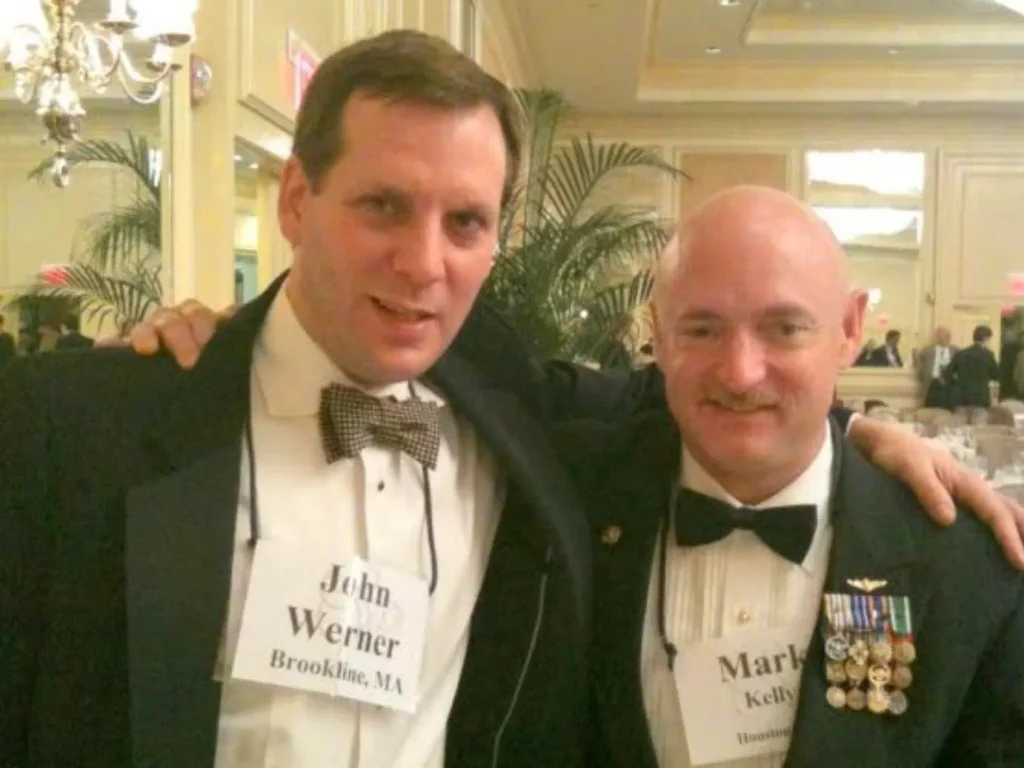
Mark Kelly and John Werner, January 2, 2010 | Courtesy of John Werner
It is in these types of scenarios that courage, in a domestic sense, comes in handy, and this runs through the subtext of the book, along with the question: will Americans succumb to something that we always thought was the exclusive state of other nations?
Not if the ten profiled here have anything to do with it. It’s a compelling read on standing up for your fellow citizens, all of them, when you feel that their inalienable rights might be in peril. Like Kelly, the other nine profiled each have their own stories, and Barcott chronicles them well. I was very impressed with this book, and I think we need to think big thoughts, if we are going to use the fruits of AI for positive change, and ward off any tendency toward dystopia.
Barcott says he wrote the book with one audience especially in mind: high school and college students. I can think of no better group to read this than young adults thinking about the direction they will take their lives. Each chapter stands on its own as a case study to think about service in moments that matter, and With Honor has posted free study guides for AP and IB civics classes, and free books for teachers at its website couragecansaveus.com.